
Between extreme volatility and serial liquidations, several altcoins recorded dizzying falls. Find out which ones and the reasons for this underperformance.
Setbacks in the crypto market in October
While many investors were hoping for a favorable October for the crypto market, events took a completely different turn.
The famous “Uptober” gave way to deep disappointment, a sentiment widely shared on social media, particularly on X.
Over the last 30 days, the price of Bitcoin has fallen by 18% and the price of Ether by around 28%. This has created a particularly tense environment, especially for the most volatile assets such as altcoins. Among the cryptocurrencies hardest hit by this environment are AVAX, ENA, APT, ASTER, and IP:
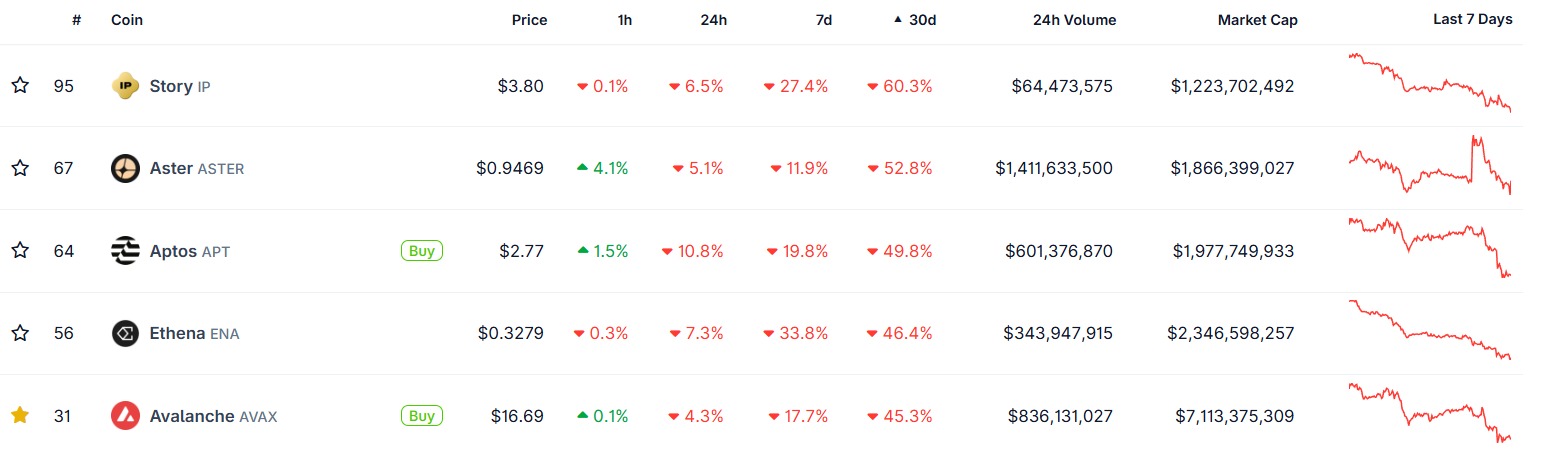
5 – Avalanche (AVAX): – 45%
Avalanche is a layer 1 blockchain compatible with EVM, allowing the creation of subnets dedicated to specific use cases. Its native token, AVAX, plays a key role in governance, transaction fee payments, and network security via staking.
Over the last 30 days, the price of the AVAX token has fallen by more than 45%.
From an on-chain perspective, this decline could be linked to a notable decrease in activity on the Avalanche blockchain’s decentralized exchanges (DEX):
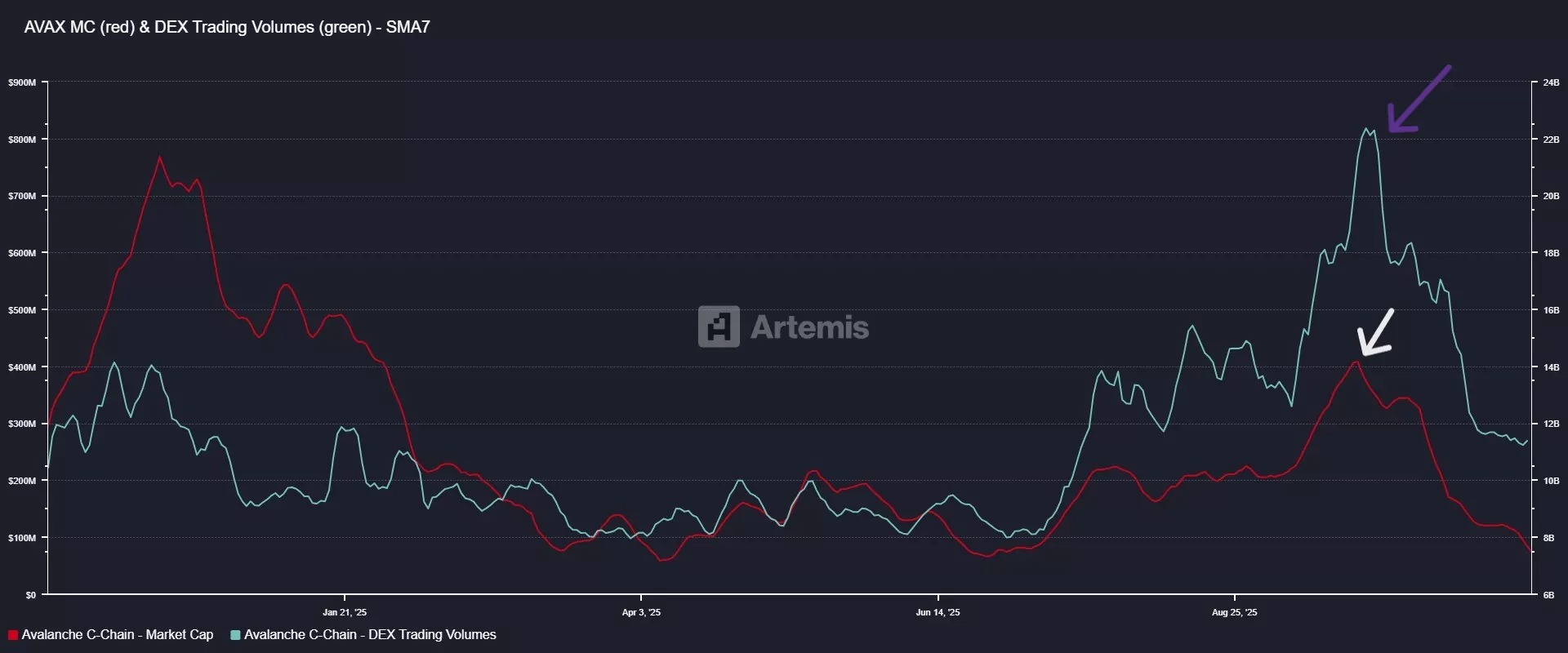
As we can see in the chart above, the drop in trading volumes on Avalanche blockchain DEXs (indicated by the purple arrow) preceded the drop in the valuation of the AVAX token (indicated by the white arrow).
Between September 24 and November 4, DEX trading volumes fell from $1.2 billion to $360.8 million, a drop of 70%. Over the same period, the valuation of the AVAX token fell by around 50%.
In addition, the liquidation event that occurred on October 10 contributed to accentuating the trend. The token lost up to 64% of its value in a matter of minutes, before recovering some of that loss shortly thereafter.
This type of shock reinforces investor mistrust of highly volatile assets, even when circumstances are exceptional.
4 – Ethena (ENA): -46%
Ethena is a decentralized finance (DeFi) protocol that offers an alternative to traditional stablecoins through a product called USDe, a “synthetic” stablecoin pegged to the dollar.
Unlike reserve-backed stablecoins (such as USDT or USDC), USDe is kept stable through a hedging strategy based on crypto derivatives.
The ENA crypto is the governance token of the Ethena protocol. It allows users to participate in decisions about the protocol’s development and receive staking rewards.
Over the last 30 days, the price of the ENA token has fallen by around 46%.
In October, Ethena suffered a double blow, both to the price of the ENA token and to its USDe stablecoin. The latter’s market capitalization, which stood at $14.1 billion on October 8, was down to $9 billion on October 31, a drop of around 36% in just three weeks.
This sharp decline follows directly on from the liquidation event on October 10, which destabilized confidence in Ethena’s model, which is highly dependent on hedging strategies.

As we can see from the chart above, USDe has experienced sustained growth in recent months.
However, its recent drop in capitalization has relegated it to fourth place among stablecoins, considering that DAI and USDS are associated with the same entity.
3 – Aptos (APT): -50%
Aptos is a layer 1 blockchain born from the ashes of Diem, a crypto project abandoned by Facebook (Meta) under regulatory pressure. Based on the Move language, Aptos is an ultra-fast blockchain. It offers significantly lower transaction fees than the Ethereum blockchain, making it relevant in the high-frequency trading sector.
Over the last 30 days, the price of the APT token has halved. Here again, the liquidation event on October 10 had a significant impact on the cryptocurrency.
However, other catalysts may have accentuated APT’s decline, as shown by on-chain data:

As we can see from the chart above, the Aptos blockchain has lost more than 49% of its TVL in the space of six months. We can also see a sharp slowdown in the volumes posted on its various DEXs since October 10 (indicated by the purple arrow), in the order of 71%.
Furthermore, it is worth noting the inflationary nature of the APT token supply. Each month, more than 1.1% of the token’s valuation is unlocked, which may contribute to selling pressure.
In short, it appears that the fall in the APT token was fueled both by the liquidation event and by fragile fundamentals.
2 – Aster: -53%
Aster is a DEX specializing in perpetual contract trading, but also offers spot trading and tokenized stocks.
Publicly supported by Binance founder Changpeng Zhao (CZ), Aster has quickly established itself as a relatively credible alternative to industry leader Hyperliquid.
We use the term “relatively credible” mainly because the founder of DeFiLlama (one of the most popular on-chain analysis platforms in the crypto ecosystem) suspects that Aster’s data has been deliberately rigged with Binance’s data.
We’ve been investigating aster volumes and recently their volumes have started mirroring binance perp volumes almost exactly
Chart on the left is XRPUSDT on aster, you can see the volume ratio vs binance is ~1
Chart on the right is XRP perp volume on hyperliquid, where there’s… pic.twitter.com/MwVD7rRyEn
— 0xngmi is hiring (@0xngmi) October 5, 2025
Although we don’t yet have the final word on this story, it’s worth acknowledging that Aster’s hyper-growth in volume seems inorganic.
Also, despite Aster’s initial success, many users have complained about a poor experience (delays in displaying balances, inefficient interface, etc.), far from the standards of the leader Hyperliquid.
Over the last 30 days, the price of ASTER has fallen by 53%.
1 – Story (IP): -60%
Story is a layer 1 blockchain focused on intellectual property, hence the name of its crypto IP. Thanks to its tokenization mechanism, Story aims to enable its users to protect and monetize their creations, whether they are artistic works, data, or code.
Although Story’s promise is appealing on paper, execution may prove to be a more difficult task. Indeed, it will be necessary to convince enough high-quality creators/builders to join the network in order to get the ball rolling.
At the time of writing, IP’s fully diluted valuation (FDV) of $3.7 billion seems completely disconnected from its fundamentals, despite the 60% drop in IP’s price over the last 30 days.
Story Protocol is one of the projects heavily funded by venture capital (VC) firms: according to DeFiLlama data, the project has raised a whopping $133.7 million.