Companies dedicated to Bitcoin mining are currently undergoing a major internal transformation, largely driven by the emergence of artificial intelligence (AI). This shift in dynamics appears to be accelerating among industry leaders.
Bitcoin Miners Are Turning to AI
Over the years, the mining industry associated with the Bitcoin blockchain has become increasingly competitive and demanding in terms of computing power, even though some solo miners still regularly manage to mine their own blocks.
This reality is shaped by certain developments in the cryptocurrency market, including the perception that BTC price performance has become less explosive and volatile since the massive influx of traditional finance, as well as the parallel development of AI in search of suitable data centers.
This situation is prompting some miners to diversify by allocating a portion of their computing power to artificial intelligence or high-performance computing (HPC). This trend now reportedly involves 7 of the 10 largest mining companies—representing 70 percent of the sector—in such initiatives.
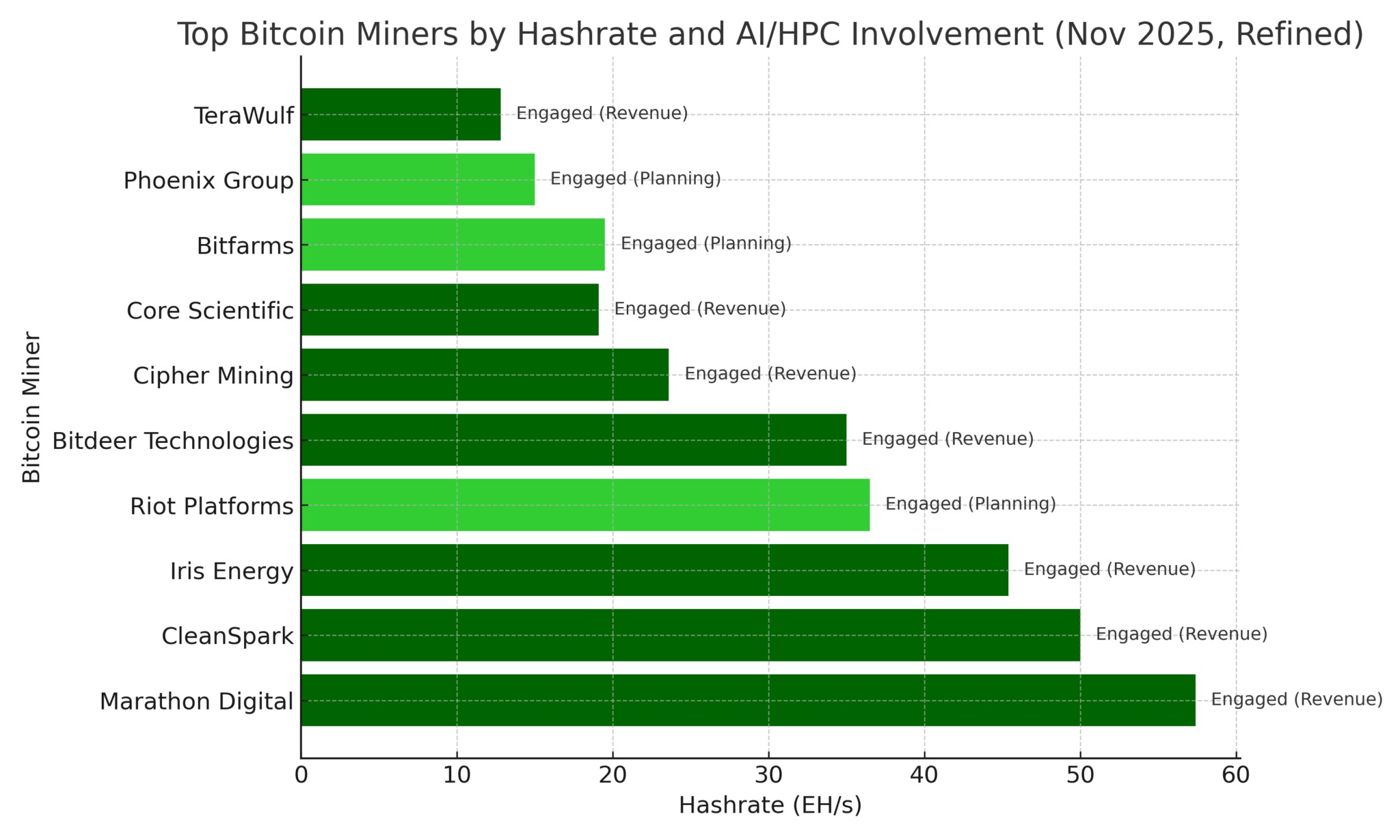
Hashrate of Bitcoin miners engaged in AI or high-performance computing (HPC)
The mining company TeraWulf is emerging as a very active player in this shift, following the signing of two 10-year hosting contracts with Fluidstack, a company specializing in high-performance cloud computing, for a total of 200 MW.
Similar initiatives have also been launched by Core Scientific, Cipher Mining, CleanSpark… and Marathon Digital, which recently acquired a majority stake in Exaion, EDF’s HPC and blockchain subsidiary.
Toward a global overhaul of the sector?
In this context, mining infrastructures that are already operational and established represent rare and coveted sources of computing power far beyond BTC mining, offering more stable and predictable long-term revenues for AI or HPC.
According to current estimates—assuming a BTC price of $104,000—the average revenue per MW of computing power is around $1.2 to $1.3 million per year, compared to approximately $1.85 million for AI hosting contracts. That’s enough to motivate even the most reluctant.
This development could permanently reshape the Bitcoin mining industry. Indeed, the hashrate of its major players dedicated to this activity could decline over the next few years, while simultaneously triggering an increase in the valuation of these companies due to their growing involvement in the AI sector.
Nevertheless, BTC mining remains highly lucrative, and a simple increase in its price or in the fees charged by miners could quickly narrow the existing profitability gap with AI. The problem? The prospect of a major bear market looms like a sword of Damocles that cannot be ignored.