The US Federal Reserve (Fed) will announce its latest monetary policy decision of the year this evening, with an expected cut in the federal funds rate to 3.75%. Jerome Powell will hold a press conference and the Fed will update its macroeconomic projections for 2026. Read Vincent Ganne’s analysis of the effects this could have on cryptocurrencies.
The Fed is eagerly awaited on the future evolution of its balance sheet
The US Federal Reserve (Fed) will unveil its latest monetary policy decision of the year this evening, with an expected cut in the federal funds rate to 3.75%. Jerome Powell will hold a press conference and the Fed will update its macroeconomic projections for 2026. There is now a complete balance between the unemployment rate target and the inflation target. We should also bear in mind that the Quantitative Tightening (QT) program has been suspended since Monday, December 1, and that the Fed is prepared to use the monetary instrument of its balance sheet to reduce any emerging tension in the interbank and money markets and also to ensure that bond rates do not place a strain on the government and businesses.
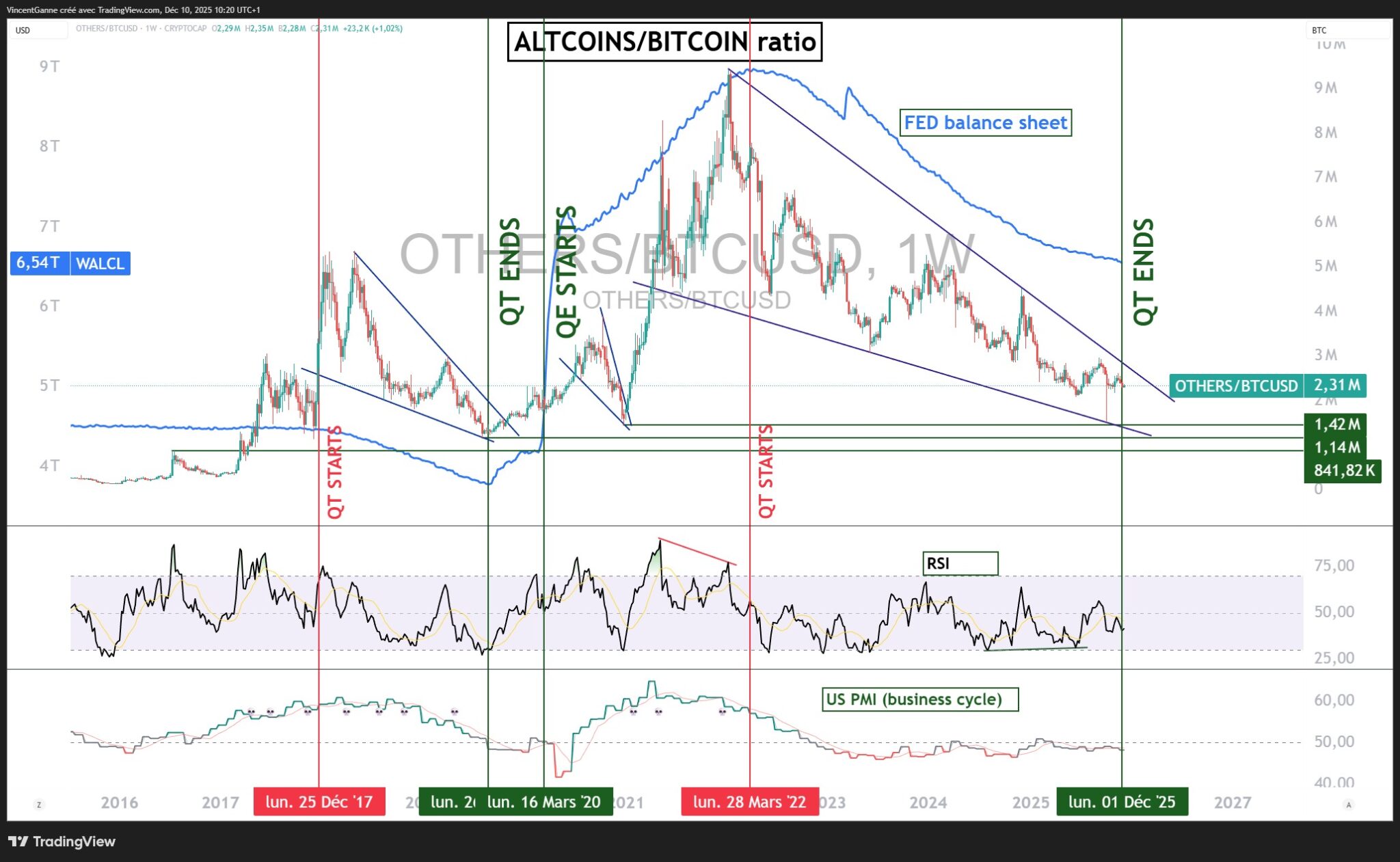
Indeed, a graphical analysis of the Altcoins/Bitcoin ratio (see chart below) clearly shows that periods of strength for altcoins relative to bitcoin are closely linked to changes in the Fed’s balance sheet. Simple technical QE is not enough; classic QE is needed to truly revive the altcoin market.
It is important to understand that “technical QE” is not a conventional Quantitative Easing (QE) program and that its impact on long-term interest rates remains limited. In this respect, technical QE certainly provides short-term liquidity, but it does not provide structural liquidity support.
In concrete terms, technical QE mainly consists of stabilizing the functioning of the money market: repo operations, temporary balance sheet adjustments, targeted interventions in the event of tension. This prevents short-term rates from skyrocketing without warning, but it does not mean that the Fed is embarking on a cycle of massive easing.
Whereas conventional QE flattens the entire yield curve, stimulates credit, and fuels a genuine cycle of risk appetite, technical QE acts as a “bumper” rather than an engine. It prevents a liquidity crisis, but does not create new structural momentum, and it is this structural momentum that altcoins need in order to hope to enter a bullish phase again. That is why the Fed’s announcements on the prospective evolution of its balance sheet will be decisive for the trend of cryptos in 2026.
Altcoins need Fed QE to rebound in 2026
The chart below highlights a key point: the Altcoins/Bitcoin ratio has been moving in a broad downward wedge since early 2022, exactly in parallel with the decline in the Fed’s balance sheet. The timing is striking: each peak in the ratio corresponds to the start of QT by the Fed, i.e., a reduction in its balance sheet. Conversely, each end of QT followed by QE (a sharp increase in the Fed’s balance sheet) coincides with the start of a strong recovery in the alt market.
We can also see that the ratio is currently testing the lower bound of this multi-year wedge, which represents an extreme level of compression, generally associated with major reversals… provided that systemic liquidity picks up again, which requires an upward revival of the Fed’s balance sheet in 2026.
Finally, the economic cycle indicator (PMI) at the bottom of the chart reinforces the idea that the market is coming to the end of its slowdown, an area where previous liquidity cycles have been launched. In other words, the technical stage is set, but the key piece is missing: a clear expansion of the Fed’s balance sheet. In summary: altcoins will only rebound sustainably when QE becomes an active instrument of Fed monetary policy again. Simply stopping QT is not enough.