
Bitcoin Treasuries have been accumulating BTC all summer, like the ant in the fable. But with the market contracting, they need liquidity and returns. Bitcoin DeFi (BTCFi) solutions are multiplying. Will this be enough to restart the cycle?
Bitcoin Treasury Companies are crying famine
Crypto-asset treasuries are under pressure. Their model is being tested painfully, and all eyes are on one indicator: market net asset value (mNAV). This is a ratio between the value of cryptocurrencies in cash and the market capitalization of the company.
If it is high, everything is fine, but if it falls below the equilibrium threshold of 1, everything is bad.
In order to boost this indicator, companies are finding ways around it, such as accumulating yield-bearing cryptocurrencies (staking yield), such as Ether and Solana’s SOL. Unfortunately, these cryptocurrencies are not digital gold. But Bitcoin does not generate yields. Really? In reality, solutions for generating returns on Bitcoin do exist. However, the decentralized finance market around Bitcoin is largely underdeveloped.
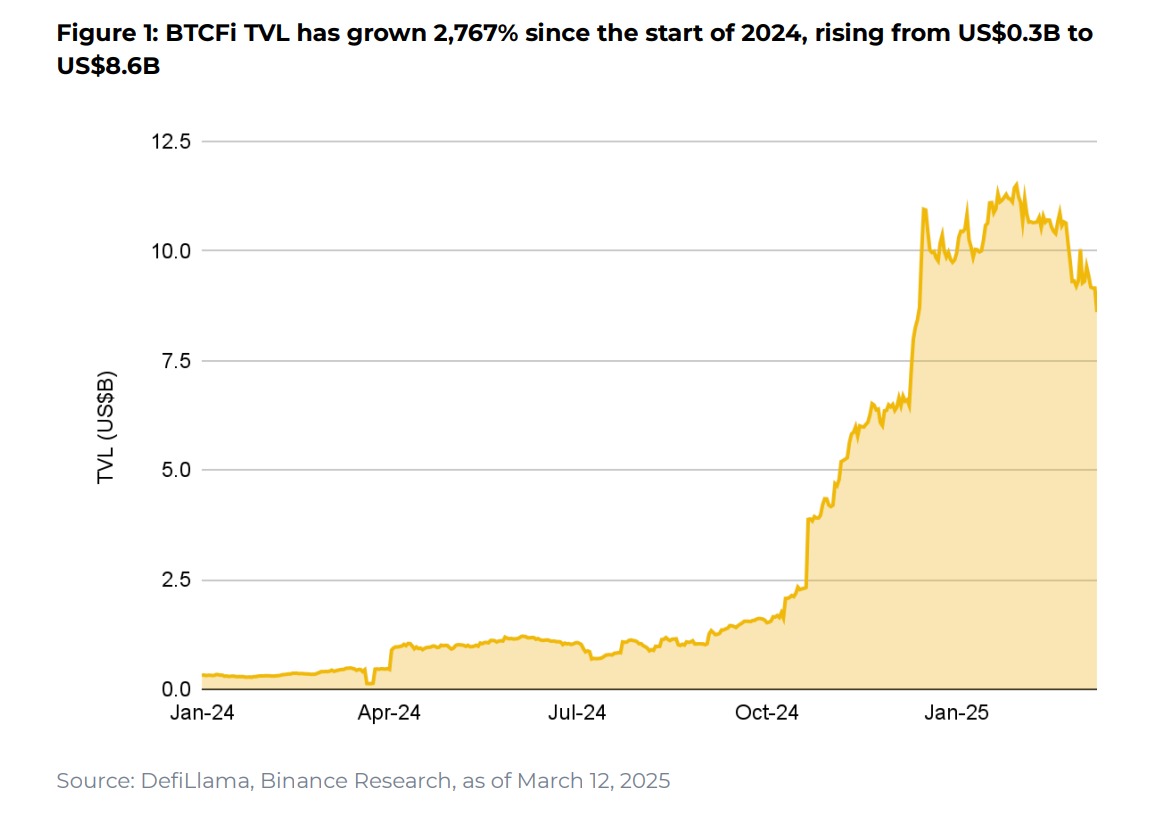
As of March 12, 2025, Bitcoin DeFi (BTCFi) protocols were worth $8.6 billion, compared to just $0.3 billion at the beginning of 2024, according to a report by Binance. This is not much compared to the hundreds of billions of DeFi on Ethereum.
To hold their own in the current market environment, Bitcoin treasuries are increasingly looking to existing solutions. Traditional DeFi solutions exist, but according to Jad Comair, CEO of Melanion Capital, interviewed by TCN, they “often involve significant counterparty or regulatory risks.” “
This is why regulated financial institutions are now offering to generate income on Bitcoin. Melanion Capital recently launched a Bitcoin cash management system based on financial engineering: ”structuring, liquidity, risk management.”
Sygnum’s solution: generating Bitcoin yield and liquidity
Other companies are getting involved. This is the case with Sygnum, a Swiss bank that has specialized in cryptocurrencies since 2017 and is in the process of obtaining MiCA regulation for the European market.
The latter has recently launched a new product that allows users to profit from Bitcoins in cash while generating liquidity. How does it work?
Through an arbitrage strategy, the BTC Alpha Fund guarantees an annual return of between 8% and 10%. The advantage is that this fund pays interest in BTC. Treasuries can therefore add even more Bitcoin to their balance sheets and increase their mNAV without having to take on debt or dilute their shares. Even better, Sygnum’s Alpha BTC fund is eligible as collateral for loans from the same bank, allowing companies to generate liquidity in addition to returns. This solution is attractive because it addresses the two major pain points for Bitcoin treasuries, namely the lack of regulated returns and liquidity.
This cash could, for example, be used to pay coupons on debt or make new investments to grow these companies.
Bitcoin yields will most likely be the source of the next big wave of speculation and euphoria around Bitcoin Treasury Companies, and even the entire crypto-asset treasury (CAT) market. The current narrative, summarized as “we are going to accumulate thousands of BTC,” does not work for everyone. While Strategy and Capital B can boast of having raised money regularly without faltering, this is not the case for others.
Could the new narrative of “we are accumulating BTC, which is generating money and even more BTC,” coupled with the explosion of the BTCFi market, fuel enough hype to revive a moribund cycle?