
On Monday, the AWS outage caused problems on Coinbase, Circle, and even the default APIs used by MetaMask. Here’s an overview of the situation, which raises philosophical questions about decentralization.
Several crypto applications go down following the AWS incident
On Monday, Amazon Web Services (AWS) experienced a major outage lasting several hours, which took several Internet applications offline.
On the crypto side, some services were also affected, such as the Robinhood and Venmo (a PayPal subsidiary) platforms, as well as Coinbase. To elaborate a little on the case of Coinbase, although everything seems to be back to normal now, on Monday evening, around 7:30 p.m. Paris time, customers were still experiencing problems:
We are aware that customers are unable to use many key Coinbase features, such as trading and transfers, due to ongoing issues with AWS.
Circle also experienced outages on its Circle Mint APIs, payments, and inter-blockchain transfers.
More significantly, Infura’s APIs caused problems for access to several blockchains and layer 2, namely:
- Ethereum;
- Polygon;
- OP Mainnet;
- Arbitrum;
- Linea;
- Base;
- and Scroll.
While this is not a deal-breaker for using the affected networks, several blockchain applications, starting with the MetaMask wallet, are connected to Infura’s RPCs by default. In fact, MetaMask support invited its community to use Consensys’ Discord server yesterday due to problems contacting support following the AWS outage.
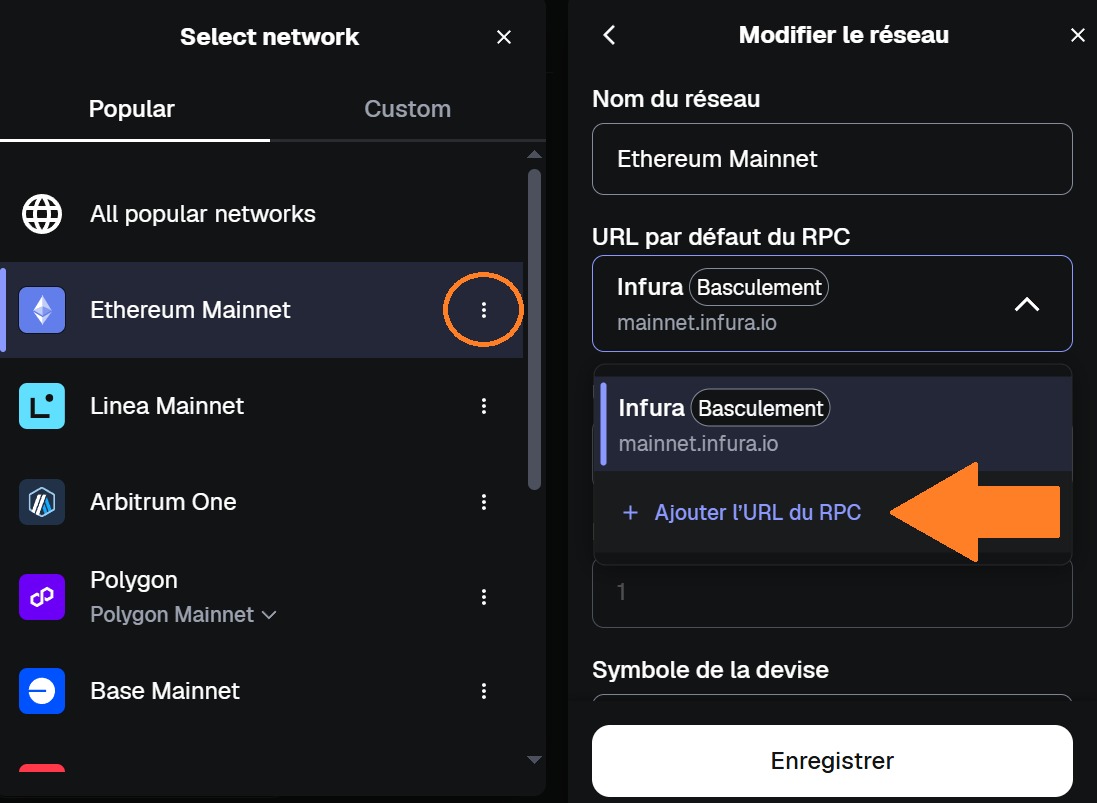
On the wallet, it is possible to change the default RPCs on any blockchain, and websites such as ChainList can provide many alternative RPC addresses.
To change an RPC address on MetaMask, go to the network selection interface:
A problem of centralization
While this outage did not have serious consequences for the ecosystem, it does raise philosophical questions. And for good reason: although the crypto ecosystem is often touted for its decentralized and uncensorable nature, this incident reminds us once again that not all players have the same approach to decentralization.
Two years ago, in an article on the situation of Ethereum one year after the Merge, we already pointed out the overrepresentation of AWS in the hosting of nodes on Ethereum.
Indeed, a blockchain such as Ethereum is relatively heavy to store, which means that more resources are required than for other networks, such as Bitcoin (BTC), to host your own node at home. A compromise can then be found by renting storage space on cloud solutions such as AWS or Google, but this easy solution means that decentralization has to be overlooked.