
Jupiter Exchange, the decentralized exchange aggregator on Solana, announced major reforms to its JUP token on October 15, 2025. These include a simplified DAO focused on high-impact votes, a vesting period reduced to seven days, and a DAO vote on the destruction of 121 million tokens from the Litterbox Trust. Let’s take a closer look at how these changes will impact the platform.
Three key reforms to revive its JUP token
For some time now, beyond the performance of its token, Jupiter has been facing internal issues, likely fueled by JUP’s results. After an explosive launch in 2024 and a period of euphoria thanks to its airdrops, the hype faded and gave way to real problems. To get things back on track, the team has decided to implement three major measures to redefine the future of its cryptocurrency. These three measures mark a strategic turning point for Jupiter, which seems to want to reposition JUP not just as a simple governance token, but as a central economic asset within its ecosystem. In a sense, these adjustments are not only aimed at improving governance: they establish a model in which every economic decision potentially translates into value for holders.
The DAO returns to basics
The DAO is at the heart of the JUP overhaul project, and rightly so. In an ecosystem where decisions made by DAOs, such as Uniswap, MakerDAO, and Curve, are based on portfolio size, Jupiter wanted each voter’s weight to be as equal as possible. Despite good intentions, a problem quickly arose: there were far too many new proposals, most of which were considered unnecessary. This naturally led to a loss of interest among the community, which was overwhelmed by too much information. To overcome this problem, the team made a bold decision: to eliminate work groups in order to focus on tokenomics, cash management, and major strategic directions.
This means: no more work groups, fewer votes overall, and public communication more focused on products and growth.
Kash Dhanda, CEO of Jupiter
A Fresh Start for $JUP (Major Changes Coming)
This one is for the token holders. The ride or dies. The folks who have held through up and down, supporting a project they believe has the ability to change the future of finance. We know it hasn’t been easy lately. But here’s the…
— Kash (🐱, 🐐) (@kashdhanda) October 15, 2025
This decision was welcomed by the community, as it puts an end to what users called the “era of micro-proposals.” A new model that should make the DAO more efficient.
More efficient staking
The second change concerns the locking of staked tokens, which has been reduced from 30 to 7 days. This simplification responds to a request from the community and investors. The previous system, designed to prevent vote farming (a practice where users stake tokens solely to influence votes before withdrawing them), discouraged some token holders from locking them.
As the project matured and the profile of token holders evolved, this model proved to be too rigid. Many users reported that the 30-day lock-up period was a deterrent to holding JUP. In a DeFi environment where liquidity and flexibility are paramount, such a delay penalized adoption, limiting the inflow of new capital.
By reducing the unstaking period, Jupiter makes participation more accessible and fluid, while maintaining a reasonable level of commitment. Users who stake JUP are eligible for the Meteora airdrop, which is an additional incentive for future airdrops.
This change should also strengthen the liquidity of the JUP token by increasing the availability of tokens in liquidity pools, thereby facilitating trading and attracting new participants.
The Litterbox Burn, a historic decision
Finally, the last change, probably the most significant and symbolic, concerns the Litterbox Trust. This is an institutional wallet controlled by the DAO, designed to buy JUP on the secondary market using 50% of the revenue generated by the Jupiter protocol.
In other words, every time Jupiter generates profits through its products (DEX aggregator, bridge, swaps, etc.), half is used to buy back its token and store it in the Litterbox. The result: more than 121 million tokens accumulated, representing 1.7% of the total supply and approximately 3.8% of the circulating supply.
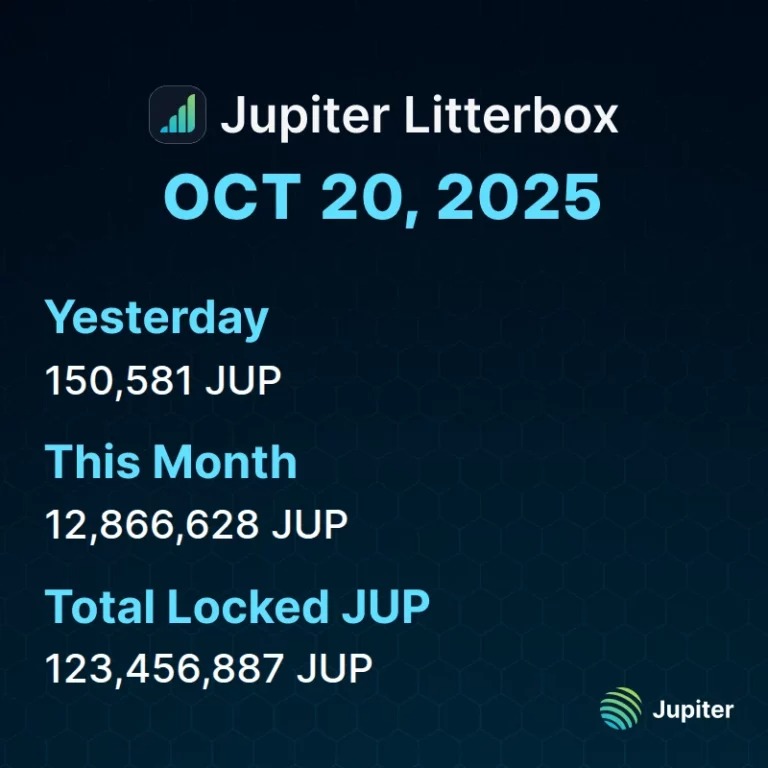
The problem was that this growing reserve with no destination was causing uncertainty. Some feared that it would weigh on the price or be used in an opaque manner. Furthermore, buybacks were deemed ineffective, given the performance of the JUP token compared to the rest of the Solana ecosystem. In light of these findings, the most popular solution proposed by the community is simple: burn the Litterbox. This means burning the 121 million tokens accumulated to remove them permanently from circulation. This has not yet been validated; a 10-day public vote is underway, with a second vote to be held on the management of future revenues.
Furthermore, Jupiter’s recent integration into Uniswap via the Ultra API could, if it increases transaction volumes, increase the fees generated by the protocol, which would allow for more JUP buybacks for the Litterbox Trust before a possible burn.
A revival for JUP?
In turmoil since its last ATH on April 3, 2024, at $1.83, it is now settling around $0.36 after the crash on October 11.
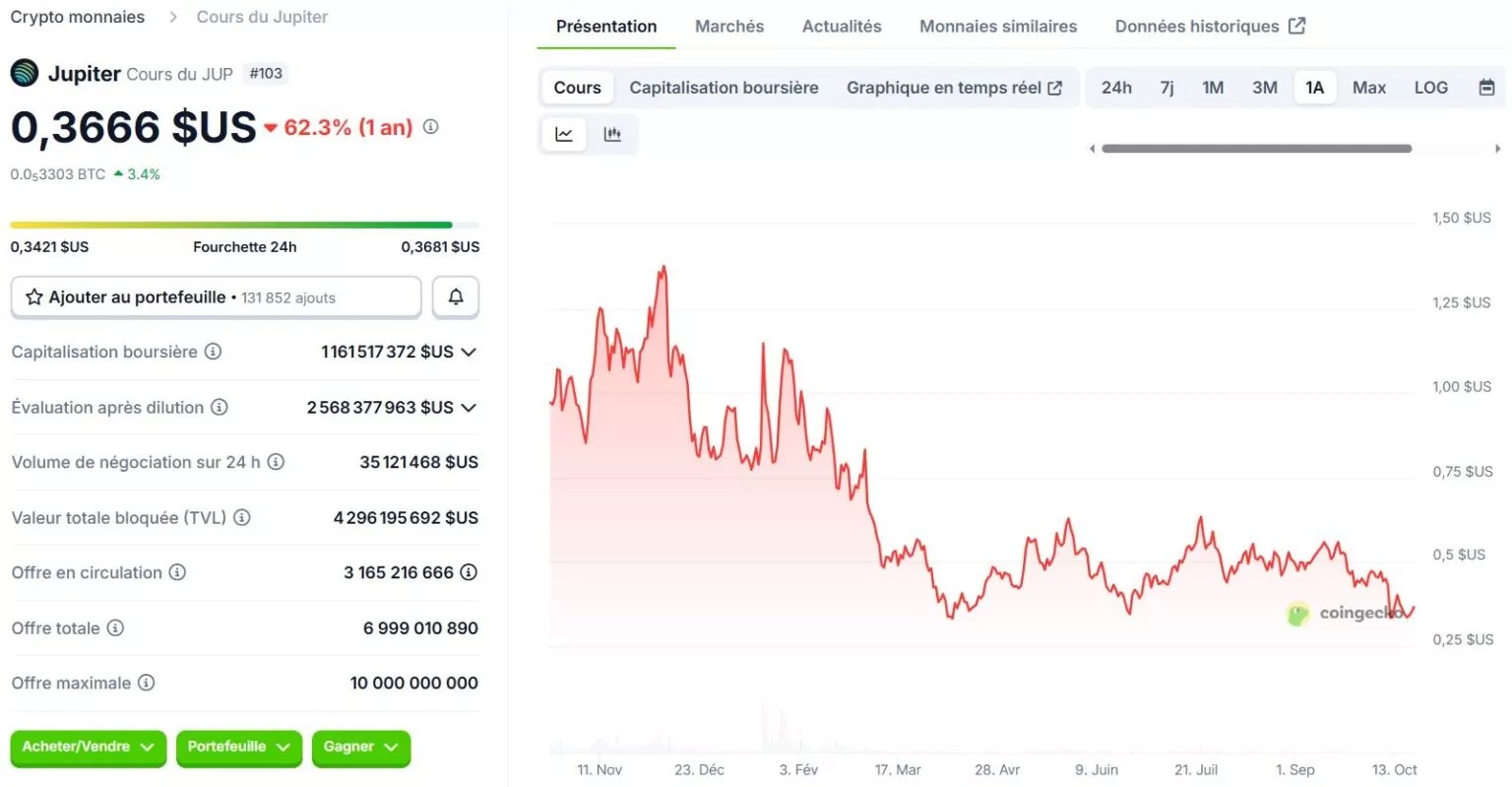
Investors hope that this update will give the token a second wind thanks to the potential burn of 121 million JUP, representing around 4% of the circulating supply, especially as it is accompanied by a continuous monthly burn, executed via the protocol’s revenues.
This will automatically reduce the circulating supply, leading to potential buying pressure on the token. In the medium and long term, remaining optimistic about the burn system, we can imagine a recurrence of revenue-related burns (15 million tokens per month). This mechanism would make the token an asset correlated with the growth of the protocol, create scarcity, and be a sign of economic maturity for Jupiter. It remains to be seen whether these measures will be enough to restore investor confidence.