
The Bank for International Settlements (BIS) is actively opposing the development of the cryptocurrency sector. Its latest idea is to blacklist all cryptocurrencies that pass through wallets without KYC. What does that mean?
The BIS wants to control all crypto transactions
Since its creation in 1930, the Bank for International Settlements (BIS) has established itself as the international entity responsible for overseeing the proper functioning and cooperation between the major central banks. This role clearly places it at the center of the global monetary landscape.
It is therefore not difficult to understand why its decisions are mostly contrary to the development of the cryptocurrency sector, whose monetary vocation has only been confirmed over time. The latest example is the announced failure of stablecoins last June, in the face of news reports saying exactly the opposite.
According to BIS economists, one of the main problems with cryptocurrencies is the inability to control their flows and identify their users. This is why it is a fervent advocate of the widespread use of KYC (Know Your Customer) identification.
Is this really enough? Apparently not, according to its latest report on “anti-money laundering for crypto-assets”:
Although customer verification can be carried out at points of contact with the traditional monetary system (e.g., via cryptocurrency exchange platforms) (…) once assets are transferred to wallets not hosted on a public blockchain, transactions escape traditional forms of intervention.
BIS
Developing a “culture of self-control”… with the help of a compliance score
This is why the BIS is calling for “a culture of due diligence among cryptocurrency market participants.” The focus is on non-custodial wallets that do not require KYC-type identification.
In practice, the bank of central banks proposes to determine “an Anti-Money Laundering (AML) compliance score based on the probability that a crypto unit or balance is linked to illicit activity.” If the result appears insufficient, the funds concerned will be placed on a “rejection list.”
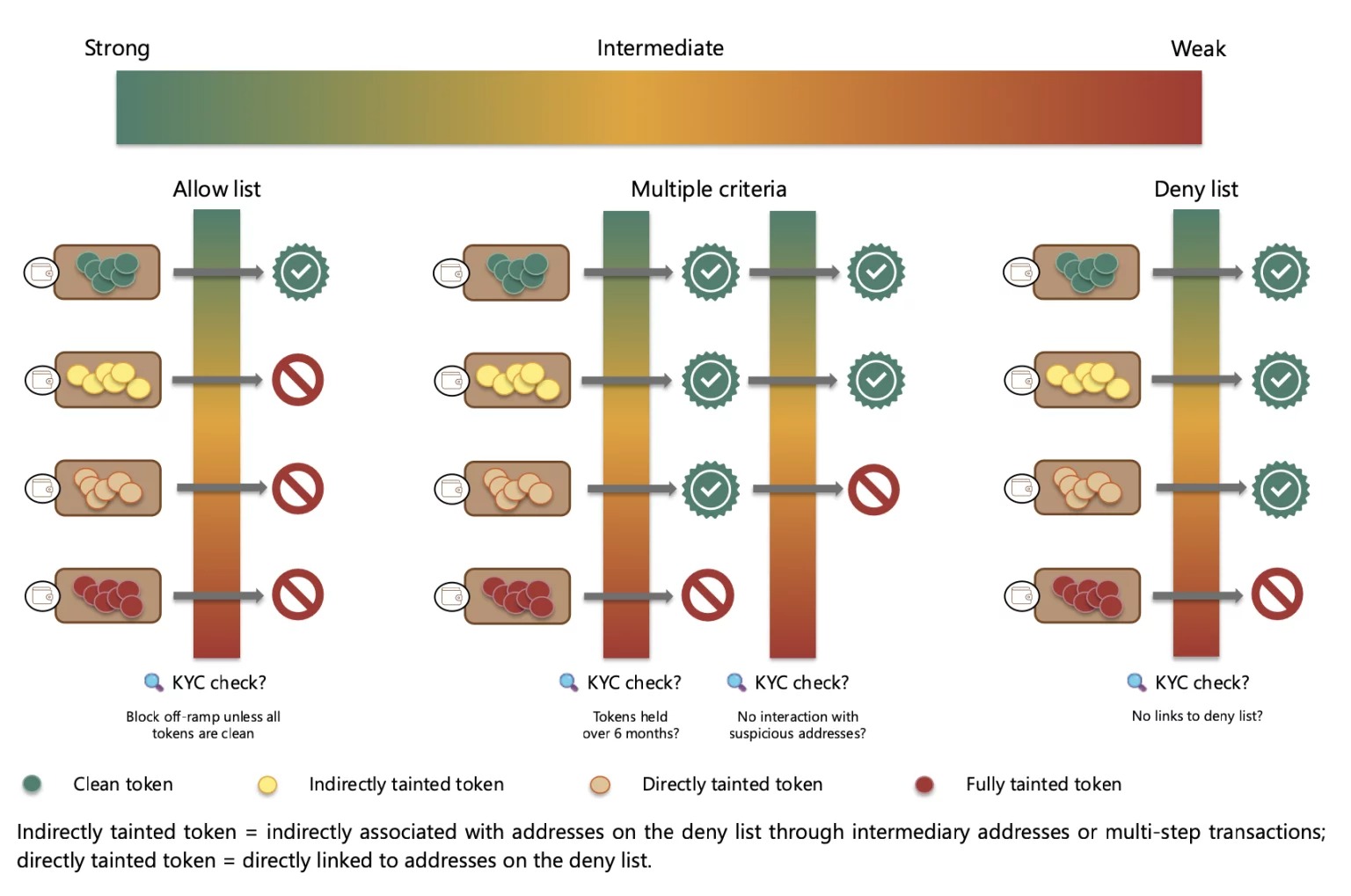
The strictest form of AML compliance would require exit points to accept tokens for conversion only if they have passed through addresses that have satisfied KYC compliance checks — i.e., wallets on a “whitelist.”
BIS
According to this principle, all cryptocurrency users—including (or especially) those who use non-hosted wallets—will have to undergo KYC checks in order to exchange their “uncontaminated” funds for traditional currencies.
The BIS rule does not specify whether it is also necessary to verify that the banknotes obtained have not been involved in illegal activities. Nor does it specify the date from which this regulatory irregularity will be taken into account for the cryptocurrencies involved.