
In a sign of increasing institutionalization, Blackrock now owns more Bitcoins than Coinbase or Binance. The same could soon happen with Ethereum’s Ether, but that’s not necessarily a bad thing. Analysis.
Blackrock overtakes Binance and Coinbase
According to recent data, Blackrock’s ETF, the iShares Bitcoin Trust ETF (IBIT), now holds 745,357 BTC, compared to 706,150 for Coinbase and only 584,557 BTC for Binance. Blackrock surpassed Coinbase in May 2025 and Binance in August. Now, only Satoshi Nakamoto holds more Bitcoins than the Wall Street giant.
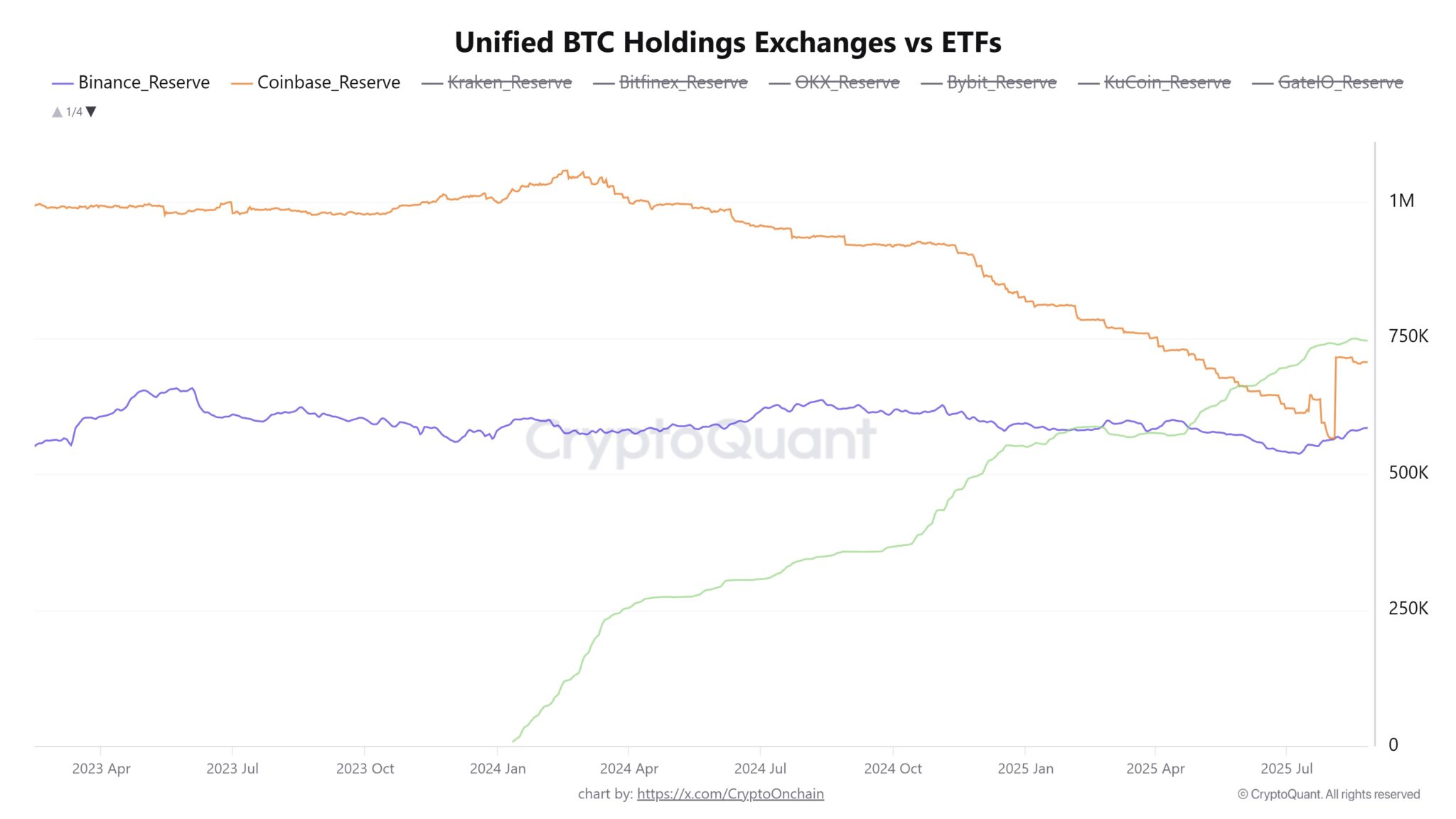
Bitcoin is not the only cryptocurrency affected by this phenomenon.
The same thing is about to happen to Ethereum’s Ether.
Binance is still the largest holder of Vitalik Buterin’s cryptocurrency, with 4.7 million Ether in reserve. But Coinbase, which was once the largest holder with more than 8 million Ether in 2019, now has only a slight lead over Blackrock. Today, Coinbase holds 3.8 million Ether, and Blackrock holds 3.6 million. What’s more, Blackrock is on a buying spree, adding 1.2 million Ether over the last two months. At this rate, according to CoinTelegraph journalists, Blackrock will have overtaken Coinbase by the end of the year.
The end of centralized exchange platforms (CEX)?
In the early days of cryptocurrencies, centralized exchanges (CEX) did not necessarily have the largest reserves of Bitcoin or Ethereum.
This is evidenced, for example, by the wallets from the “Satoshi era” (2009-2011), which hold astronomical amounts of Bitcoin; These wallets are constantly monitored by blockchain investigators, who watch their every move. A wallet from the “Satoshi era” that starts selling can have a significant impact on the price of Bitcoin.
Since around 2017, investors have begun to abandon custodial wallets in favor of centralized exchange platforms.
This was the advent of Binance, created in July 2017, which quickly became one of the largest companies in the world; the same is true for Coinbase, although it is much older (2012).
Today, it seems that it is the turn of CEXs to give way to players such as BlackRock. The movement we are seeing today reflects a new stage of market maturation.
Exchanges are not selling, ETFs are accumulating
Two mechanisms are at work: the first concerns Blackrock, and the second concerns CEXs such as Binance and Coinbase. Regarding Blackrock, ETFs now allow institutional and retail investors to buy cryptocurrencies without having to go through Web3 platforms. This guarantees security and simplicity, especially since ETFs are accessible to savers via bank accounts such as PEA (personal equity plans) or retirement savings accounts. As for CEXs, it would appear that investors are not interested in selling.
Despite Ether reaching historic highs, inflows—the amount of Ether deposited on CEXs for the purpose of selling—are equivalent to those of April 2025, a period when Ether was worth only $1,700.
This means that Ether holders have not come to sell, despite the rise in the price of Ether. The absence of inflows on exchanges combined with the accumulation of ETFs brings together all the pieces for a significant bullish movement by the end of the year.
Especially since the price of ETFs is determined by the price on CEXs, and not the other way around. If supply dries up on CEXs, the price will rise across the entire market.