
Since late January, Bitcoin’s decline has accelerated significantly, dragging the entire crypto market down with it. How can we explain this widespread collapse, now viewed as an ongoing “structural decline”?
Trauma linked to the October 11 crash that refuses to fade
In the space of just four months, Bitcoin has once again demonstrated its legendary volatility, falling from an all-time high of $126,000 in early October to a decline of nearly 50% as of early February. This has wiped out all the gains associated with the “Trump effect,” settling 10% below that symbolic threshold.
Indeed, the price of BTC is currently hovering around $65,000, with the main outlook being a possible return to the $50,000 level. However, analysts at the Kobeissi Letter assert that “the fundamental situation for crypto hasn’t really changed over the past 60 days.” But then… why this massive and widespread decline?
Clearly, the answer to this question requires looking back at the historic crash of October 10 and its record liquidations, estimated at a total of $19.5 billion—nine times the previous record in the sector.
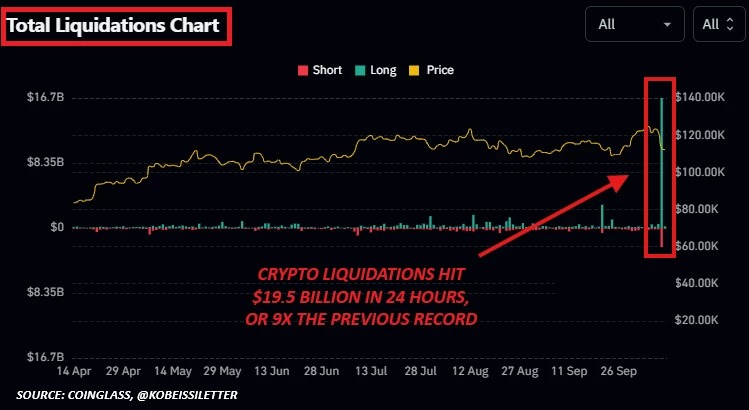
Something structural seems to have changed on October 10
According to analysts at the Kobeissi Letter, “something structural seems to have changed on October 10, and the markets have never really managed to recover from it.” A loss of confidence that triggered an almost perfectly straight downward trend that no rebound has managed to reverse.
A situation equivalent to the FTX collapse in 2022
Currently, crypto investor sentiment as measured by the Fear & Greed Index is clearly in “extreme fear,” except that the reading displayed today by all of these tools appears to be at a historic low. And it could get even worse…
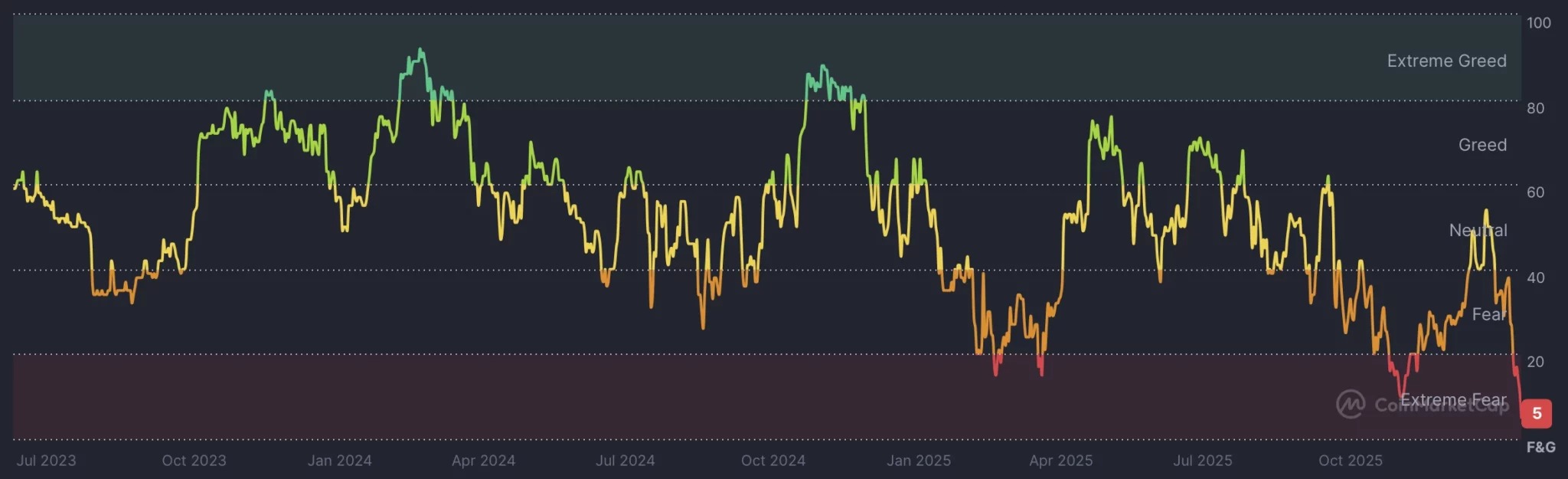
The Crypto Fear & Greed Index is at a historic low
In this context, liquidations are continuing at a significant pace, totaling $10 billion since January 24—more than 50% of the record set on October 10. This is accompanied by “selling pressure spreading to other asset classes” such as the stock market, “despite strong earnings and few fundamental changes.”
This is “further evidence of the structural nature” of this crisis, which is also reflected in Bitcoin’s market depth. Indeed, the capital available to absorb large orders is currently more than 30% below its October peak. “The last time this happened was after the FTX collapse in 2022 .”
This raises the question on everyone’s mind: when will Bitcoin—and the crypto market as a whole—hit bottom? According to analysts at the Kobeissi Letter, the answer is obvious: “when structural liquidity returns.”
This will require a combination of price and leverage capitulation, as well as extremely bearish sentiment. We seem to be gradually approaching this point.
Kobeissi Letter
The prospect of a good entry point?
At the same time, waiting for a bullish rebound to take a position when Bitcoin’s price is currently at very attractive levels seems like a strategic mistake, as Vincent Ganne is quick to point out in his latest special video on the subject.
Indeed, periods of intense market stress often represent the best entry points to secure significant returns once the storm has passed, particularly when using a dollar-cost averaging (DCA) investment strategy.
Of course, the risks taken should not exceed what one can afford to bear. And there is no guarantee that the price of BTC will not continue to fall over the coming weeks before stabilizing and resuming its upward trend.