
Although cryptocurrencies are often singled out in the context of fraud, they are clearly not the only payment method used by malicious actors. In fact, bank transfers are now emerging as a widely preferred method in so-called “social engineering” scams.
Payment fraud is on the rise
Regardless of the technique used or the payment method selected, malicious actors are always on the lookout for the best available opportunities to ensure the success of their schemes. This reality is currently unfavorable for cryptocurrency holders, who have been targeted by an unprecedented increase in cases of extortion and lock-ins since the beginning of the year.
In this context, the Payment Security Observatory (OSMP) has just published a recent report on the more specific issue of payment fraud. A sector that appeared to have stabilized in 2024 saw a resurgence of activity in the first half of 2025, with a 7% year-over-year increase resulting in an estimated loss of 618 million euros.
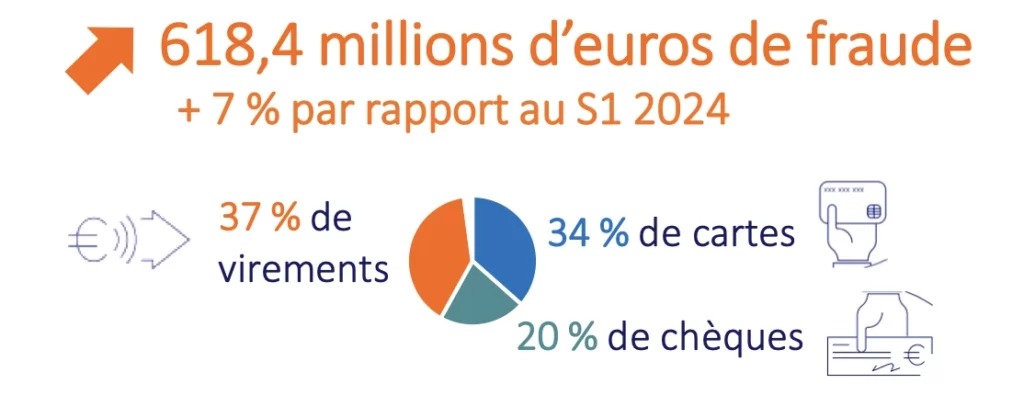
Payment fraud is on the rise
This increase, as reported by the organization—which brings together public authorities, the banking sector, merchants, and consumers—is higher than the growth in non-cash payment flows (bank transfers, checks, mobile payments, and even cryptocurrencies), estimated at 5% over the same period.
The cause: a record increase in “social engineering” fraud, which now accounts for 40% of the total amount stolen in the first half of 2025, compared to 32% in 2023 and 2024. These manipulation and deception techniques include phishing scams, as well as “pig butchering” romance scams and, increasingly, targeted deepfake calls.
The Observatory is therefore urging users to remain highly vigilant, particularly against social engineering techniques through which fraudsters impersonate bank agents or payment service providers using various methods: fake calls, emails, text messages, or instant messages, fraudulent ads redirecting to fake websites…
Increased use of bank transfers
Faced with these recurring scams, the banking system has decided to implement stricter authentication measures. As a result, fraudsters are now attempting to circumvent them by moving away from credit card payments and turning to “bank transfers made via online banking by individuals and businesses .”
Following the improvement of strong authentication processes on the one hand, and the deployment of the number authentication mechanism (MAN), which has helped curb the theft of phone numbers on the other, fraudsters are now using generic numbers such as “06” or “07” or the calling features of instant messaging apps.
Faced with this situation, Denis Beau, Deputy Governor of the Banque de France and President of the OSMP, wishes to maintain and intensify the measures already in place. Indeed, he states that “the resurgence of fraud through manipulation, which particularly affects remote payments by card and bank transfer, shows that this collective effort must continue.”
To achieve this, the Observatory will focus its efforts in 2026 on “the deployment of new technical measures (…) among major digital players.”