
According to forecasts, the prediction market sector is expected to reach $100 billion by 2035. However, it is in markets based on war and insider trading that Polymarket and Kalshi truly stand out. In this feature, we break down what the rise of these platforms implies, with valuable insights from Armand Drouet, a member of the Growth team at Kalshi who kindly answered our questions.
The Limits of Prediction Markets
Platforms like Polymarket and Kalshi have seen explosive growth. Their cumulative trading volume now stands at nearly $10 billion for the month of November 2025 alone.
However, in their early days, prediction markets operated in the shadows of the financial ecosystem, known primarily to crypto investors and limited to predictions about sports and election results. Then geopolitics and events related to wars and conflicts made their appearance on Polymarket, propelling these markets into the spotlight.
Currently, geopolitical events account for between 5% and 8% of the total volume of prediction markets. Since the beginning of 2026, a single contract on Polymarket regarding “U.S. strikes against Iran by…” has generated over $155 million in volume as of this writing.
The evolution of this market is quite revealing. Indeed, traders initially estimated the probability of U.S. military intervention in Iran at 35%. This figure rose sharply to over 67% by the end of March, following a series of ongoing tensions.
The Wall Street Journal also reported that many critics warn against the harmful incentives that war-related prediction contracts can create, particularly if those responsible for conducting military operations are tempted by speculative positions in these markets.
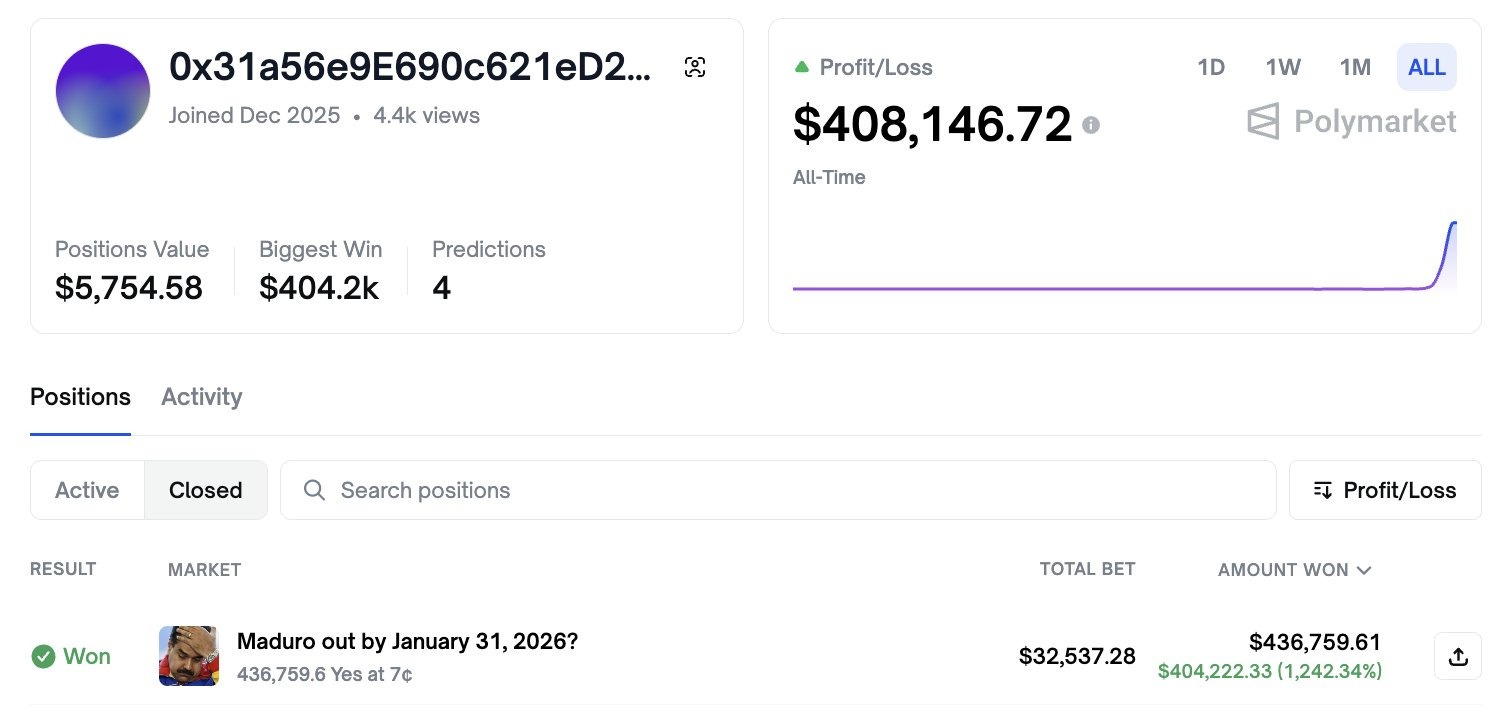
Another major issue: on January 2, 2026, just hours before the U.S. special forces raid that led to the capture of Venezuelan President Nicolás Maduro, an anonymous trader pocketed $436,000 on the Polymarket prediction platform following his capture. Several analysts have accused Polymarket of being a platform where insider trading is not only permitted but also encouraged.
While Polymarket remains vague on the various issues raised, this is not the case for Kalshi, the other leader in prediction markets. Indeed, the company offers institutional-grade security, transforming a prediction into a genuine financial asset protected for its clients. When interviewed by Cryptoast, Armand Drouet, a member of the Growth team at Kalshi, explained that:
For our users, this guarantees strict segregation of assets and compensation by a licensed clearinghouse, ensuring that every dollar is protected against the risk of bankruptcy or hacking.
Unlike Polymarket, Kalshi strictly prohibits politicians and experts with access to confidential information from trading on markets related to their roles. And regarding contracts related to wars, Armand adds:
For Tarek and Luana [the co-founders of Kalshi], Kalshi must be a serious platform where death must not be traded. This internal commitment aligns with a strict legal obligation: as a regulated exchange in the United States, Kalshi is subject to CFTC rules, which strictly prohibit contracts related to terrorism, assassination, or war, deemed contrary to the public interest.
The Trump administration’s silence
Today, there is a regulatory vacuum regarding prediction markets in the United States. Legally, the CFTC (Commodity Futures Trading Commission) has the authority to regulate these event contracts. The Commodity Exchange Act even allows it to ban certain contracts if it deems them contrary to the public interest. In 2024, the CFTC had in fact proposed restrictive rules, arguing that:
Such speculation is fundamentally shocking and could potentially increase the risk of a terrorist attack, assassination, or act of war by financially incentivizing a perpetrator to take a position and then profit by committing this heinous act themselves.
However, these proposed rules never took effect. Since the Trump administration took office, the trajectory has reversed. In January 2026, the new CFTC chairman withdrew the restrictive proposals from 2024 that aimed to ban sports and political contracts on prediction markets.
This about-face can be explained in particular by the direct ties between the administration and the platforms: Donald Trump Jr. sits on the board of Kalshi and Polymarket, while also being a partner at 1789 Capital, a venture capital fund that has invested in Polymarket. Armand Drouet explains that:
The CFTC’s current position is not a retreat, but an adaptation. While the Trump administration is ushering in a wave of deregulation, it is primarily Kalshi’s legal victories and the need to repatriate offshore trading volumes that are driving this new course. For the CFTC, the challenge is no longer to ban these markets, but to ensure they operate with the same integrity as traditional exchanges.
Twelve Angry Men
A group of twelve U.S. senators has decided to present a united front against the regulatory vacuum surrounding prediction markets. On January 11, 2026, Democratic Senator Catherine Cortez Masto of Nevada led her colleagues in sending an official letter to CFTC Chairman Michael Selig, demanding concrete answers regarding the plan to combat insider trading, manipulation, and fraud in prediction markets.
According to their letter, if prediction market contracts involving military operations or other national security considerations are manipulated by insider information, foreign adversaries such as China or Russia could potentially exploit this:
Event contracts that create bets on military operations or other national security matters risk exposing sensitive information to foreign adversaries.
Armand Drouet explains that senators, often pushed by the casino and tribal lobby, are attempting to reclassify “event contracts” as “gambling” to subject them to each state’s various laws protecting gambling monopolies. He also notes that:
Federal courts have ruled that, as a DCM (Designated Contract Market), Kalshi falls under the jurisdiction of the CFTC, which nullifies the states’ power to ban it (federal preemption). The Trump administration advocates deregulation, and the new CFTC chairman refers senators to the courts’ decisions.
NEW: CFTC Chair Michael Selig announces plans to craft new rules for the prediction markets industry.
“It is time for clear rules and a clear understanding that the CFTC supports lawful innovation in these markets.” pic.twitter.com/DJSP39jXIV
— Cointelegraph (@Cointelegraph) January 30, 2026
According to Bloomberg, a reform of prediction markets is also imminent. The new CFTC Chairman, Selig, has asked his team to create a clear new regulatory framework. Although his predecessor was hostile to this sector, Selig clarifies his position by explaining:
It is time to establish clear rules and unequivocally reaffirm that the CFTC supports legal innovation in these markets. True to my commitment to promoting responsible innovation in crypto markets, I will continue to support the responsible development of event contract markets.
In any case, prediction markets, once mere curiosities, have now become genuine instruments with significant financial implications. Their extension to geopolitical conflicts, however, still raises ethical questions that remain unanswered today.