Ethena is reportedly working on HyENA, a decentralized perpetual futures trading platform (perp DEX) built on Hyperliquid’s HIP-3 model, with USDE as its sole collateral. This alliance would combine Ethena’s stability with the power of the Hyperliquid engine, paving the way for a new generation of on-chain derivatives. A strategic collaboration that could well mark a major turning point for DeFi in 2025.
Challenges for Ethena
For Ethena, the stablecoin provider, this wouldn’t be its first collaboration, but this one could very well change everything. By leveraging a relatively new product like HIP-3, the protocol would send a clear message: it places its trust in Hyperliquid and aims to become the platform’s number one perpetual.
Its stablecoin, USDe, could play a central role in the future perpetual DEX. It is the third-most-used stablecoin behind USDC and USDT, making it a major player in the ecosystem. For now, it is the only token accepted as collateral on HyENA. Traders will need to purchase or hold it to open or maintain a position.
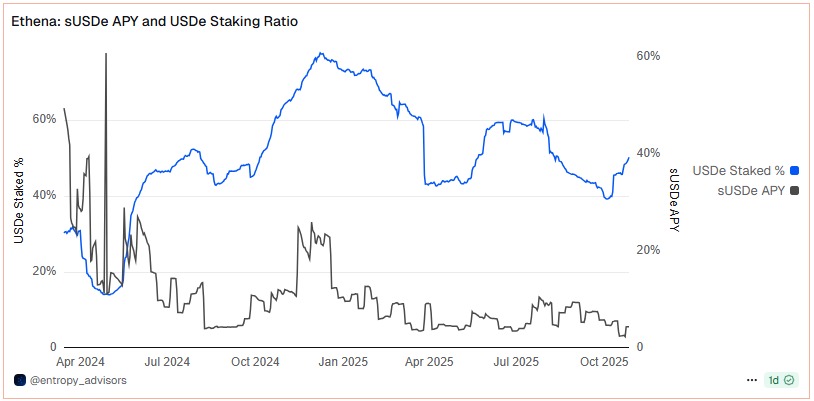
This mechanism will naturally boost its circulation and, consequently, its yield. It is worth noting that USDe (and especially its staked version, sUSDe) generates a native yield of 4% to 6%, thanks to Ethena’s delta-neutral strategy. Traders thus earn passive returns even when using it as collateral, which significantly optimizes capital efficiency and attracts liquidity.
That’s not all: according to some sources, Ethena receives a significant portion of the trading fees on HyENA. We’re talking about a percentage of around 50% of the DEX’s revenue. This revenue could go toward boosting the yield of sENA (the staked token), further strengthening its position as a major asset.
Challenges for Hyperliquid
While this collaboration marks a turning point for Ethena, it also represents a major strategic step for Hyperliquid. Until now, the protocol had primarily distinguished itself through its technical performance and liquidity, but it still lacked a key external partner to validate its HIP-3 model. With HyENA Trade, that has now been achieved.
HyENA becomes the first large-scale implementation of the HIP-3 standard, a format that allows third-party teams to build their own derivative platforms using Hyperliquid’s engine. This is a “real-world” validation, far more powerful than any announcement or testnet.
From a more economic perspective, the stakes for Hyperliquid and its ecosystem are clearly significant. With approximately $10 billion in USDe in circulation, a portion of this money supply could be redeployed to HyENA, directly boosting the trading volumes and market depth of the Hyperliquid engine.
By becoming the underlying engine of the protocol holding the third-largest stablecoin, Hyperliquid is gradually establishing itself against industry giants such as Bybit, Kraken, or perhaps even Coinbase and Binance. By combining execution speed, a user experience similar to that of a centralized platform, and an architecture that enables decentralization, it is gradually bringing together the strengths of CEXs and DEXs into a single product.
By becoming a true decentralized CEX, it now possesses, beyond technology, another essential quality: credibility. Thanks to the integration of Ethena, professional players now view USDe as high-quality collateral and Hyperliquid as a serious ecosystem, far removed from the image of an “airdrop farm” or fleeting experiments.
It should be noted that even though the track record is excellent, Ethena’s delta-neutral strategy carries significant risks; we are not immune to mismanagement, and the cash flow remains somewhat unclear at times.
HyENA, the genesis of a product that could become a benchmark
Built on Hyperliquid’s CLOB (Central Limit Order Book), HyENA guarantees execution in under 200 milliseconds, real market depth, and a user experience comparable to that of a CEX, while remaining entirely non-custodial and KYC-free. This proves that institutional trading can take place directly on-chain, without any compromise on performance.
Economically, the model could prove just as innovative: governance shared between ENA and HYPE would create an unprecedented alignment between the two protocols. ENA holders could capture value through the “fee switch” and the growing demand for USDe, while HYPE stakers could benefit from HIP-3 revenue sharing and the rise of the Hyperliquid engine.
Finally, thanks to HIP-3’s permissionless architecture, HyENA could evolve into multi-asset products:
- Cryptos
- Indices
- Commodities
- Stocks
Each new market deployed would strengthen both Hyperliquid’s liquidity and the Ethena ecosystem, creating a unique network effect. This deployment would therefore be much more than a simple launch; it would be a long-term model combining infrastructure, yield, and governance.