After a hiatus of more than four years, the Federal Reserve has discreetly resumed its liquidity injections. In 2025, $128 billion has already been reintroduced into the banking system via overnight repos. This is a strong signal that could revive interest in Bitcoin.
The Federal Reserve’s discreet return to money printing
In 2025, the Fed clearly began its monetary pivot: the key interest rate fell from 5.5% in July to 4% in October. The markets are now anticipating a further 25 basis point cut at the December 10 meeting, with an estimated probability of more than 80% according to the CME.
The economic slowdown is reinforcing this conviction among investors. However, the consumer price index (CPI) remains stable at 3%, still above the 2% target, which could justify maintaining a cautious and still restrictive monetary stance.
Having ended its monetary injection operations in June 2020, the US Federal Reserve (Fed) quietly opened the liquidity floodgates in 2025.
Since the beginning of the year, $128 billion has been injected into the banking system via overnight repo operations, a level not seen since the emergency response to the pandemic in 2020.
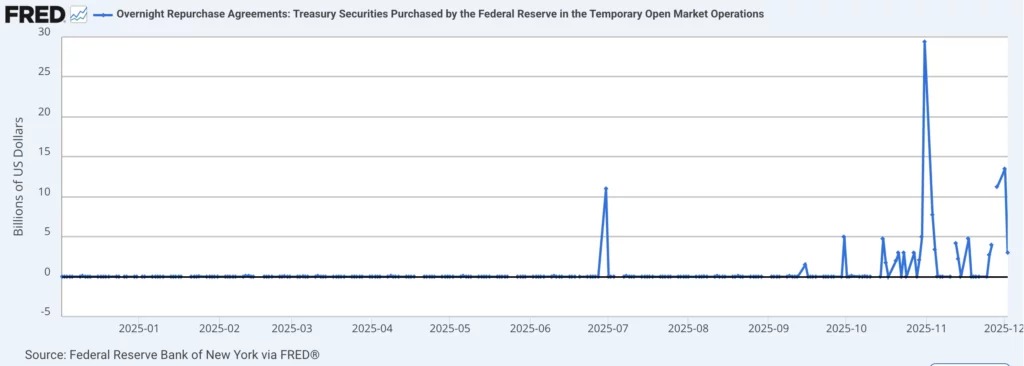
The latest example: $13.5 billion was added on December 1, one of the largest operations since the COVID crisis.
A few days earlier, $11.25 billion was injected on November 28, and $29.4 billion on October 31.
Overnight Repurchase Agreements (or overnight repos) are very short-term loans through which the Federal Reserve temporarily injects liquidity into the financial system.
In concrete terms, it buys Treasury securities from a bank or institution, with the agreement that these will be sold back to it the next day at a slightly higher price. These operations are mainly aimed at stabilizing short-term interest rates, particularly when demand for liquidity rises sharply. By injecting this liquidity, the Fed prevents interbank rates from rising too high, which could lead to a credit crunch and market tension. In other words, repos are not directly aimed at lowering long-term bond rates (as quantitative easing would do), but at preventing a sharp rise in short-term rates. This mechanism is crucial for maintaining market liquidity, especially in times of monetary instability or restrictive policy.
Can the bull run resume for Bitcoin?
This influx of tens of billions in liquidity could well act as a catalyst for risky assets, particularly Bitcoin, which is currently trading below $100,000.
Expectations of a further rate cut by the Fed have propelled the price of BTC from $86,000 to $93,000 in the space of 24 hours, an increase of nearly 8%.
Historically, BTC has always responded well to periods of accommodative monetary policy, buoyed by its digital scarcity and the influx of capital in search of returns.
With markets already anticipating a rate cut as early as December, this quiet resumption of money creation could reignite interest in Bitcoin as an alternative store of value.