A controversial new proposal, BIP-444, seeks to restrict non-financial data on Bitcoin. Presented as a temporary security measure, it nevertheless threatens “legitimate” transactions and raises the question of control over the protocol once again.
BIP-444: Protection or danger for Bitcoin and its consensus?
Since the beginning of 2025, the Bitcoin community has been rocked by a debate over non-monetary data recorded in the blockchain via the OP_RETURN field of its transactions. While Bitcoin Core developers have chosen to raise the old 80-byte limit to 100,000 bytes, Luke Dashjr, creator of the competing Bitcoin Knots client, strongly opposes this, considering this data to be spam, an attack on Bitcoin. Today, more than 20% of nodes now use his client.
At the end of September, a leak of messages relayed by The Rage revealed that Dashjr was considering a Bitcoin hard fork to retroactively remove content deemed illegal. He proposed the creation of a trusted multisignature committee responsible for censoring blocks containing this data by replacing them with cryptographic proofs (zero-knowledge proofs). This proposal was not initially taken seriously.
Now, with pull request #2017, which will likely become BIP-444, a new Bitcoin Improvement Proposal, Luke Dashjr hopes to protect the Bitcoin blockchain from non-monetary data entries.
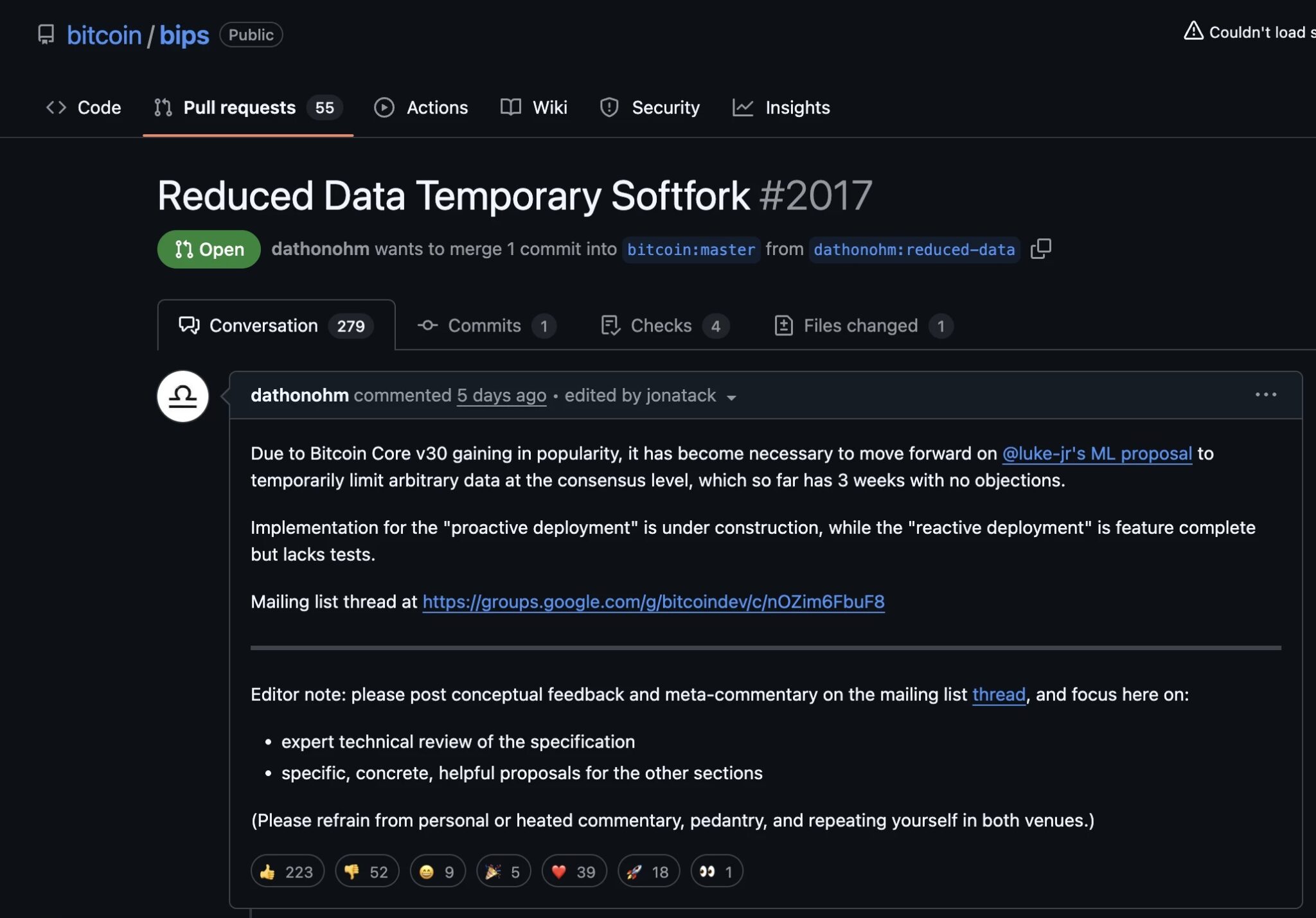
Contrary to his initial idea of a hard fork, BIP-444 now proposes a temporary soft fork lasting one year, aimed at restricting what is considered abusive use of the blockchain.
In concrete terms, this would involve reinstating technical limits that were lifted in version 30.0 of Bitcoin Core:
- Reduction of OP_RETURN to 83 bytes;
- Limitation of OP_PUSHDATA to 256 bytes;
- Restriction of ScriptPubKey size to 34 bytes.
This BIP is presented as an emergency and transitional measure, while the community develops a more sustainable response, whether in the form of more detailed rules or non-consensus solutions.
The main concern expressed by Dashjr and his supporters is to preserve Bitcoin’s legal neutrality by preventing illegal content from posing a legal risk to node operators.
A soft fork that would likely end Bitcoin’s neutrality
Although Luke Dashjr’s initial motivations for proposing this soft fork are commendable, the mechanisms he wants to put in place could have major consequences for the functioning of the blockchain, as well as its neutrality. On several occasions, the proposal has been compared to the European ChatControl regulation. In practice, BIP-444 could lead to the freezing of certain funds by making UTXOs unspendable for the duration of the soft fork, which, although presented as temporary, could be extended indefinitely if no lasting consensus emerges.
These UTXOs would be deemed invalid because they do not comply with the new rules introduced by the update.
One of the major changes is the deactivation of the OP_IF opcode in Tapscript, preventing the execution of conditional scripts. This would impact “legitimate” use cases such as inheritance mechanisms (conditional timelocks) or multisigs used by some advanced Bitcoin wallets.
In addition, the restriction on Taproot control block sizes makes certain “deep spends” in complex Merkle trees impossible, permanently blocking access to the funds concerned.
Supporters of BIP-444 believe that users will have time to move their assets before activation via a “User-Activated Soft Fork (UASF),” and dismiss criticism as FUD. But opposing voices denounce this as a form of protocol censorship, likely to cause a messy fork and freeze dormant funds.
For now, the proposal has not yet been formally accepted as an official BIP, but it is already stirring up debate about the decentralization of Bitcoin.
Ironically, the pull request that could make this text BIP-444 bears the number 2017, an unintended reference to the year of the Bitcoin Cash fork, marked by another ideological battle over block size.