
In just three weeks, Ethena’s USDe has seen its capitalization increase by 77% to become the third largest stablecoin on the market. A look back at this exceptional performance.
Ethena’s USDe becomes the third largest stablecoin on the market
Over the past few days, we have talked about Ethena’s ENA on several occasions, but at the same time, the USDe stablecoin in this ecosystem is also experiencing rapid growth. In fact, among all its competitors, USDe seems to be the stablecoin that has benefited the most from the adoption of the GENIUS Act in the United States, as the asset has now climbed to third place in its category:
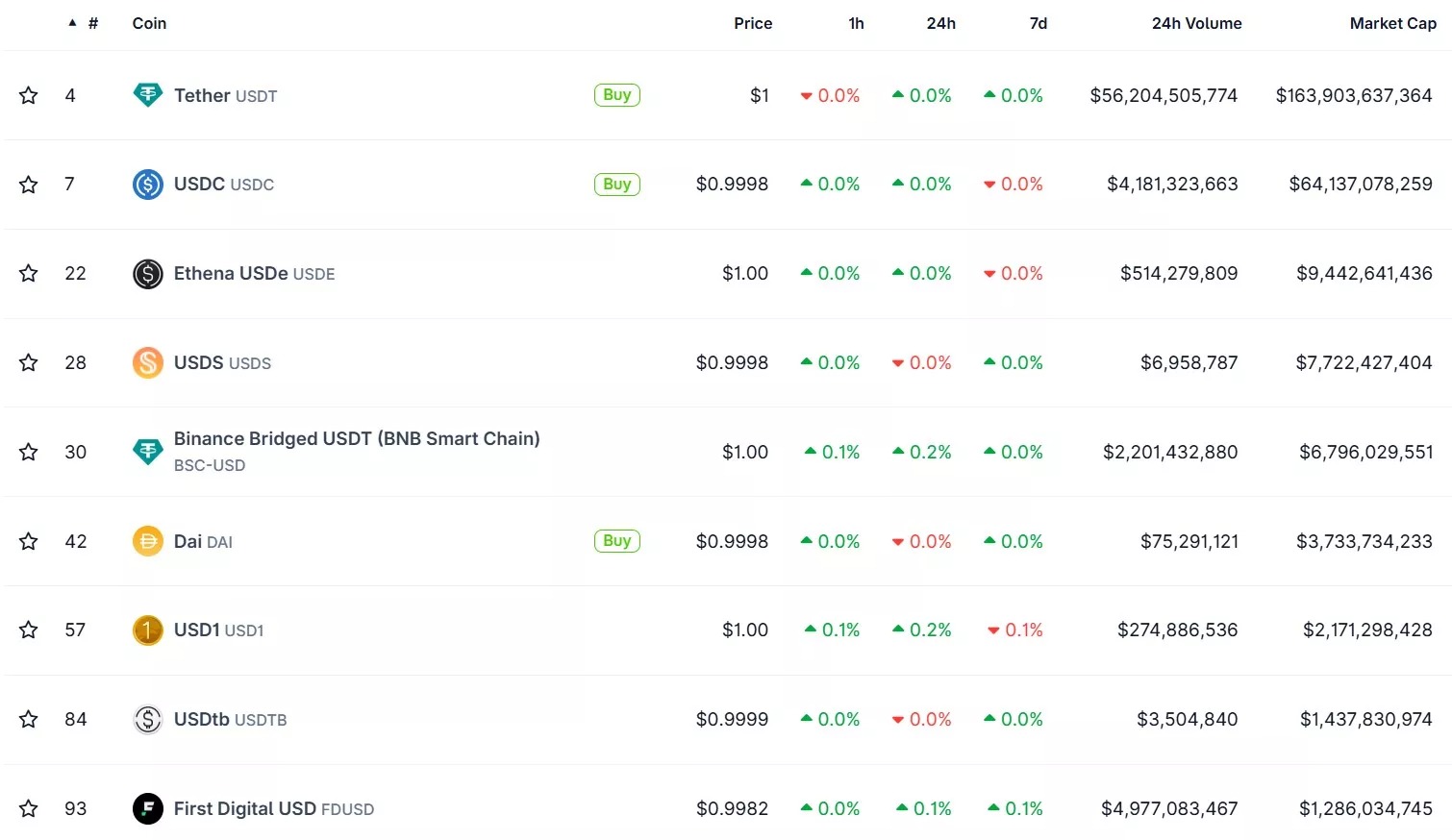
To appreciate the scale of this performance, it should be noted that the USDe saw its capitalization grow by 53% in July, from $5.3 billion to $8.16 billion. What’s more, the third-largest stablecoin on the market grew by 77% in just three weeks, with a market cap of $9.44 billion.
Of course, the asset is still far behind Circle’s USDC and even further behind Tether’s USDT, which have market caps of $64.14 billion and $163.9 billion, respectively. For example, USDe would need to see its market cap increase 6.8-fold to surpass USDC under current market conditions. However, the performance is still noteworthy, as when comparing their performance since July 1, USDC has grown 4.31%, compared to 3.92% for USDT.
In addition to the GENIUS Act, other factors may explain this strong growth. Last Thursday, we mentioned the arrival of the stablecoin on The Open Network (TON) blockchain, as well as a particularly interesting incentive program for its use on the decentralized finance (DeFi) protocol Aave.
Is USDe risky?
Despite this particularly encouraging news, a degree of caution is still warranted given the algorithmic nature of USDe. Although the term “algorithmic” may bring to mind the sad fate of Terra’s UST (LUNA), the two assets are in no way comparable in terms of technology.
On the other hand, even assuming that the Ethena Labs teams are completely reliable, there are still risks. This is because USDe reserves are spread across several assets, platforms, and addresses. While this intelligently diversifies risk, it also increases the likelihood of failure at one of these points, which could lead to USDe becoming undercollateralized.
For example, with 15% of the assets securing the USDe located on Bybit, last February’s impressive hack could have led to a disaster scenario if the situation had worsened.
While this does not mean that we should be systematically pessimistic, these are at least parameters to be taken into account in your risk management strategy.