
The tokenization of real-world assets (RWAs) is redefining the boundaries of traditional finance, to the point of raising concerns among members of the Bank for International Settlements (BIS). At issue: the growth of tokenized money market funds, which have the potential to amplify the risks associated with traditional finance.
An unprecedented rise in tokenized money market funds
The Bank of Central Banks, also known as the Bank for International Settlements (BIS), often takes a negative stance toward the many advancements associated with the cryptocurrency sector.
This skepticism has now extended to the significant growth of the tokenized money market funds (TMMF) market, which has risen by 265% over the past year. This is largely due to the involvement of giants in traditional finance, such as BlackRock and its BUIDL fund, as well as Franklin Templeton.
After a slow start, TMMFs have experienced rapid growth over the past two years. Total Value Locked (TVL), equivalent to assets under management, stood at only about $770 million at the end of 2023, but had increased more than tenfold to nearly $9 billion by the end of October 2025.
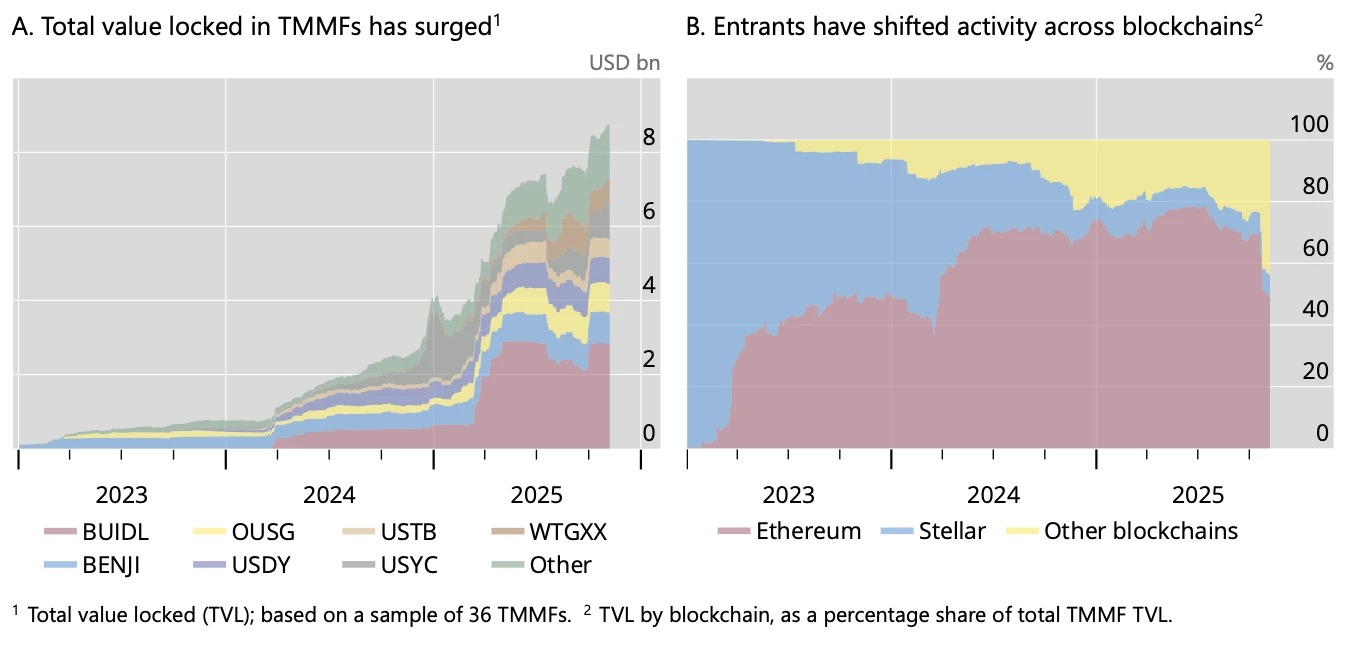
Growth of tokenized money market funds
The reason for this success? Their ability to maintain a certain level of stability while distributing on-chain interest to their holders—unlike U.S. stablecoin issuers, which cannot offer this type of passive return. Unless, that is, the companies in question delegate their management to third-party entities, as in the case of Coinbase and PayPal.
At the same time, these TMMFs issued in the form of tokens “share key features of stablecoins, such as peer-to-peer transactions and programmability via smart contracts.” This is sure to appeal to users of decentralized finance (DeFi) who are constantly seeking reliable and readily available collateral.
Risks that mirror and may amplify those of conventional funds
Currently, investments in these funds are limited to portfolios approved using tokens (ERC-1400/3643) capable of blocking transfers to unlisted wallets. However, this restriction can be circumvented very quickly using wrapped tokens or through certain platforms.
This growth has the potential to make these tokenized money market funds the “foundation of the future financial system.” This has prompted BIS analysts to sound the alarm, calling for “prudent risk management, which is essential to maintaining confidence.”
Tokenized money market funds give rise to risks that mirror—and may even amplify—those of conventional funds of the same type and of stablecoins.
This amplification could occur due to “the transparency of on-chain transactions, which can exacerbate liquidity risk by serving as a coordination mechanism among investors.” It could also stem from the principle of “composability” specific to DeFi, which interlocks protocols with one another like financial Legos.
And what about leveraged borrowing strategies (looping), which involve “using MMFs as collateral to borrow stablecoins in order to purchase more MMFs”? All of these situations could exacerbate certain spillover effects, particularly in the event of a market shock.