
France’s borrowing costs continue to rise. The 10-year yield recently reached 3.69%, a high not seen since 2011, amid public deficits, geopolitical tensions, and caution on the part of central banks. This development is being closely watched by financial markets.
Geopolitical tensions, monetary policies, and budget deficits: the causes behind the rise in French interest rates
With French public debt now exceeding 3,400 billion euros, rising interest rates are reigniting concerns about the sustainability of public finances. After years of virtually free money, the government must once again borrow under much less favorable terms.
The French 10-year yield is now trading above its highest levels in the past 14 years, after reaching 3.69% last Friday.
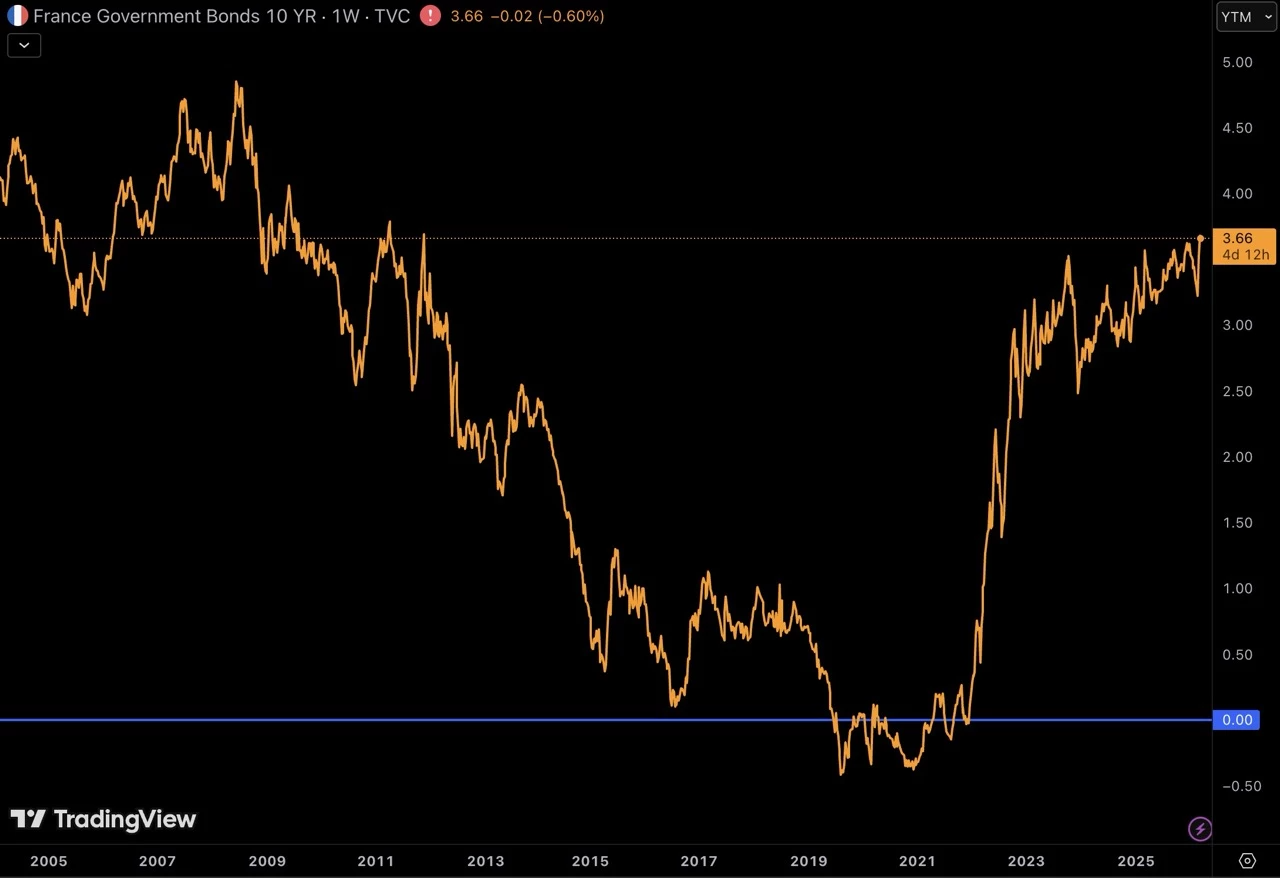
French 10-year yield since 2005
The era of “magic money”—marked before the COVID crisis by rates near zero or even negative—is now a thing of the past. Between 2019 and 2021, the French 10-year yield had indeed hovered around 0%, against the backdrop of the European Central Bank’s (ECB) extremely accommodative monetary policy, particularly through its large-scale asset purchases.
Since 2021, the trend has reversed, before accelerating sharply in 2022. This rise can be explained by several factors:
- The return of inflation following the post-COVID recovery;
- The energy crisis following the invasion of Ukraine;
- The ECB’s monetary tightening to try to curb rising prices.
Beyond these crises, investors are also concerned about growing mistrust regarding France’s fiscal trajectory. France has not posted a balanced budget since 1974, and with no prospect of a turnaround, fears of a headlong rush into deficit spending over the next few years are discouraging investors.
Rating agencies have already expressed their concerns; for example, in September 2025, Fitch downgraded France’s sovereign rating to A+, the fifth-highest level on its scale, even though the country still held the top AAA rating in 2011.
Finally, current geopolitical tensions in the Middle East may also be contributing to this recent spike in interest rates. The war is driving up oil prices, with Brent crude back above $100, reigniting the risk of imported inflation in Europe.
As a result, markets are anticipating fewer rate cuts by the ECB—or even a more cautious monetary policy—which is fueling the rise in French long-term interest rates.
How to Protect Yourself from a Potential French Debt Default?
The spiral of uncontrolled debt is easy to understand: if investors lose confidence in France’s ability to repay, they will demand ever-higher interest rates. The government, caught in a bind, would no longer be able to finance its deficits or public services, eventually being forced to impose a drastic adjustment to its finances.
This scenario is extreme, but far from unprecedented, as illustrated by Argentina, which has defaulted on its debt nine times in 200 years, Germany, which defaulted twice following the two world wars—contributing notably to the hyperinflation of the mark in the 1920s—or Greece, with its partial default in 2012.
In this context, Bitcoin emerges as an alternative. On an individual level, holding Bitcoin can provide protection against potential currency devaluation resulting from policies that sacrifice the currency’s value, as well as against potential seizures of citizens’ assets, such as those carried out by Roosevelt in 1933 via Executive Order 6102, which prohibited the holding of physical gold.
For the government, using Bitcoin as a strategic reserve—much like gold—would allow for diversification of reserves and the potential to benefit from the currency’s long-term growth. If debt spirals out of control, Bitcoin could serve as a safe haven for both citizens and nations.