Often accused of being a tool for financial crime, crypto today shows a very different reality. The latest data from Chainalysis and TRM Labs shows that the share of illicit flows on major centralized exchanges is falling sharply, with Binance standing out with a particularly low level of exposure. Discover these figures and the platform’s efforts to limit transactions linked to illegal activities.
Crypto crime in sharp decline, Binance at the forefront
Cryptocurrency-related crime is declining sharply, and now the data proves it.
According to independent analyses by Chainalysis and TRM Labs, the share of flows directly linked to illicit activities on major centralized exchanges fell sharply between early 2023 and mid-2025, now representing only a tiny fraction of volumes.
On the seven largest exchanges by volume, direct exposure to addresses identified as illicit was around 0.018% to 0.023% of total volume in June 2025.
In other words, less than $2 to $2.3 out of every $10,000 traded comes directly from wallets associated with scams, hacks, ransomware, or sanctions violations.
Binance has a lower level of exposure than its competitors
In this context, Binance appears to be one of the most advanced exchanges. According to Chainalysis, only 0.007% of the volumes processed by the platform in June 2025 were directly linked to illicit wallets, compared to an average of 0.018% for the six other major exchanges. Binance’s ratio is therefore more than 2.5 times lower than that of its peers.
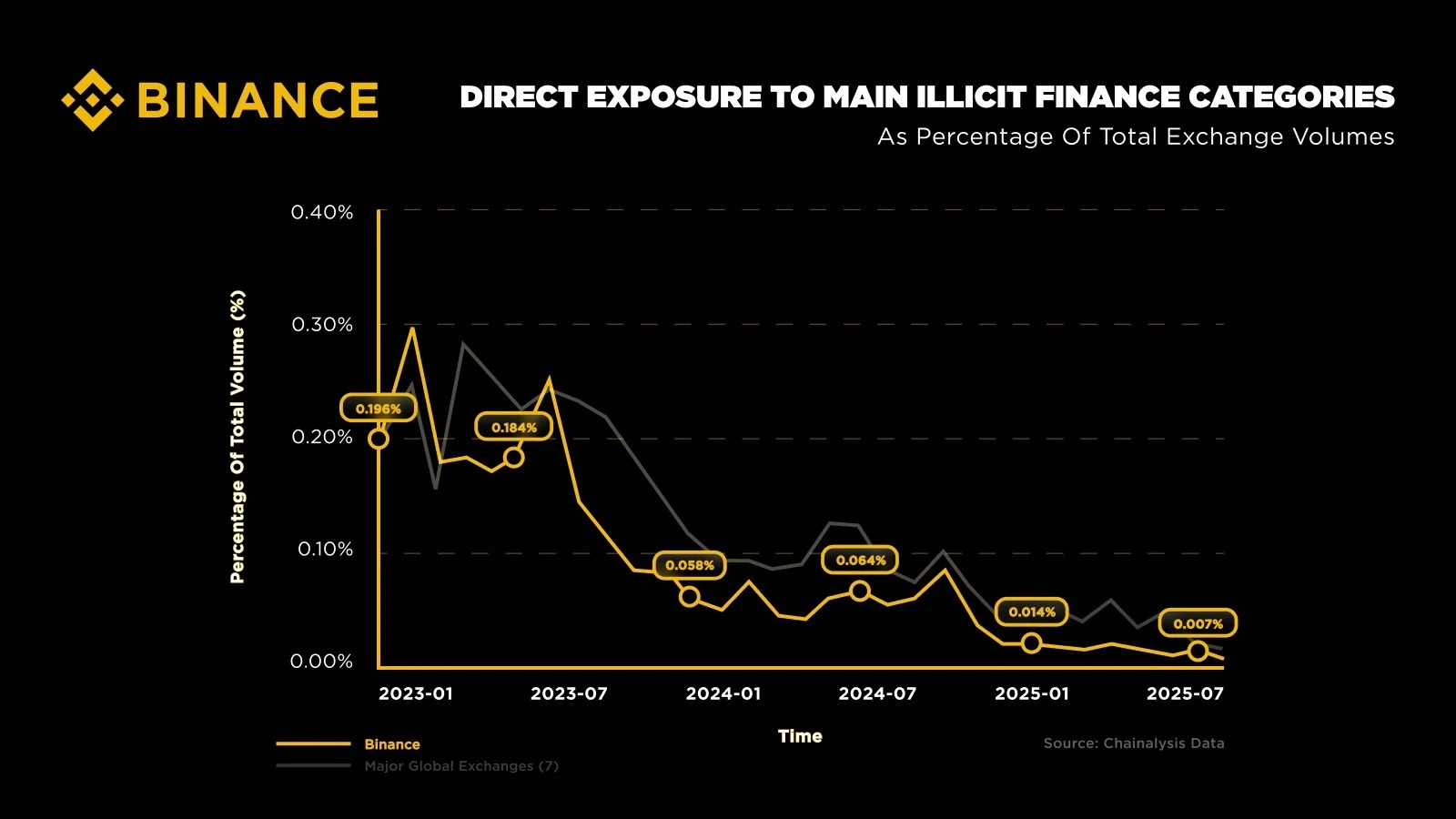
TRM Labs reaches similar conclusions using its own methodology: approximately 0.016% of Binance’s volume is directly exposed to illicit funds, compared to 0.023% for other major platforms, a difference of approximately 30%.
Above all, both studies point to the same trajectory: between January 2023 and June 2025, Binance is expected to reduce its direct exposure to illicit flows by 96% to 98%, which is a few points better than the average for other major exchanges.
This is despite the fact that in 2025, the platform will be processing more than $90 billion in volume per day, for approximately 217 million daily orders, levels comparable to the cumulative volume of several of its competitors.
Why it is important to talk about direct exposure
The figures quoted refer to direct exposure to illicit funds, i.e., the share of volumes that come directly from or are sent to addresses identified as linked to criminal activities.
If, out of $10,000 processed, $1 is linked to an address identified as illicit, the direct exposure is 0.01%.
The lower this rate, the more effective the platform’s filtering and compliance systems are at isolating these flows upstream, reporting them to the authorities, and even blocking them before they spread.
Unlike traditional banking systems, the transparency offered by blockchain allows these exposures to be measured with a high degree of granularity, making it possible to compare different exchanges in this way.
Illegal amounts well below those in traditional finance
These data also take on another dimension when compared to estimated illicit flows in traditional finance. Nasdaq estimates that approximately $3 trillion in illicit funds circulated through the global financial system in 2023, while the UN and IMF estimate that money laundering accounts for between 2% and 5% of global GDP each year.
In terms of cryptocurrencies, Chainalysis and TRM Labs estimate that the amounts identified as illicit and passing through large centralized exchanges are limited to a few billion dollars per year, a fraction of the overall volume.
This does not mean that everything is detected or that the risk has disappeared, but these orders of magnitude put into perspective certain claims that Bitcoin and other cryptocurrencies are mainly used for money laundering.
What is Binance doing to reduce illicit flows?
Binance attributes these results to a combination of measures involving human resources, detection technologies, and cooperation with authorities.
More than 1,280 specialists, or nearly 22% of its workforce, are dedicated to compliance, investigation, and risk management functions, with annual budgets of several hundred million dollars for KYC, transaction monitoring, and financial investigation.
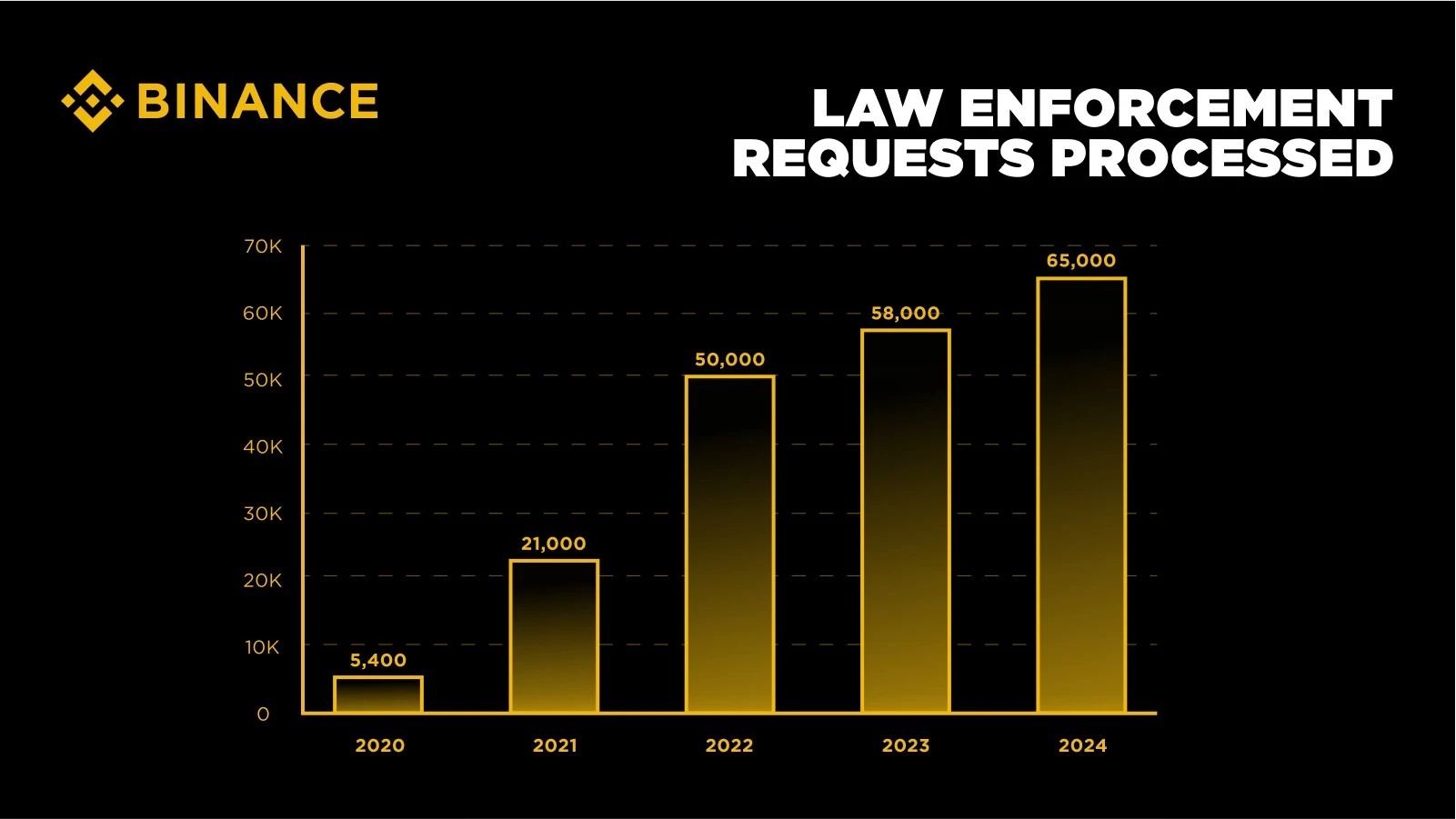
The platform also emphasizes collaboration with law enforcement agencies. It reports having responded to more than 240,000 requests and organized more than 400 training sessions for investigators and regulators around the world to share methods for on-chain tracing and fraud prevention.
These efforts are in addition to Binance’s participation in collective initiatives such as the Beacon Network and the T3+ program, alongside Tether, TRON, and TRM Labs, among others, which aim to share real-time red flags and freeze funds identified as illicit before they can be dispersed.
Towards wider adoption through greater transparency?
The continued decline in the share of illicit funds on major exchanges and the convergence of analyses from several data providers reinforce the idea of an industry in a mature phase.
Thanks to the transparency of blockchains and stricter anti-money laundering standards, crypto is becoming one of the most traceable financial systems.
For regulators and traditional financial institutions alike, emerging use cases around tokenization or payments are based on one key condition: trust.
Players capable of operating on a global scale while maintaining a very low level of exposure to illicit flows are helping to create this foundation of trust and paving the way for broader integration of blockchain and crypto into mainstream finance.