The race for artificial intelligence is driving a sharp increase in global demand for RAM. Reflected in the economic and diplomatic rivalry between the United States and China, RAM is becoming a true strategic issue. This exponential price increase is also impacting Bitcoin, for which memory and storage remain essential for nodes and mining infrastructure.
AI is creating unprecedented pressure on memory supply chains
Since September 2025, prices for RAM modules (printed circuit boards on which integrated memory circuits are mounted) have surged by 163% to 619%. This dramatic shift is taking place against a geopolitical backdrop marked by a frantic race toward artificial intelligence (AI).
Since 2024, the rise of AI has profoundly changed memory usage patterns. This is particularly true for large language models (LLMs), which require high computing power as well as very fast data transfer capabilities between GPUs and memory.
As a result, high-bandwidth memory (HBM) has become indispensable, as it offers both low latency and very high data rates. Major AI players are thus consuming a growing share of global memory production (DRAM and NAND) to equip data centers dedicated to training and inference of large-scale models.
These infrastructures are extremely memory- and high-speed storage-intensive, prompting manufacturers to prioritize the most profitable segments, such as server memory and HBM, at the expense of consumer products. This strategic reallocation has created an artificial shortage in certain market segments.
The price increase is not uniform and particularly affects high-capacity variants. This is the case for DDR4 and DDR5 modules, standard models used in PCs and mining rigs in particular.
The 32GB DDR5 module, for example, has seen a dramatic price increase across all markets; U.S. prices rose from $149 to $392 (+163%), and Japanese prices saw the most extreme increase, rising from ¥16,000 to ¥115,090 (+619%).
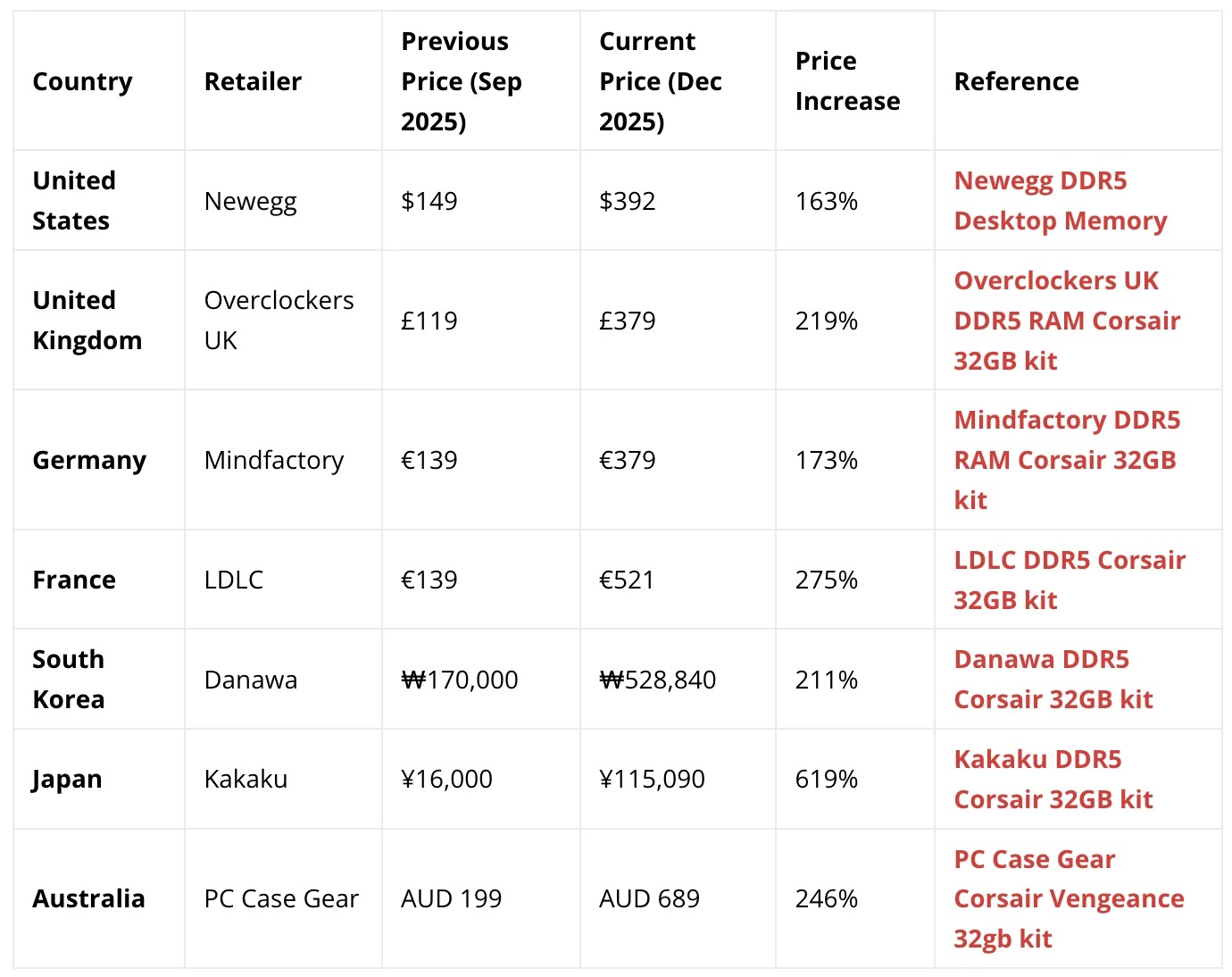
Regional impact on RAM prices, by Rost Glukhov
Limited direct impact, but costly indirect repercussions for Bitcoin mining operations
As you know, Bitcoin mining relies on the SHA-256 algorithm, a hash algorithm used to secure and validate blocks on the network. This algorithm is essentially arithmetic, meaning it performs computationally intensive operations but requires only very small amounts of RAM to store temporary variables.
In practice, this means that even a significant increase in the price of RAM has virtually no effect on the manufacturing cost of ASICs (specialized circuits for mining), which are primarily driven by the cost of silicon, nanometer-scale etching, packaging, and thermal management.
However, the impact of rising RAM prices is felt indirectly. This is because Bitcoin nodes store the entire blockchain on an SSD, which uses NAND flash memory, and use RAM for the mempool or the UTXO cache.
If RAM prices rise sharply, the operating costs of these nodes will increase, which could deter some individuals or organizations from running full nodes, thereby reducing the number of independent participants and the diversity of the network.
In other words, Bitcoin remains resilient in the face of rising RAM prices for block production, but a prolonged increase in memory costs could affect the network’s decentralization and resilience.
It is worth noting that the CEO of TeamGroup, a RAM module manufacturer, has indicated that memory prices are unlikely to stabilize before 2027–2028, pending the arrival of new production capacity on the market.