
Bittensor has just reached a historic milestone. For the first time since the network’s launch, the protocol has undergone its very first halving, a major event that profoundly alters the issuance dynamics of its TAO cryptocurrency. From now on, daily issuance will drop from 7,200 to 3,600 TAO, marking a significant transition for the entire ecosystem. An in-depth look at this key event for the ecosystem.
Half the Issuance
Like Bitcoin, TAO has a maximum supply capped at 21 million units. However, unlike Bitcoin, Bittensor’s halving is not triggered by a certain number of blocks being reached, but by the total number of TAO issued. In practical terms, as long as the total supply does not reach certain predefined thresholds, the network continues to issue TAO at a fixed rate. Before this first halving, each block, produced every 12 seconds, generated 1 TAO, or approximately 7,200 TAO per day. Thus, since the halving, 0.5 TAO are now generated every 12 seconds.
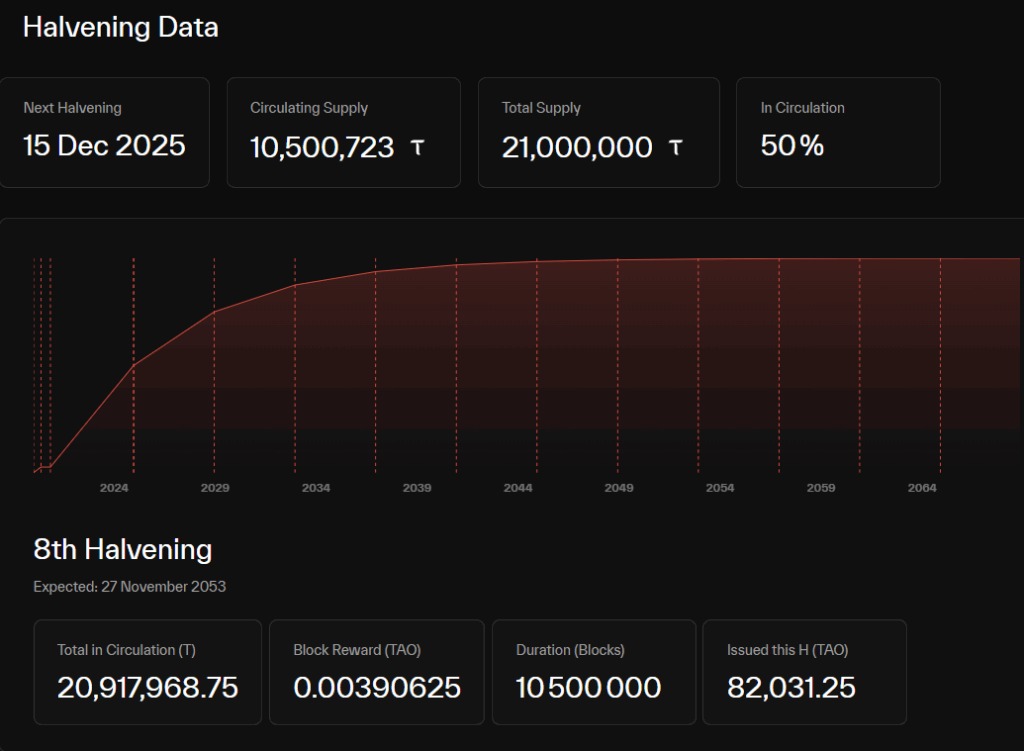
Bittensor Halving
Another key mechanism: recycling. A portion of the TAOs used to register miners and subnets is returned to the “unissued” supply. In practice, this process artificially reduces the actual circulating supply and can delay the arrival of a halving.
Unissued Supply
This corresponds to the portion of TAOs included in the 21 million cap but which have not yet been created. These tokens will be issued gradually over time through block rewards.
Since February 2025, Bittensor has also introduced the concept of Dynamic TAO. Each subnet now has its own Alpha token, which can be exchanged for TAO on decentralized exchanges. These Alpha tokens follow the same capping and halving logic as TAO, but with one important difference: only the portion of Alpha tokens injected into liquidity pools is affected by the reduction in issuance.
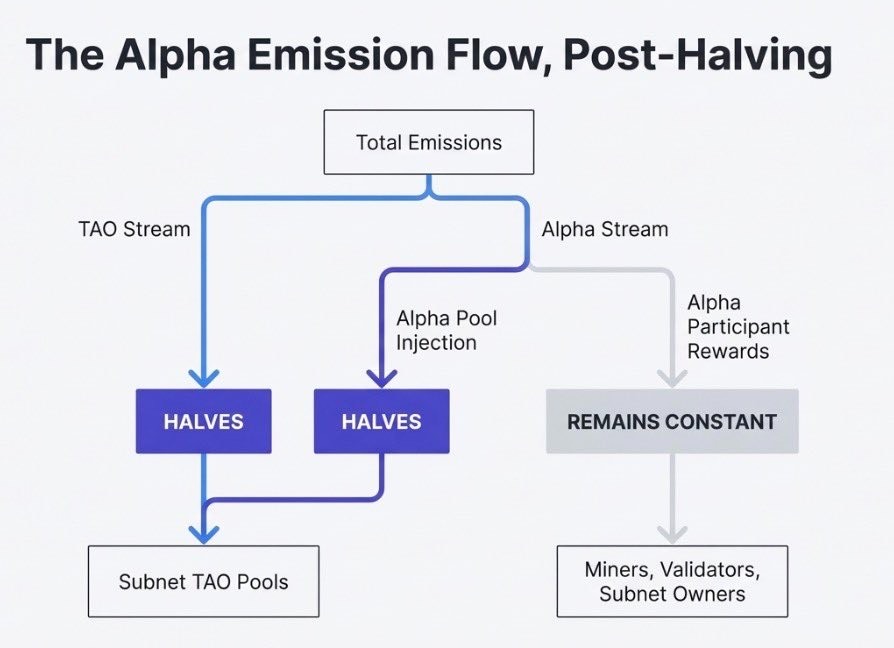
Changes in subnet liquidity pools: TAO Flows
What does this mean for the Bittensor ecosystem?
This first halving marks a turning point for Bittensor. The reduction in emissions has a direct effect on the liquidity available in subnet pools. Fewer TAO issued also means fewer TAO and Alpha injected daily. However, not all stakeholders are affected in the same way. Alpha distributions to miners, validators, and subnet owners remain unchanged.
For TAO, just as for BTC, the decline in inflation is a strong signal. Fewer tokens are being created, while demand for AI-related services continues to rise.
This new configuration favors the oldest subnets. Launched before the halving, they have benefited from several months, or even years, of higher liquidity injections. Conversely, new subnets will have to contend with more limited inflows, making competition more intense.
However, this change is not without risks. Scarcer liquidity may widen the gap between the highest-performing subnets and less robust projects. Design flaws, lack of real-world usage, or poor capital allocation will become harder to conceal. The network is gradually entering a phase of efficiency rather than rapid expansion.
Furthermore, a reduction in TAO rewards could discourage small-scale miners and validators, leading to the centralization of these activities by larger players.
Key Takeaways
Bittensor’s first halving is not a short-term event. It is neither an immediate market signal nor a promise of an instant rise in the TAO price. By reducing inflation while maintaining incentives, Bittensor is initiating a transition toward a more mature ecosystem, where value is based more on the actual use and performance of subnets. As with Bitcoin in its early days, the effects of this halving will become apparent over time.