
The price of gold has just crossed the historic threshold of $4,000 per ounce, driven by a global context marked by inflation, geopolitical tensions, and growing doubts about the dollar. This increase raises a key question: is it simply a bubble or the beginning of a monetary shift?
Gold breaks another record, exceeding $27 trillion in market capitalization
In recent months, the global geopolitical and economic situation has been under strain. The war in Ukraine, tensions in the Middle East, economic sanctions, and Sino-American rivalries are fueling growing uncertainty in the markets.
On the economic front, persistent inflation, financial market volatility, and historic levels of global debt are undermining confidence in fiat currencies, including the dollar and the euro. Faced with this systemic instability, private investors and institutions are seeking solutions to preserve their purchasing power and financial sovereignty. In this context, gold is regaining its relevance as a safe haven.
As a result, the price of gold has risen 55% since the beginning of 2025 and 22% since August, crossing the symbolic threshold of $4,000 per ounce last night, with a total market capitalization now exceeding $27 trillion.
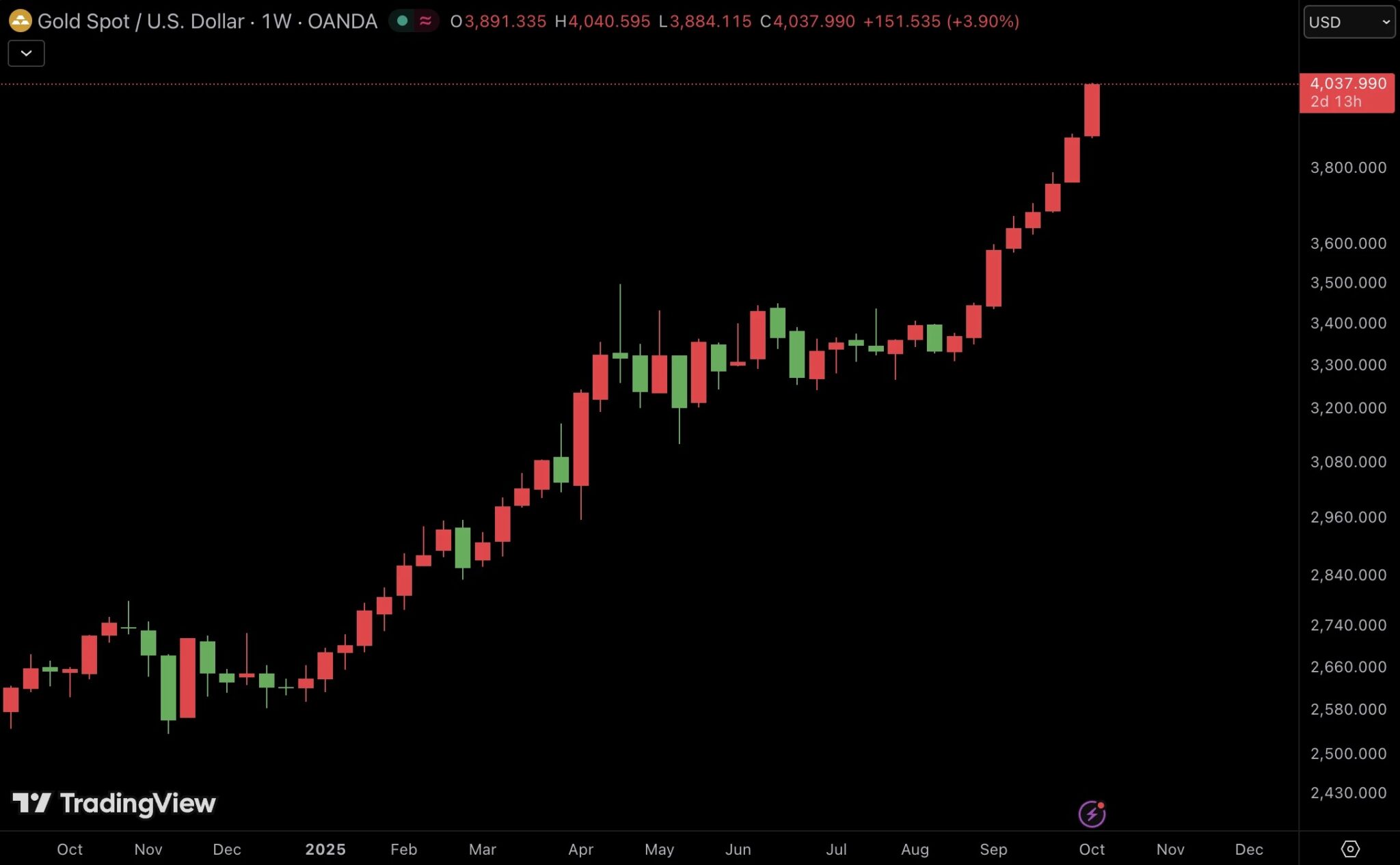
Although gold is performing remarkably well in 2025, its upward momentum is nothing new. Since the end of the Bretton Woods Agreement in 1971, marking the abandonment of the gold standard, its price has been on a veritable bull run. Despite two major corrections, a 70% drop between 1980 and 2001, then another between 2011 and 2015, gold has recorded a cumulative increase of more than 11,000% since this historic break with the previous monetary system.
More recently, it is the US federal government shutdown and the uncertainties it is causing for the economy that are supporting the rise in gold. This shutdown, now in its seventh day, is fueling fears of a prolonged paralysis of public institutions.
The Federal Reserve, for example, is unable to access certain economic data that is essential to the conduct of its monetary policy. A prolonged deadlock could not only delay its decisions, but also influence them, with knock-on effects on the entire global economy, which remains highly dependent on the dollar. In this climate of budgetary tensions and monetary fragility, gold is establishing itself more than ever as a safe haven.
We are witnessing a global monetary pivot to the detriment of the dollar
Although the price of gold has been on an uninterrupted upward trend for more than 50 years, its relative performance against the US money supply (M2) has not always followed the same trajectory.
In other words, if you had simply held onto dollars since the 1970s, your purchasing power would have declined significantly relative to gold. On the other hand, holders of U.S. Treasury bonds, benefiting from interest rates paid by the government, outperformed gold between 1980 and 2001. But this dynamic is now reversing.
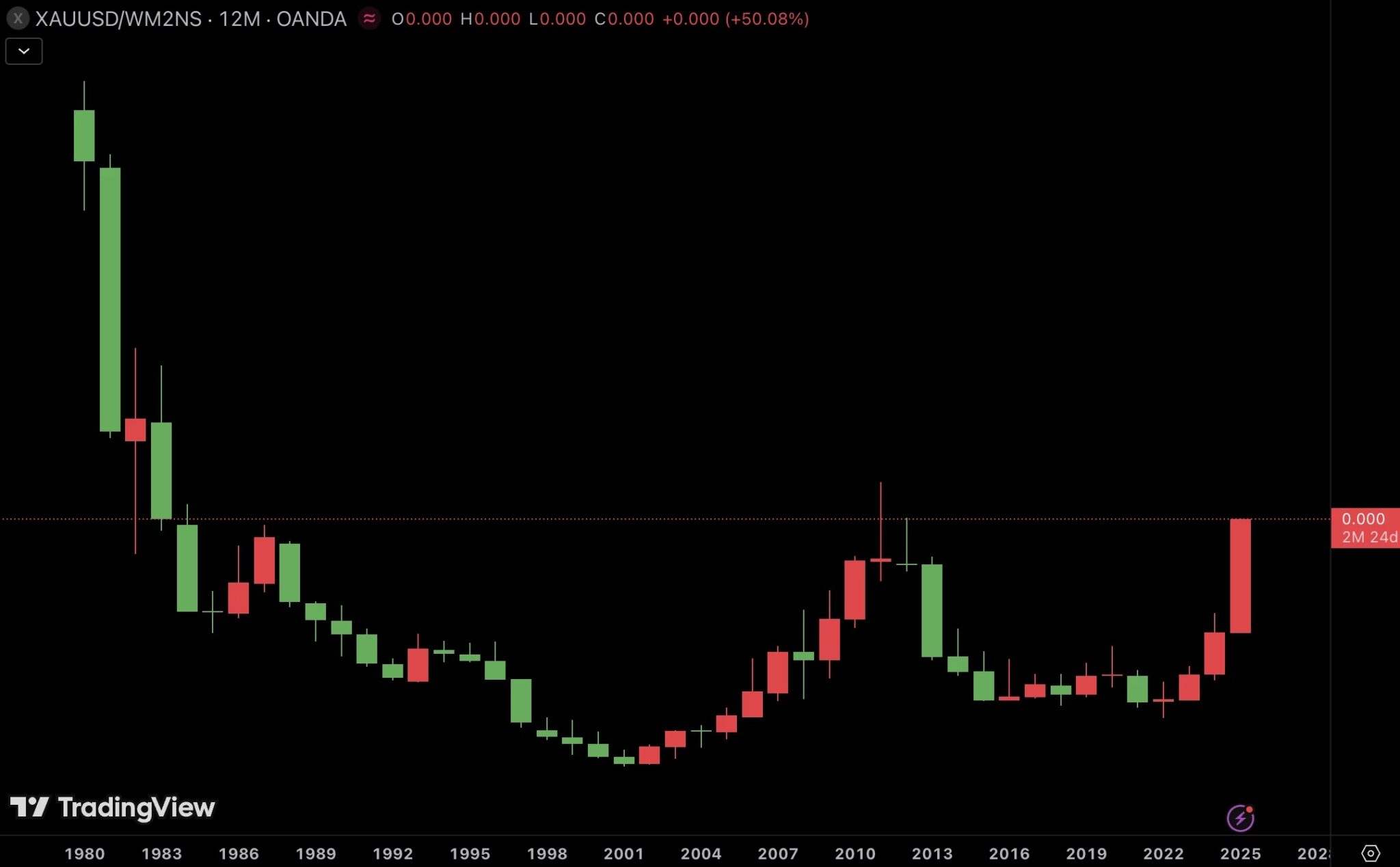
As the chart above shows, since 2001, gold has clearly outperformed the dollar when monetary expansion is taken into account. This means that the capitalization of gold, relative to that of the dollar, is increasing.
Despite a correction phase after 2011, the price of gold adjusted for monetary inflation jumped 50% in 2025 and is set to exceed its previous peak.
If this trend continues, it could mark the beginning of a paradigm shift: a lasting weakening of the dollar’s role as a safe-haven asset, to the benefit of gold and even other alternatives. In this context, holding US government bonds becomes potentially less profitable than simply holding gold.
In the short term, a technical correction cannot be ruled out, given the sharp rise. However, the current geopolitical and monetary environment seems to favor a transition to alternative assets. Gold, a safe haven for thousands of years, is benefiting from this, but so is Bitcoin, which has seen spectacular growth recently: compared to gold, it is up 26% over the last 12 months and 59% since the beginning of 2024.