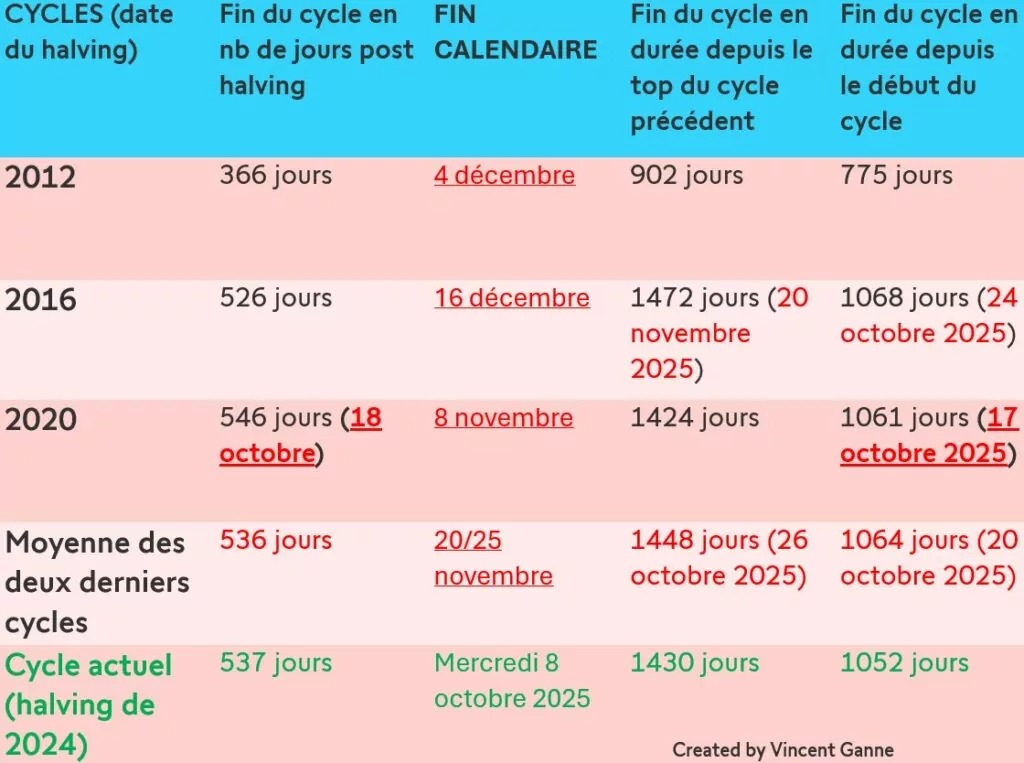
If the peak of the bull cycle linked to the 2024 halving occurs in mid-October, then the duration of the cycle will be exactly the same as that of the previous cycle (linked to the 2020 halving). So can we go beyond mid-October?
Bitcoin: a cycle peak expected around October 17-18, 2025?
Bitcoin’s evolution traditionally follows cycles linked to “halving,” events that reduce the reward given to miners by half. This decrease in available supply has always marked the start of a bullish phase, culminating in a major peak, before a prolonged corrective period sets in. If the duration of the current cycle mirrors that of the previous one, the peak could be reached around Friday, October 17 or Saturday, October 18, 2025.
What previous cycles show:
Since 2012, there have been three major historical cycles:
- 2012 cycle: the peak occurred 366 days after the halving, on December 4, 2013.
- 2016 cycle: the peak was reached 526 days later, on December 16, 2017.
- 2020 cycle: the peak occurred 546 days later, on November 8, 2021.
The last halving occurred in April 2024. Applying the two calculation methods from the previous cycle gives very similar estimates:
- 546 days after the halving → October 18, 2025
- 1,061 days after the November 2021 peak → October 17, 2025
These two independent projections converge on the same key period: mid-October 2025, which could mark the end of the current bull cycle.
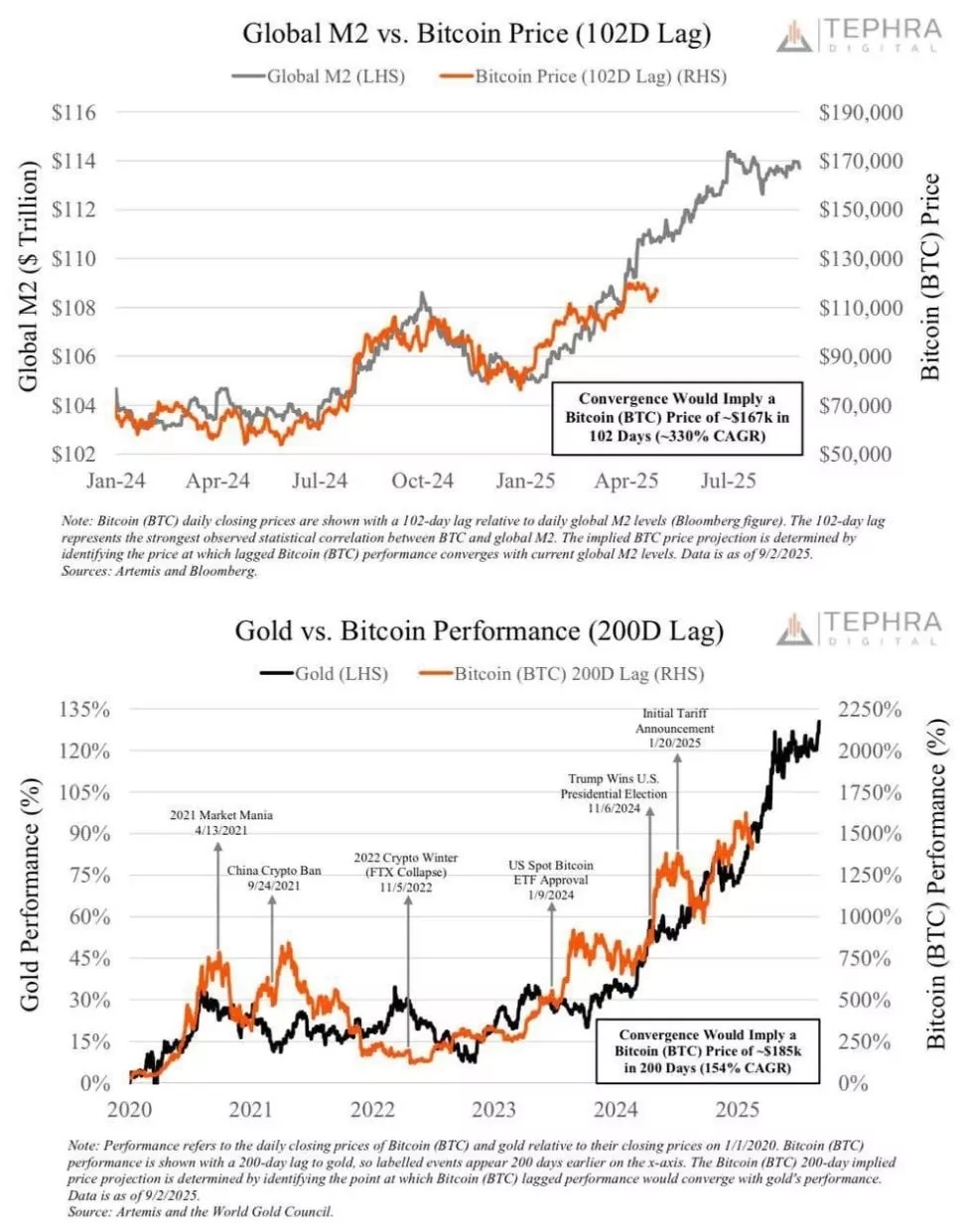
Correlation with gold and global liquidity suggests the cycle could last even longer
Recent data shows a strong correlation between Bitcoin, global money supply (M2), and gold. Looking at the evolution of M2 with a 102-day lag, the model suggests that Bitcoin’s current trajectory could take it to levels close to $167,000 by January 2026, extending the cycle beyond mid-October 2025. Similarly, comparing Bitcoin’s performance with that of gold, with a 200-day lag, indicates a potential target of around $185,000 in the next 200 days.
These statistical convergences reinforce the idea that the bull market could continue longer than expected, driven by expanding global liquidity and growing investor confidence. The peak of the cycle would therefore not necessarily be reached in October, but could shift to the end of 2025 or the beginning of 2026.