
Since its historic transformation in 2022, the Ethereum blockchain has been based on a Proof of Stake consensus model. The security of this system is ensured by certain procedures such as slashing, which has just hit 39 validators at once. What happened?
A slashing procedure on Ethereum targets 39 validators
In its early years, the Ethereum blockchain operated on a Proof of Work (PoW) consensus model identical to that of Bitcoin. This model was abandoned in 2022 during The Merge event, which was intended to trigger a transition to Proof of Stake (PoS).
Since then, miners have been replaced by validators who must stake 32 ETH in order to participate in securing the blockchain. This status requires compliance with certain specific rules in order to avoid the risk of being penalized by a slashing procedure.
In practice, this procedure is rarely triggered. And for good reason: it is used to punish behavior deemed problematic on the part of validators—such as excessive disconnections or double signatures, among other things—with the direct consequence of losing a portion of the funds deposited in staking.
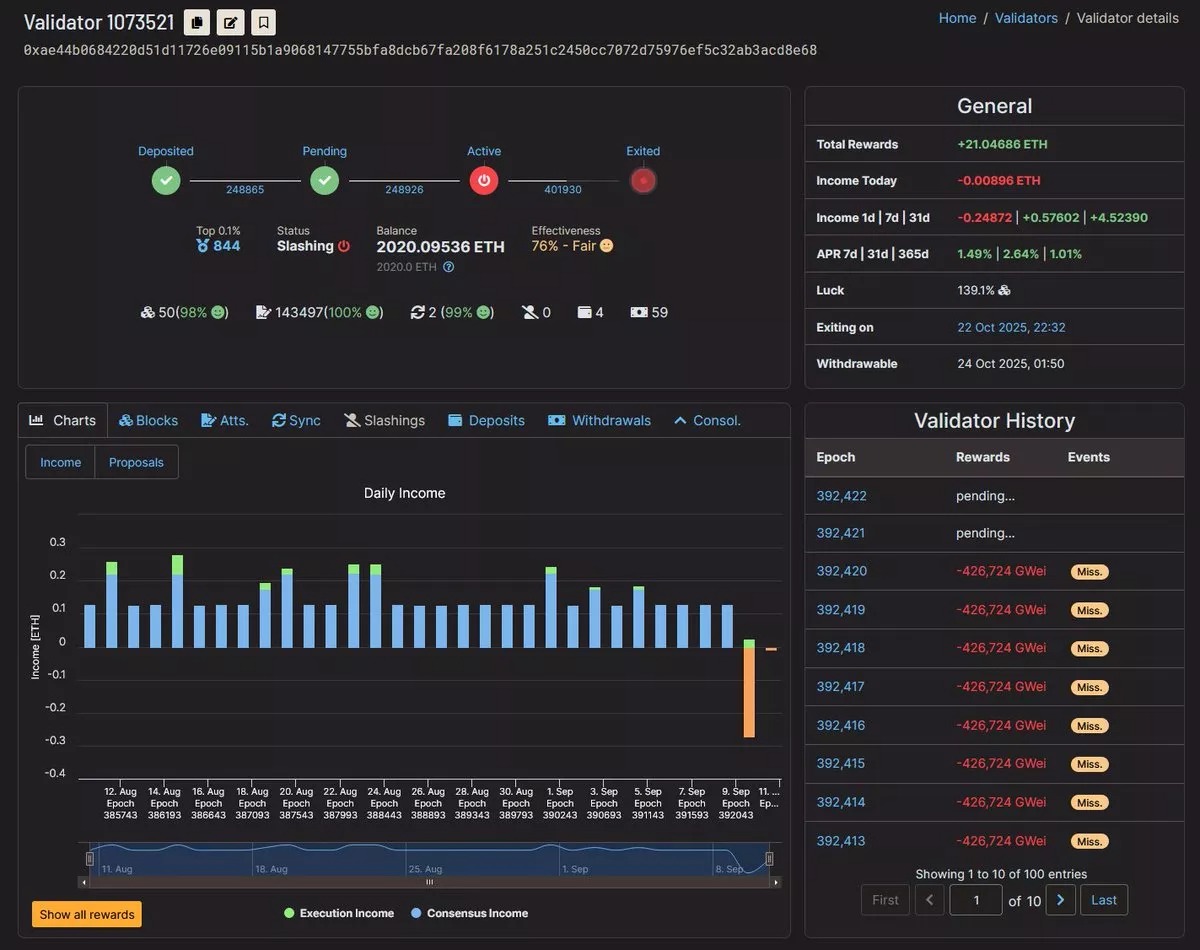
However, it is precisely this type of punishment that was applied to a group of 39 validators on September 10. A “mass slashing” identified by the X Beacon Chain account, the origin of which was linked to the detection of a double-signing violation (two conflicting attestations for the same epoch). What actually happened?
A double-signing violation issue
This extremely rare event involving such a large number of validators quickly caught the attention of the crypto community, who sought to understand its origin. An investigation quickly pointed in the direction of the SSV Network protocol, designed to enable distributed operation of Ethereum validators (DVT) to increase their resilience and decentralization.
In response to this revelation, SSV Network published a post-mortem detailing the sequence of events and their consequences for the validators concerned, while explaining how it remains “external to its protocol.” Indeed, “if the validation keys are executed outside of SSV, the guarantees no longer apply.”
Two causes are currently under investigation: on the one hand, maintenance carried out by the Liquid Staking Ankr protocol, which may have caused double signatures, and on the other hand, a configuration problem during a migration procedure initiated by the server provider Allnodes a few weeks ago, with the same result.
In terms of financial consequences, the losses incurred remain difficult to estimate. However, the first validator identified by the X Beacon Chain account was reportedly fined 0.3 ETH, for a total holding of just over 2,000 ETH, or approximately $1,350 at the current ETH price. Should we multiply that by 39?