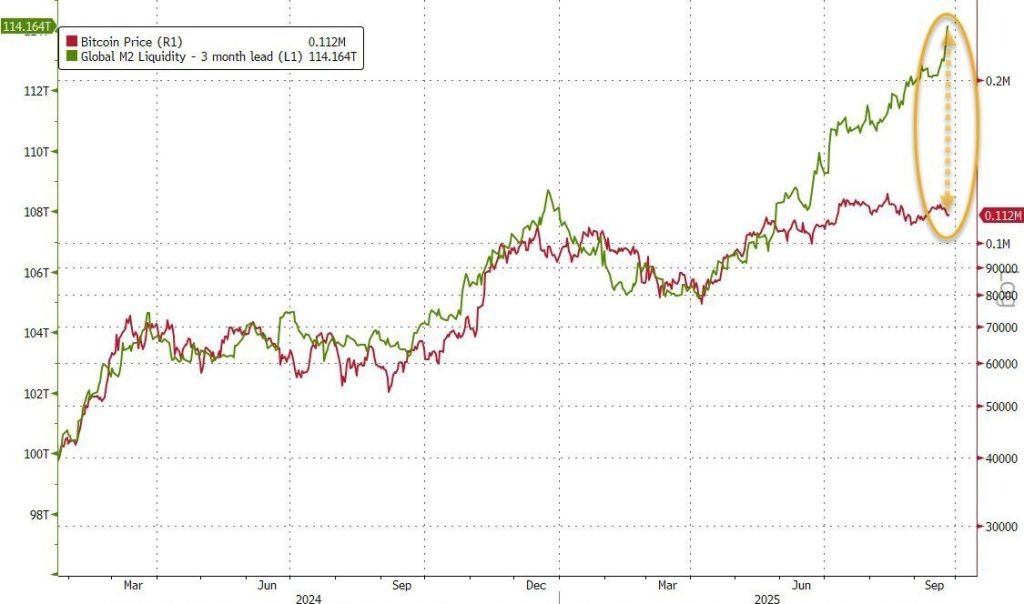
Starting in the second week of October, the US Treasury’s account with the Fed will be replenished and liquidity should gradually return to the economy and markets. This could provide support for the price of Bitcoin in the fourth quarter of 2025.
The TGA: a liquidity vacuum cleaner
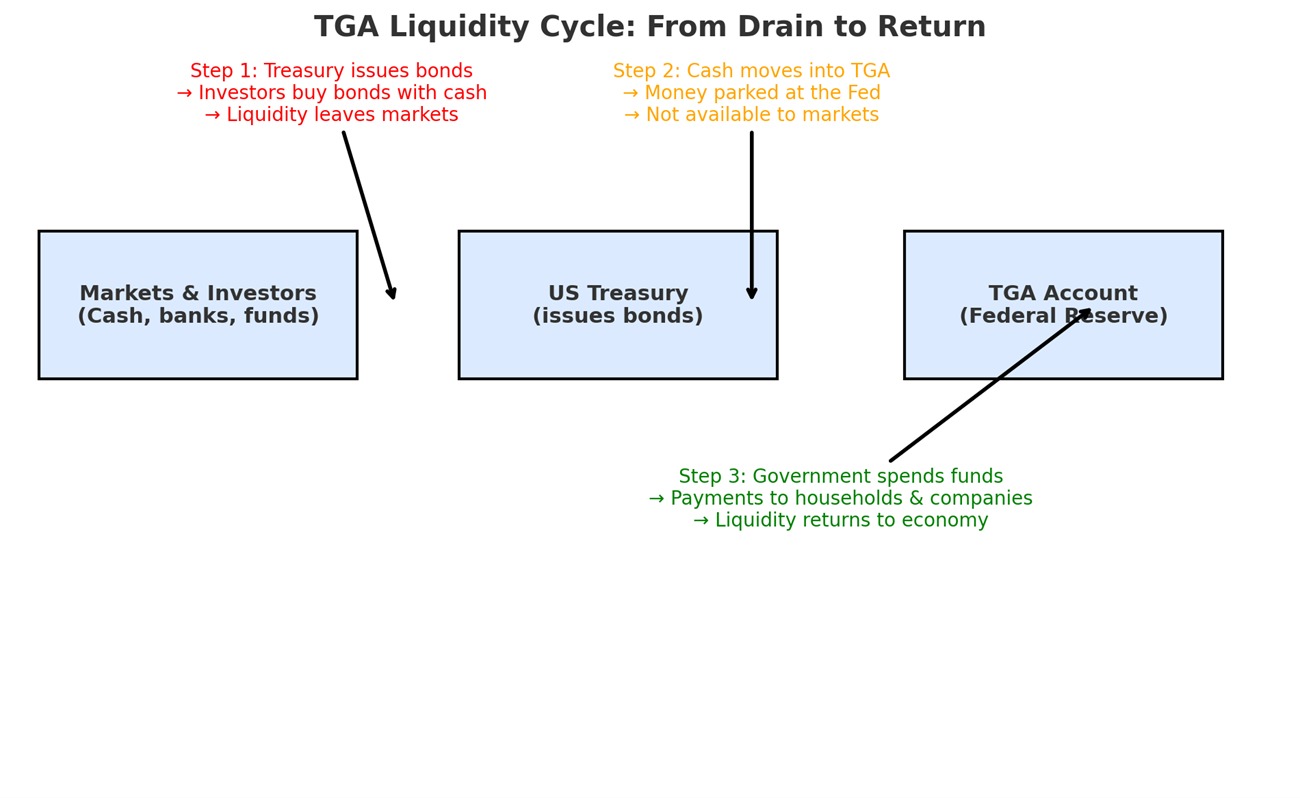
The US Treasury’s account with the Federal Reserve (Fed), known as the Treasury General Account (TGA), is one of the most important mechanisms for understanding global liquidity trends. When it fills up, it sucks money out of the financial markets; when it empties through public spending, it injects these funds back into the economy.
This liquidity cycle not only has consequences for the bond and stock markets, it can also significantly influence the behavior of Bitcoin, which is often considered an asset that is sensitive to the abundance or scarcity of liquidity in the global financial system.
In concrete terms, when the US Treasury needs to finance its deficit or replenish its reserves, it issues Treasury bills. Investors (banks, funds, individuals) buy these securities by mobilizing their cash, which is then transferred to the TGA held at the Fed. This money is no longer available to circulate in the markets or to finance other investments: this is referred to as a liquidity drain. This situation has been striking in recent months, as the Treasury has undertaken to massively replenish its TGA after the suspension of the debt ceiling. This process has put pressure on global liquidity, creating a more constrained environment for financial assets, including Bitcoin. In other words, as long as the TGA is being filled, the liquidity available to fuel risk-taking remains limited.
The return of liquidity and the potential impact on Bitcoin
Once the Treasury considers its account sufficiently replenished, the dynamics change: public spending resumes, whether through civil servant salaries, government contracts, or social programs.
Money flows out of the TGA and back into the real economy, providing a net injection of liquidity. Historically, these phases are often accompanied by improved financial conditions and a gradual return of risk appetite to the markets. For Bitcoin, an asset with high macroeconomic sensitivity, this movement can act as a catalyst: more liquidity potentially means more capital available for alternative investments.
Add to this the approach of key events such as the reduction in supply (post-halving) and growing institutional demand via ETFs, and the last quarter of the year could offer a favorable environment.
In summary, the end of the TGA refill, expected in early October, could mark a turning point: the return of liquidity to the global economy would support risky assets, and Bitcoin could take advantage of this to resume an upward trajectory and realign with the level of global M2 liquidity.