
The Ethereum blockchain appears to be a preferred medium for the development of Real World Assets (RWA) and highly centralized stablecoins. This poses a systemic risk to its security, to which decentralized stablecoins could provide an effective solution.
Ethereum: a success story that poses a security challenge?
Ongoing regulatory advances in the United States are profoundly changing the internal dynamics of the cryptocurrency sector, in a direction that is now more open to traditional finance. The main example remains undoubtedly the current boom in stablecoins well beyond the crypto sphere, since the approval of the GENIUS Act framework.
This is a very favorable reality for the Ethereum blockchain, identified as the main support for this sector of digital stability, largely backed by the dollar. At the same time, Real World Assets (RWA) are also establishing themselves as the future of stock exchanges, also embedded within its ecosystem.
These are two booming sectors, whose main projects appear to be highly centralized and generate markets estimated to be worth trillions of dollars. This is why f(x) Protocol officials are questioning Ethereum’s ability to “grow its security as fast as the value it protects.”
This is not just a technical concern—it is a systemic issue. Ethereum’s long-term credibility as a neutral settlement layer depends on resolving the gap between the economic security of its blockchain and the trillions of dollars of external value it must protect.
f(x) Protocol
Decentralized stablecoins are the solution
To back up their argument, the members of f(x) Protocol refer to the Proof of Stake economic security model of the Ethereum blockchain. This system is essentially based on economic deterrence, in order to punish inappropriate behavior and prevent attacks against it.
In this logic, “the cost of corruption must exceed the value at stake.” This is a problem when you consider that the amount of centralized USDT and USDC stablecoins in circulation on Ethereum exceeds $110 billion. Indeed, this value “already exceeds the cost of a censorship or corruption attack.”
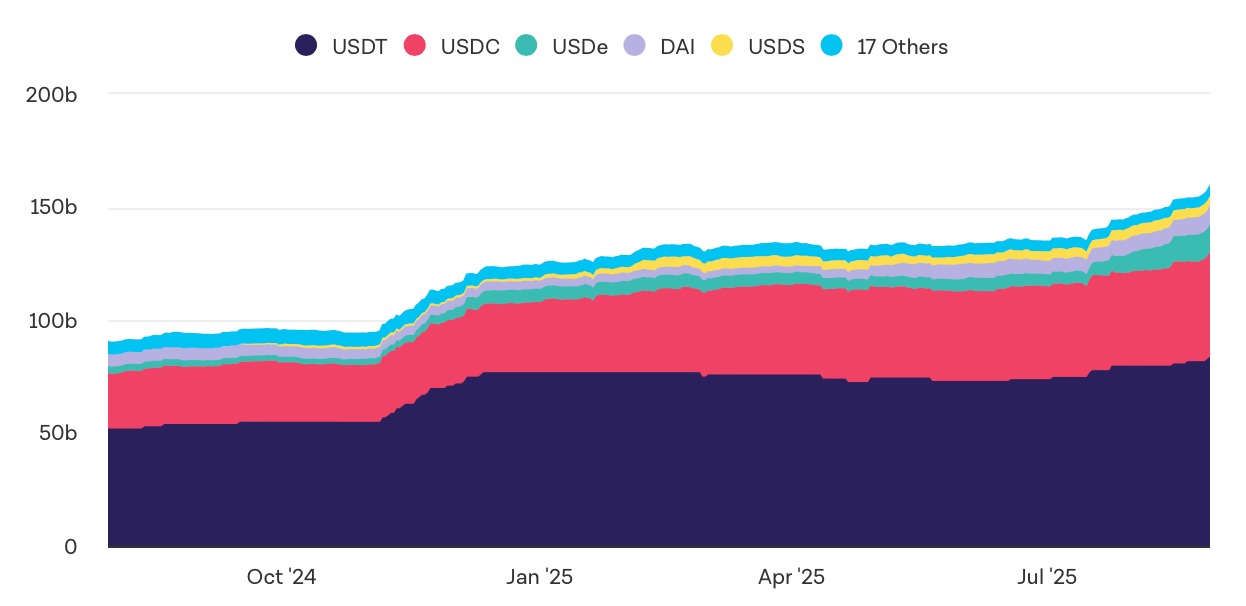
Of course, this calculation is essentially based on a theoretical view. Nevertheless, the members of f(x) Protocol consider this data sufficient to highlight a “structural vulnerability” of the Ethereum blockchain, accentuated by its growing adoption by traditional finance.
Ethereum cannot effectively secure trillions of tokenized RWAs and fiat-backed stablecoins with its current economic deterrence model.
f(x) Protocol
A “dangerous asymmetry” that the proposed solution addresses by developing decentralized stablecoins—such as f(x) Protocol’s fxUSD—that can strengthen Ethereum’s economic security while supporting its resistance to censorship. A principle according to which its strength “will be based on a decentralized currency—not on trust borrowed from traditional finance.”