
Aave, the star protocol of DeFi, is embroiled in an internal battle over the management of its governance, pitting its DAO against the leaders of Aave Labs. This conflict is symptomatic of decentralized finance and could well set a precedent for the sector.
Aave DAO vs Aave Labs: Governance Conflict Within DeFi
Within decentralized finance (DeFi), the Aave protocol has emerged as a key player with its lending and borrowing system, to the point of becoming one of the most profitable with a total value locked (TVL) estimated at $33.5 billion and “true recurring revenue at the protocol level” generated by its DAO.
A seemingly positive situation that could well be its biggest problem at the moment, as a conflict pits this decentralized entity—composed of AAVE token holders—against the (in this case, centralized) structure responsible for developing its interface and products, Aave Labs.
At the heart of the matter is the diversion of swap fees to Aave Labs, initiated following the selection of the DEX CoWSwap as the default aggregator on Aave.com. This results in an estimated annual shortfall of $10 million for the Aave DAO, described as a “stealth privatization” by Marc Zeller, founder of the Aave Chan Initiative.
To put it simply: the DAO is the engine, while the brand assets and distribution channels are the storefront and the sign. The problem isn’t just the existence of private companies. Private companies can and should build products. The problem begins when a private actor unilaterally controls the storefront and the sign, while it is the DAO ecosystem that keeps the engine running.
Marc Zeller
Who really owns the Aave protocol?
Because, as numerous reactions have shown, the problem is no longer limited to the CoWSwap affair, but rather to the question of who actually owns the Aave protocol.
This is all the more true when one considers, as Marc Zeller explains, that “the bulk of day-to-day operations has been handled by the DAO’s ecosystem of service providers,” not merely as “maintenance,” but rather in the form of “active, cumulative growth in market share and revenue generation.”
At the same time, the situation has escalated to the point where successive proposals have emerged regarding the seizure of Aave’s trademarks, domains, and social media accounts by its DAO.
Faced with this situation, Aave Labs attempted to respond on December 23 by hastily proposing a vote on a “brand seizure” proposal intended to transfer these assets (brand assets, domains, social media, naming rights, GitHub) to the Aave DAO—a proposal that its author—the former CTO of Aave Labs, known by the pseudonym Ernesto—did not even approve.
It was not my intention to submit the vote while the community was still engaged in a healthy discussion on the matter, with valuable points continuously emerging. This breaks all codes of trust with the community. Public governance must remain open to discussion, even if it is sometimes difficult. Attempting to rush a vote is shameful.
Ernesto
AAVE token drop: the true community response?
How should a community vote be implemented in a crisis context where new opinions on the subject are constantly emerging? Especially in a rushed manner, given that this power can be influenced through a significant delegation of tokens. Suffice it to say that the recent purchases of AAVE tokens made by the founder of the Aave protocol, Stani Kulechov, identified by the Lookonchain account, are likely to further fuel the debate on this subject.
Meanwhile, the focus of these discussions is now shifting toward the Aave protocol’s operating model, based on a dual-headed token/equity structure deemed “fundamentally inoperative” due to the joint—but not necessarily cooperative—involvement of the DAO and the company Aave Labs. A key issue within the DeFi ecosystem.
And as the Aave community heats up, the AAVE token has seen a significant drop of nearly 20% over the last few days, making it one of the worst performers in the current top 100 during this period, even as it tops the trending list.
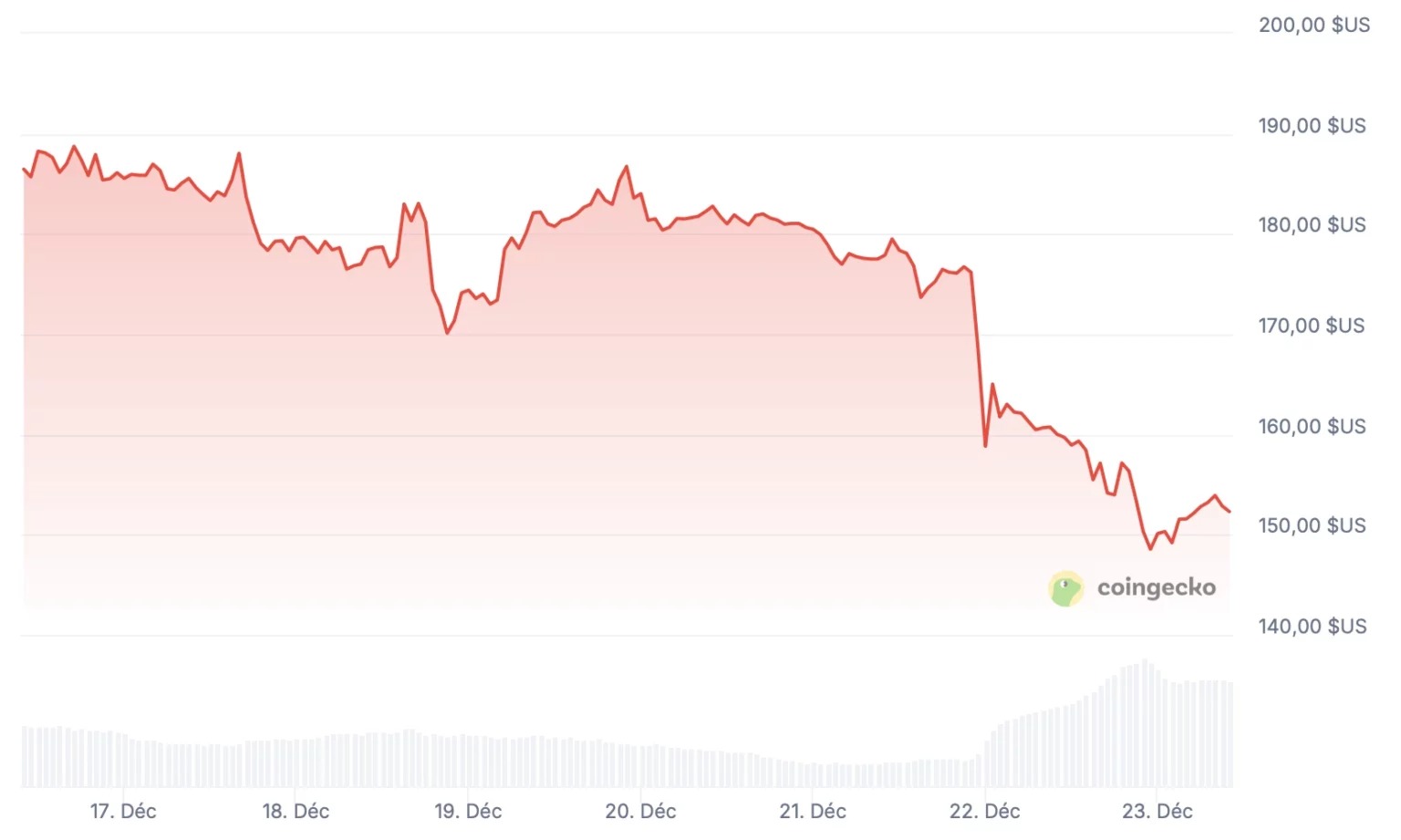
The AAVE token has seen a significant drop over the last 7 days
Isn’t this ultimately one of the only real data points to consider in an attempt to find a quick, community-driven resolution to this debate?