
Despite its legendary volatility, the cryptocurrency market has, until now, been based on the repetition of certain cycles, such as Bitcoin’s various halvings. This logic is now considered obsolete, according to these experts.
The 4-Year Crypto Cycle Is Dead
The cryptocurrency market often appears to be a digital jungle where volatility and a total lack of rules reign. However, its development follows much more precise dynamics than it seems at first glance, such as the repetition of cycles associated with its bull markets.
Until now, this logic has made it possible to predict—with varying degrees of accuracy—the prospect of a new all-time high for Bitcoin’s price following the triggering of one of its halvings, scheduled every four years. This, in turn, would set off a ripple effect, causing realized gains to flow into Ethereum and the altcoin market, in descending order of market capitalization.
This “transmission mechanism” is expected to have “weakened” considerably by 2025, according to analysts at market maker Wintermute, to the point of becoming “obsolete.” In fact, they believe that “market performance is no longer dictated by self-fulfilling timing narratives, but by the direction of liquidity flows and the concentration of investor attention.”
New financial vehicles, particularly ETFs and Digital Asset Treasuries (DATs), have evolved into “walled garden” models .” While they provide sustained demand for a few large-cap assets, this demand does not naturally spread to the broader market.
Wintermute
Cryptocurrencies: A More Established Asset Class
According to Wintermute analysts, retail investor interest over the past year has “largely shifted toward stocks and prediction markets,” with a few major altcoins—notably Bitcoin and Ethereum—having “absorbed the vast majority of new capital.”
In this particular context, the cycles associated with various popular crypto narratives have had much shorter lifespans, with an average of about 20 days in 2025, compared to 60 days the previous year and figures consistently above 40 days in 2022 and 2023.
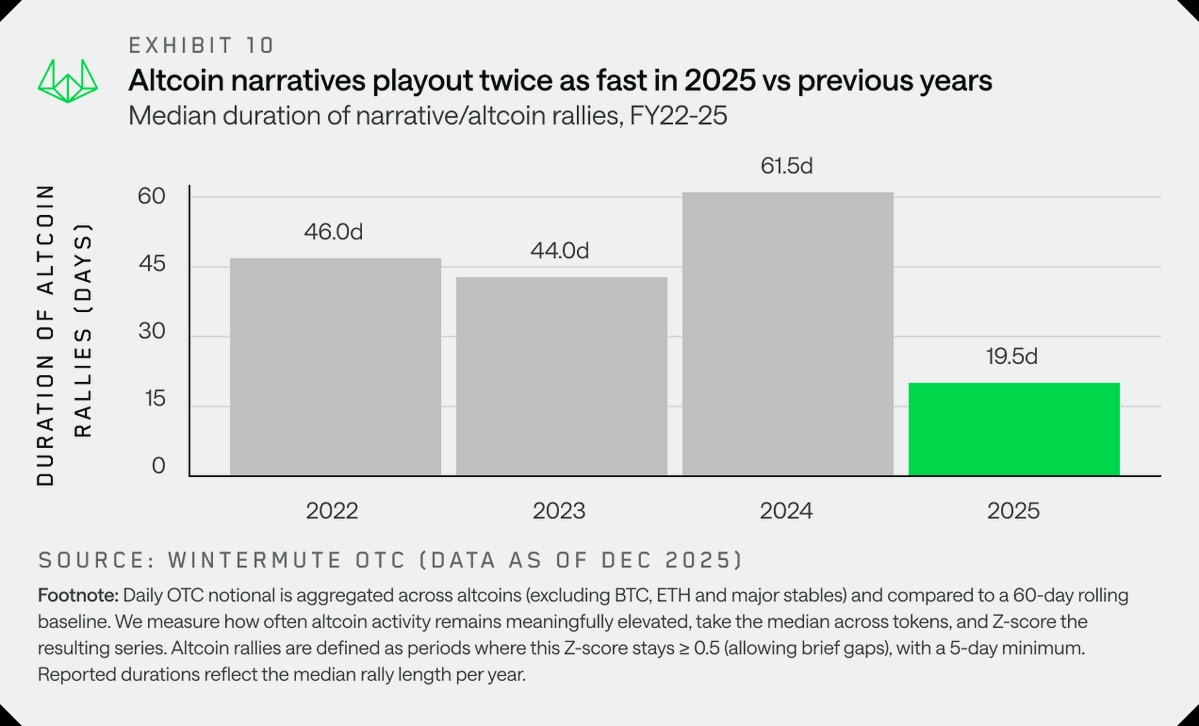
Crypto cycles underwent a notable shift in 2025
The year 2025 did not deliver the expected rally, but in hindsight, it may mark the beginning of a transition for cryptocurrencies from a purely speculative asset to a more established asset class.
Wintermute
Having taken stock of the situation, analysts at Wintermute are attempting to identify three trends that could support further market expansion, noting that at least one of these must materialize for this scenario to play out:
- The launch of ETFs or DATs outside institutional channels;
- A Bitcoin or Ethereum bull run strong enough to ripple through the altcoin market;
- A resurgence of retail investor interest in crypto.