
Bruges, Celtic, Espanyol, and Southampton are among the interested clubs: the figures are mind-boggling
The clubs that have shown interest Bitcoin miners capitulate: the hashrate is at its lowest in over 4 months
While the Bitcoin hashrate is at its lowest since September, some on-chain data suggests miners are capitulating. What’s the story?
Bitcoin Miners Feel the Impact of the Market Downturn
In the Bitcoin (BTC) mining industry, several factors must be taken into account to determine whether an operation is profitable.
Among other factors, these include a miner’s available computing power (their hashrate), the mining difficulty—whose value depends in part on the total hashrate deployed on the network—the cost of electricity, any potential ancillary revenue generated by reselling heat, for example, as well as the price of BTC and network activity, which generates varying levels of fees.
Due to all these variables, Bitcoin mining goes through cycles of profitability and others where cash flow is severely strained. On this last point, the least financially stable participants will choose to shut down their machines or turn to other activities due to a lack of profitability. When this reaches its peak, we refer to it as miner capitulation.
The market regulates itself such that the fewer miners there are, the easier it becomes to mine, thereby incentivizing participants to restart their machines—creating cycles that can be observed through on-chain analysis.
While the price of Bitcoin has fallen 28% from its all-time high (ATH) on October 6, mining difficulty has dropped 6% over the same period. This is because the price decline has eroded miners’ profitability, prompting some to leave the network. On a weekly basis, the computing power deployed on Bitcoin has thus fallen by 12.34% since its October ATH, dropping from 1,140,060,419 TH/s to 999,375,511 TH/s:
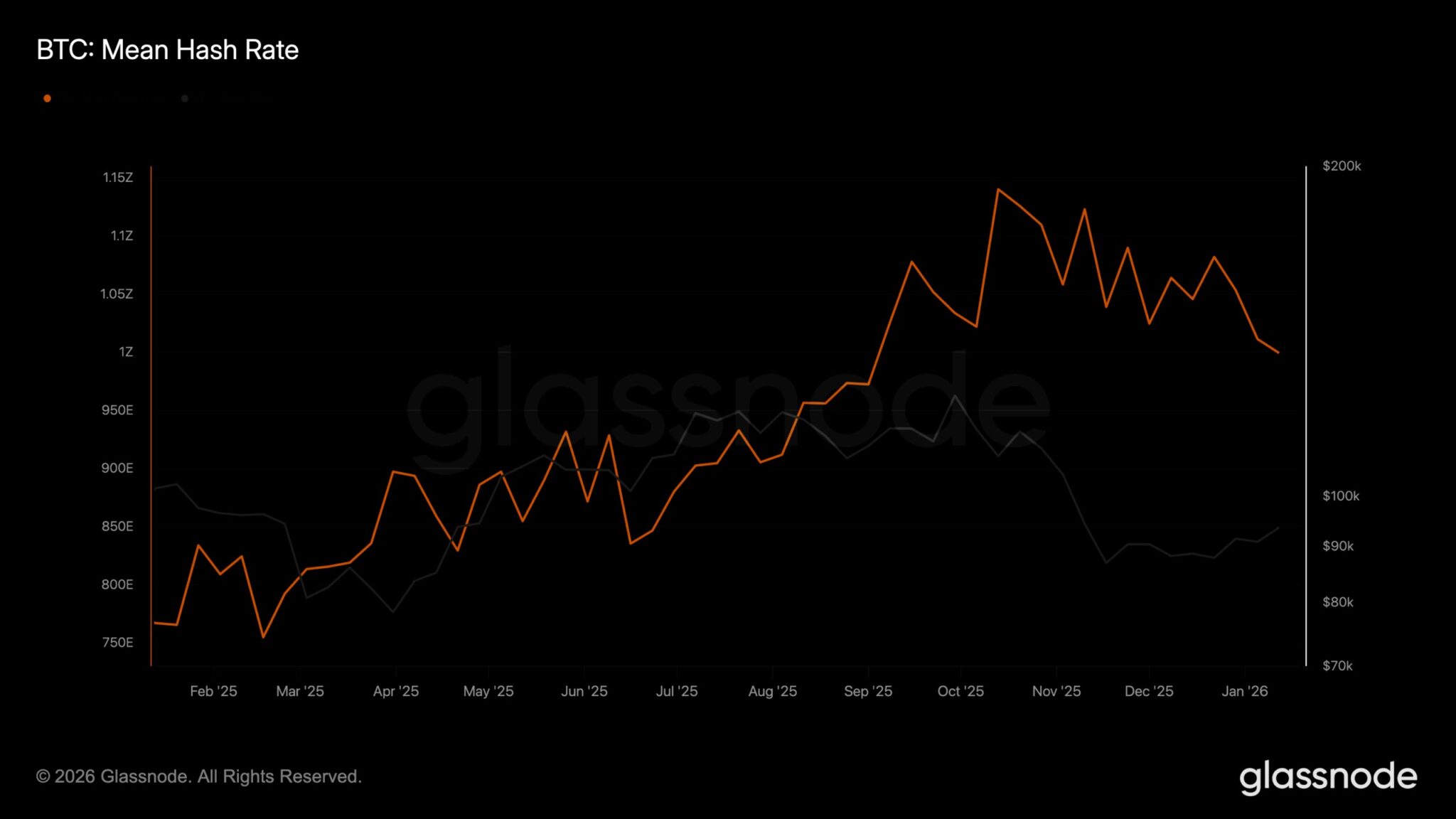
Bitcoin Hashrate (Weekly)
At the same time, the Hash Ribbon indicates a period of capitulation that began in late November. The Hash Ribbon is calculated using the 30-day moving average (MA30) and the 60-day moving average (MA60) of the hashrate. When the MA30 falls below the MA60, the chart turns dark red, suggesting capitulation. Conversely, the chart turns light red when the MA30 crosses back above the MA60, suggesting a return of miners. Despite a few interruptions, the current period of capitulation therefore appears to be the most significant since the summer of 2024:
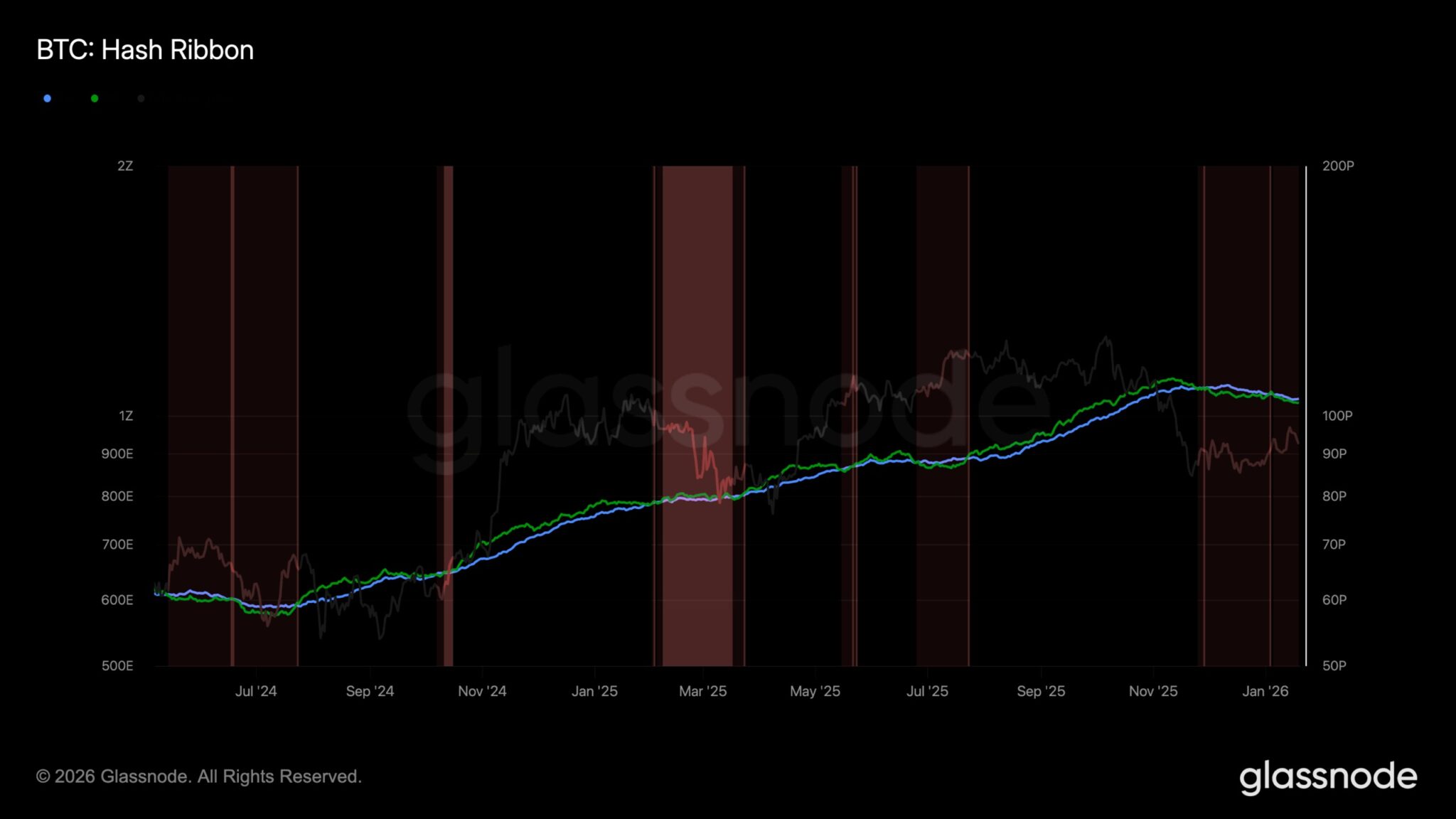
Bitcoin Hash Ribbon since May 2024
On the stock market, Bitcoin miners are also feeling the impact, as seen with MARA and CleanSpark, which have lost 44.85% and 23.29%, respectively, since October 6. Meanwhile, BTC is trading at $91,100 at the time of this writing, down 2% over the past 24 hours.
The offers are making his head spin: Bruges, Celtic, Espanyol, Southampton. And just imagine the millions being bandied about: we’re talking double-digit figures—unprecedented amounts for Serie B. Issa Doumbia is one of the league’s standout players. Italian and European clubs are knocking on Venezia’s door to inquire about that 22-year-old with a clean-cut face and a physique like Hercules, who both energizes and anchors Giovanni Stoppa’s midfield, with an ability to read the game and make an impact that grows with every match. The coach never leaves him out: 20 appearances in this season’s league, 19 of them as a starter in what has now become his established position as a central midfielder. Doumbia is one of the idols of the Unione fans, having been a standout so far with two goals and consistently decisive performances—including during the five-game winning streak (and 25 points earned in the last nine matches)—that have propelled the orange-and-green team into sole possession of second place, ahead of their away match on Saturday, January 24, in Mantua. His runs are impressive; stealing the ball from his feet is no easy feat. Issa is the heart of a midfield that features Kike Perez as a perpetual engine, Gianluca Busio as an all-around player, and Alfred Duncan as a top-tier substitute. Few teams possess such quality in the middle.
So far, the club has consistently turned down every suitor who’s come knocking for him. He’s a talent who needs to be nurtured and protected; he can and must continue to grow. For now, he’s staying in Venice, at least until the end of the season—then we’ll see. Filippo Antonelli is reaping the rewards of the intuition he had two years ago, when he scouted him out in Serie C at AlbinoLeffe. He negotiated with president Gianfranco Andreoletti and sporting director Antonio Obbedio, beat out competition from Atalanta’s Under-23 team, Juventus Next Gen, Monza, and Triestina, secured the player’s rights in January 2024, and signed him in the summer for one million plus bonuses. He had him sign a long-term contract running through June 2029. Last season, in Serie A, Eusebio Di Francesco began shaping him for the top level: a few early appearances off the bench, followed by his first start against Verona, where a missed scoring opportunity could have discouraged him, but he worked through it to carve out an increasingly important role in the second half of the season, with eight starts and a standout performance as a right central midfielder on the final matchday against Juventus. During that same period, he also had his first experiences with Italy’s Under-21 team, making two appearances in March friendlies against the Netherlands (at the Penzo) and Denmark, and—most notably—earning a call-up to the European Championship, where he started in the 1-1 draw against Spain. By the end of the summer, Doumbia’s market value had already surpassed two million euros. Today, it’s already over six million, but the feeling is that the rise won’t stop here.
ROOTS— Born in Treviglio to a family of Ivorian descent, Doumbia grew up in Zingonia. He inherited his passion for soccer from his father, a truck driver. He is very close to his older brother, Mamadou, who works in public relations and is friends with Rafa Leao. Issa has played for AlbinoLeffe since he was a youth player. He grew up with his friend Mohamed Alì Zoma, who is now learning the ropes as a forward with Miroslav Klose’s Nuremberg in Bundesliga 2. The Bergamo-based club has supported Issa’s development, found him an apartment in Zanica, and helped him believe in himself and in the prospect of a professional career. Interest from a Serie B club has made him more responsible, and today in Venice he is becoming a key player. The calls are coming in strong, from Italy and across Europe. Venezia hopes to hold on to him a little longer—perhaps even in Serie A.