
In one year, Bitcoin has lost 50% of its value against gold, bringing the BTC/gold ratio back to its level at the end of 2023. This sharp decline reflects not a collapse of Bitcoin, but a surge in gold in 2025, supported by central banks and ETFs.
Gold outperforms Bitcoin in 2025 and erases two years of digital dominance
After reaching an all-time high against gold in December 2024, Bitcoin’s price has seen its advantage erode.
In the space of a year, the BTC/gold ratio has fallen from 40.77 on December 17, 2024, to 19.87 ounces of gold per Bitcoin today, erasing its gains and returning to December 2023 levels, a 50% drop.
This decline does not reflect a collapse in the price of BTC in dollars, which remains higher than its 2021 peak, but rather the outperformance of gold in 2025.
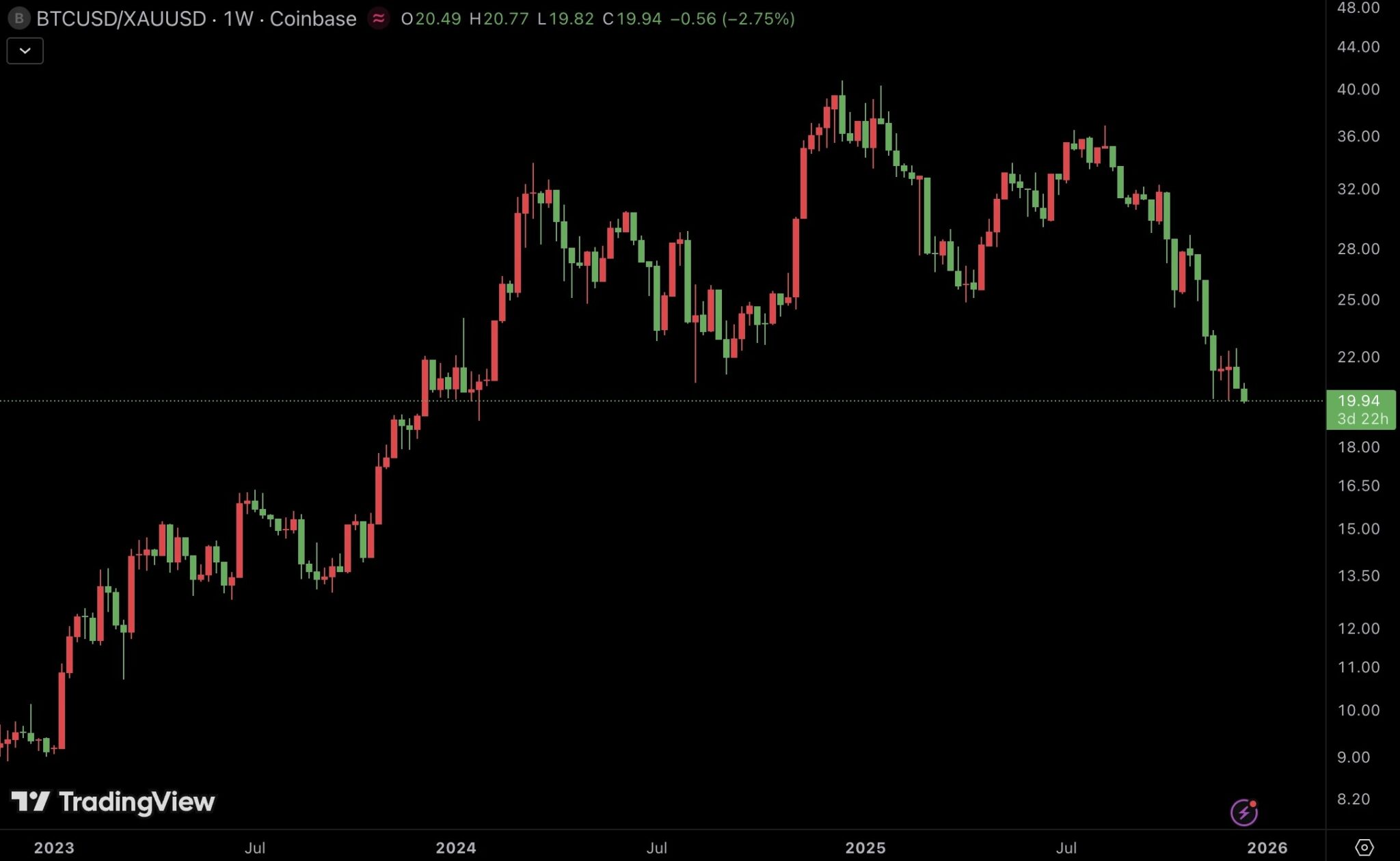
While Bitcoin has consolidated, gold has soared by more than 65% this year, exceeding $4,300 per ounce, driven by buying demand from central banks and gold ETFs, in a global climate marked by uncertainty and geopolitical tensions surrounding Donald Trump’s return to the White House.
As for Bitcoin, the peak reached in September 2025 was in fact a “bull trap,” where sellers take advantage of the FOMO effect to take profits. This phenomenon is visible in the volumes of spot Bitcoin ETFs, whose total assets under management have fallen from $164 billion to $115 billion since BTC peaked at $126,000.
This reversal in the BTC/gold ratio shows that gold fully played its role as a safe-haven asset in 2025, while Bitcoin is still struggling to join it in the category of assets that offer protection against the volatility of risky markets.
Central banks and ETFs: drivers of the gold rush in 2025
In 2025, central banks were the main buyers of gold worldwide. In the first 10 months of the year, their net purchases exceeded 254 tons, confirming their long-term strategy of reallocating reserves in favor of the yellow metal, still perceived as the ultimate safe-haven asset.
The National Bank of Poland stood out at the top of the rankings, adding 83 tons to its official reserves. These moves illustrate a clear strategic intent: to strengthen the resilience of its monetary system in the face of growing geopolitical instability, particularly in a context that could weaken the euro and other European currencies.
At the same time, gold-backed exchange-traded funds (ETFs) saw significant inflows. In 2025, these funds attracted $77 billion in net inflows, bringing their total reserves to a record high of 3,932 tons of gold.
By way of comparison, spot Bitcoin ETFs also saw significant activity. Despite a period of consolidation in the price of BTC in the second half of the year, more than $23 billion in net inflows were injected into these funds, bringing the value of Bitcoins under management from $35.2 billion to $52 billion, an increase of 47% over the year.