
Long-term Bitcoin holders are currently putting persistent selling pressure on the price of BTC. Could this be seen as a sign of a “Tradfi version of an initial public offering (IPO)”? The question has been officially raised…
Long-term BTC holders continue to sell
Each Bitcoin cycle is part of a reality linked to new developments in the cryptocurrency sector, to the point where we might question the relevance of continuing the four-year cycle associated with halvings, given that traditional finance has now emerged as one of the main drivers of its growth over the past year.
This momentum led to a new all-time high of $126,000 last October. Since then, the price of BTC has been falling, recently settling at around $85,000 following a drop of more than 30%. The reason: “long-term holders [who] have not stopped selling.”
This reality was highlighted in a recent report published by the analysis firm K33 Research, with a quantity of BTC that has been immobile for at least two years currently facing the most significant and rapid selling momentum recorded in recent years, with a total of 1.6 million BTC estimated at $140 billion.
This figure will skyrocket to $300 billion in 2025 alone if we consider BTC that has been immobile for more than a year. This significant selling pressure does not coincide with the bearish market phase, according to analysts at CryptoQuant.
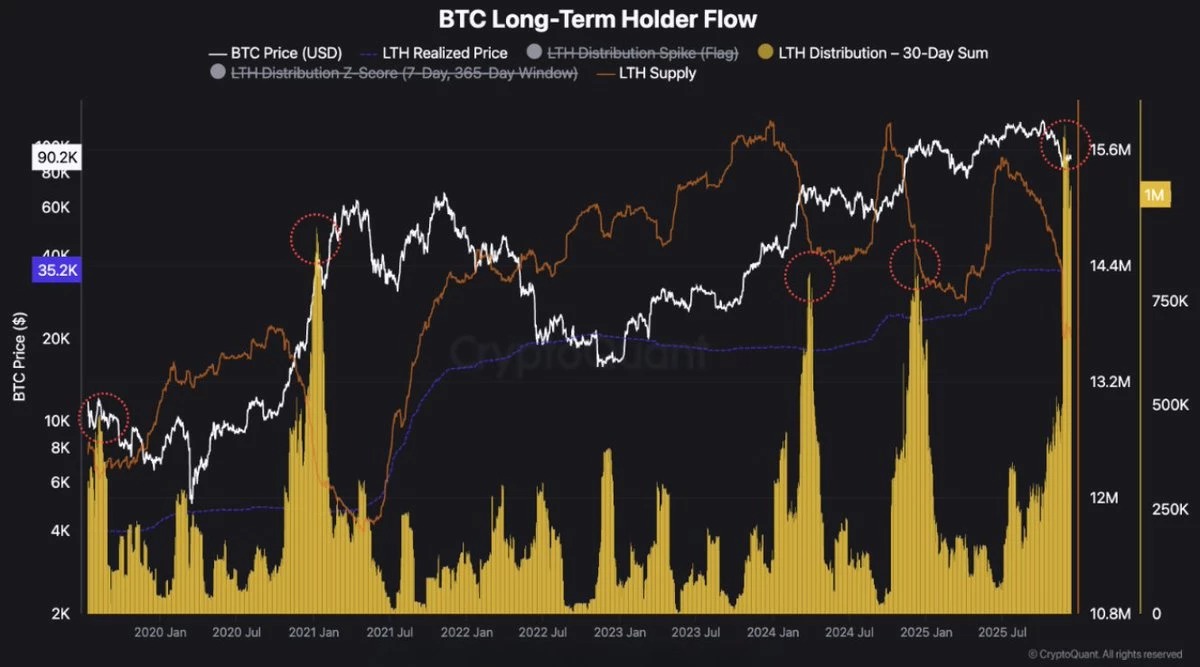
This 30-day peak in long-term holder (LTH) distribution is one of the largest in the last five years, and it typically appears near macroeconomic peaks, not troughs.
CryptoQuant
A quiet Bitcoin IPO?
Why isn’t BTC following the bullish trend, while the S&P 500 and gold are hitting historic highs? This question was posed by former Wealth Management research director Jordi Visser in response to what he sees as a misreading of the current data.
Indeed, as the regulatory framework becomes clearer around the world and Bitcoin adoption becomes more widespread in the highest echelons, its long-term holders seem to be deciding to take well-deserved profits. This situation is comparable to a “Tradfi version of an initial public offering (IPO)” of Bitcoin.
Bitcoin never had a traditional IPO because it never had a company. But economic forces don’t just disappear because the structure is different. They just manifest themselves differently.
Jordi Visser
According to Jordi Visser, the current situation with BTC corresponds exactly to “what happens during periods of IPO distribution,” when early investors methodically liquidate their positions in a market where investors “wait for the distribution to end before becoming aggressive.”