Ongoing regulatory developments in the United States have quickly positioned Circle (USDC) as the regulatory champion of the stablecoin sector. This coveted status currently exposes it to intense competition from its main rivals.
Circle faces “intense” competition
Despite its position as the perennial runner-up in the stablecoin sector, Circle continues to assert itself with a development strategy that differs from its competitors. This approach was recently reaffirmed when it went public in June of this year, proving very popular with investors.
At the same time, its flagship stablecoin USDC has quickly found a prominent place in a US market undergoing regulatory change since the approval of the GENIUS Act framework. This is a golden opportunity to establish itself against its eternal rival Tether, whose USDT is clearly struggling to win over the regulatory authorities.
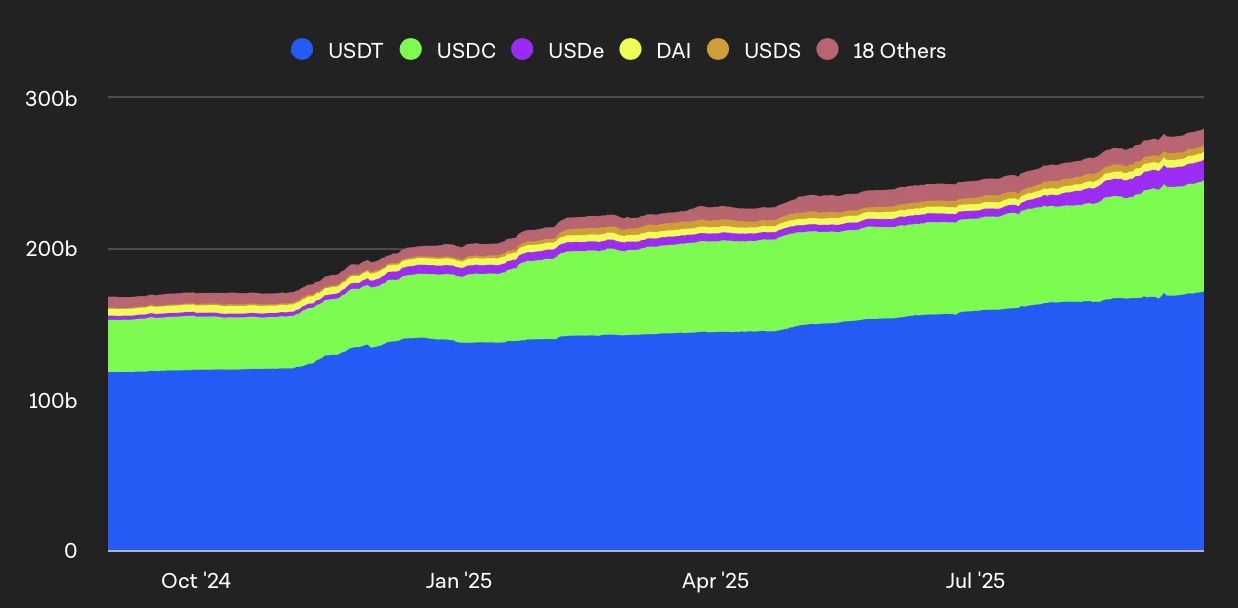
This might have seemed like a foregone conclusion, had it not been for the promises of growth in the stablecoin market, which have shaken up the sector. Competition is fierce, to the point that it recently triggered a fierce battle when the decentralized platform Hyperliquid announced that it was looking for an issuer for its future USDH stablecoin.
This prompted analysts at investment bank JPMorgan to take a closer look at what they identify as “intense” competition, capable of disrupting Circle’s dominant position.
Overall, as we move closer to the implementation of new U.S. legislation on stablecoins, new players are emerging in the U.S. market, preparing to capture market share, gain a liquidity advantage, and challenge Circle’s dominance.
JPMorgan
USDC threatened by USAT and USDH?
According to JPMorgan analysts, Circle’s current situation appears to be quite uncomfortable. This is due to fierce competition from its main rival, Tether, which is seeking to enter the US market with a regulatory-compliant stablecoin called USAT.
At the same time, the announced launch of the native stablecoin of the decentralized platform Hyperliquid USDH could also pose a significant problem. Its trading operations currently account for an estimated 7.5% of the total use of its USDC stablecoin.
JPMorgan analysts are quick to add certain fintechs such as Robinhood and Revolut to the equation, as they are actively exploring the possibility of launching their own stablecoins.
Could Circle launching its own Arc blockchain dedicated to USDC—based on Tether’s Stable version—help reduce this anticipated competitive shock? Nothing is less certain, given what some analysts describe as unnecessary complexity in an environment that is already difficult enough to understand.
However, JPMorgan analysts offer a nuanced view of this battle for market share in the stablecoin sector. Indeed, it could quickly boil down to a simple “zero-sum game,” where one participant’s gain is exactly equal to another’s loss, if the cryptocurrency market does not grow significantly at the same time.