
The development of central bank digital currencies (CBDCs) is currently facing competition from the rise of stablecoins and tokenization. This situation is pushing these monetary institutions to accelerate the trend.
91% of central banks are currently exploring CBDCs
Central banks are public institutions responsible for implementing and managing monetary policy, independently of the governments concerned. This activity also involves the study and development of digital currencies, known as CBDCs.
This sector is already largely dominated by the Chinese version (e-CNY), which has been operational for several years. However, this does not prevent other central banks from actively studying the implementation of monetary solutions of this type in other jurisdictions, with two distinct objectives: retail (general public) and wholesale (financial institutions) operations.
In order to take stock of the situation, the Bank for International Settlements (BIS) has just published a comprehensive report. The main finding of the report is that 91% of central banks (85 out of 91 surveyed) are exploring the implementation of a CBI (retail, wholesale, or both), without specifying their degree of progress.
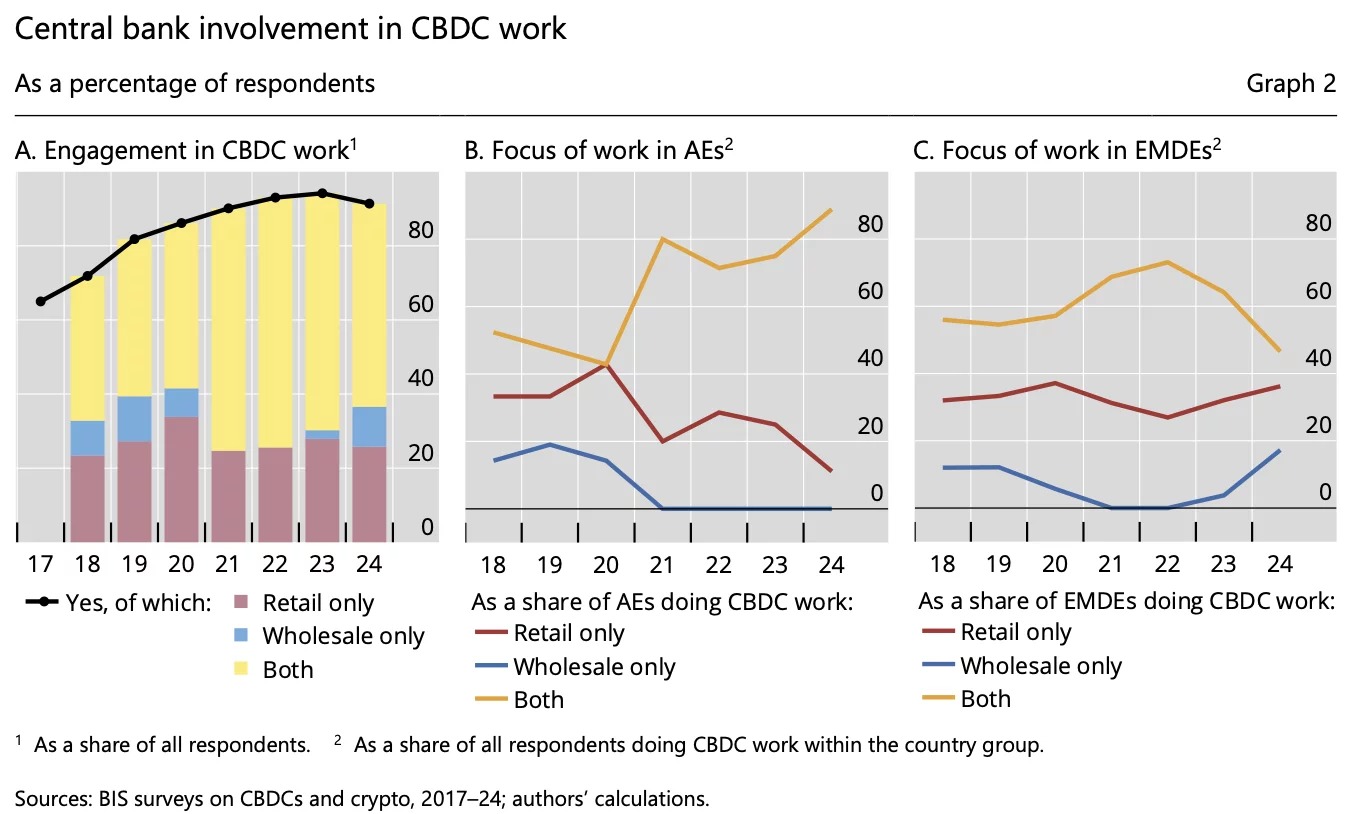
However, another key finding in the report concerns the rapid emergence of alternative solutions such as stablecoins and the tokenization of real-world assets (RWA). These tools are capable of “raising questions about the roles of central banks as issuers of currency, but also as operators, catalysts, and supervisors of payment systems.”
The survey included questions on the use of stablecoins in payments outside the crypto-asset ecosystem, as well as regulatory approaches to crypto-assets. New questions were also added to gather information on developments in the tokenization of commercial bank deposits and other assets.
BIS
A highly competitive development
Although the use of stablecoins is described as “relatively limited” by BIS experts, their current development seems sufficient to trigger a significant acceleration of progress in this area. One need only look at how the European Union is currently considering deploying its digital euro on public blockchains such as Ethereum or Solana.
Indeed, “more than a third of central banks working on an CBDC (43% for wholesale CBDCs and 35% for retail CBDCs) have stepped up their efforts in light of developments related to stablecoins and crypto-assets.” The main risk identified is that the current operating model of the financial and monetary system could be called into question.
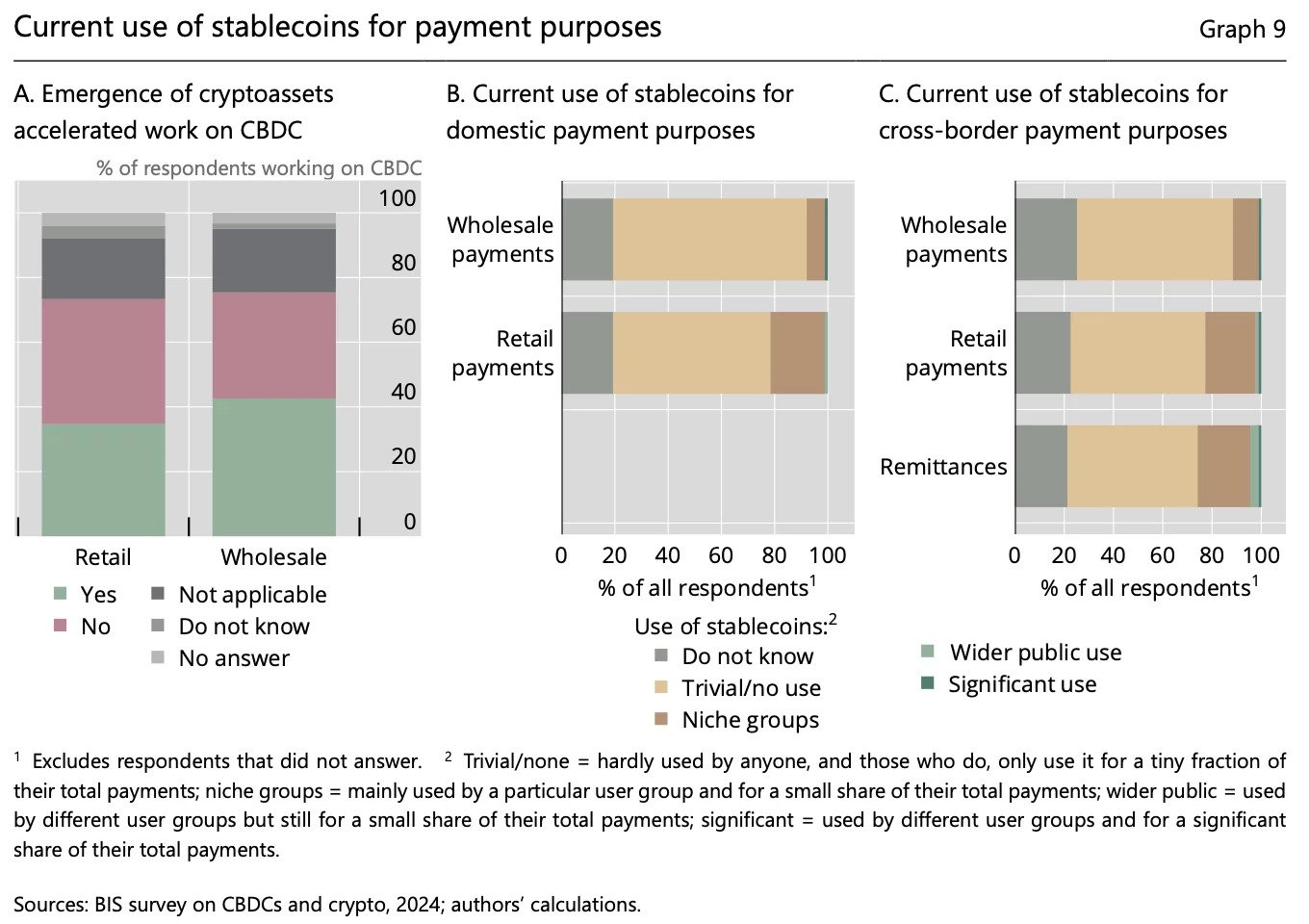
Added to this concern is the principle of tokenization, which has the potential to destabilize the current role of central banks due to its widespread use in the Treasury bond market. This is another “important motivation for many central banks” to accelerate the launch of their CBDCs. In conclusion, the Bank for International Settlements explains that the current acceleration of work on CBDCs coincides with an increase in the number of jurisdictions that have adopted—or are planning to adopt—regulatory frameworks adapted to stablecoins and other cryptocurrencies. In other words, the recent enactment of the GENIUS Act in the United States is rewriting the blueprint for the global monetary sector in real time.