
On Thursday evening, Strategy unveiled new rules governing whether it will issue new shares to purchase Bitcoin (BTC). What should we make of this?
Strategy reduces share issuance for Bitcoin (BTC) investments
When it released its financial results on Thursday, Strategy also unveiled its new policy on issuing common shares to buy Bitcoin (BTC).
With its new approach, Strategy will use the value of its mNAV, an indicator we explained last June in an article on Bitcoin treasuries. In short, mNAV allows you to compare a company’s share price with the value of its BTC holdings relative to the total number of shares outstanding. In this context, Strategy now intends to act as follows in different scenarios:
- mNAV is less than 2.5x: no share issuance, except to pay debt interest or preferred stock dividends;
- mNAV is between 2.5x and 4x: one-time share issuances to purchase Bitcoin;
- mNAV is greater than 4x: active share issues to finance bitcoin purchases.
To date, Strategy’s mNAV is 1.78x, which suggests a pause in the issuance of common shares.
What is striking at first glance is that the company is willing to print new shares to pay interest on its debt or dividends.
According to the table below, Strategy has $12.5 billion in debt, and its outstanding bonds cost it an average of 0.421% per year:

Based on these figures, the interest on this debt would amount to $52.63 million each year. We will return to Strategy’s financial results in more detail in a dedicated article, but it is worth noting that in terms of revenue, the company’s historic software business has generated $462.4 million over the last four quarters, which seems very low given the size of its debt.
Furthermore, we have already pointed out on several occasions a certain lack of consistency between Michael Saylor’s critical comments about fiat money printing and the regularity with which Strategy issues new shares.
And with good reason: since December 31, 2020, the number of Strategy Class A common shares has increased from 76.23 million to 263.91 million, a multiple of 3.46 in less than five years:
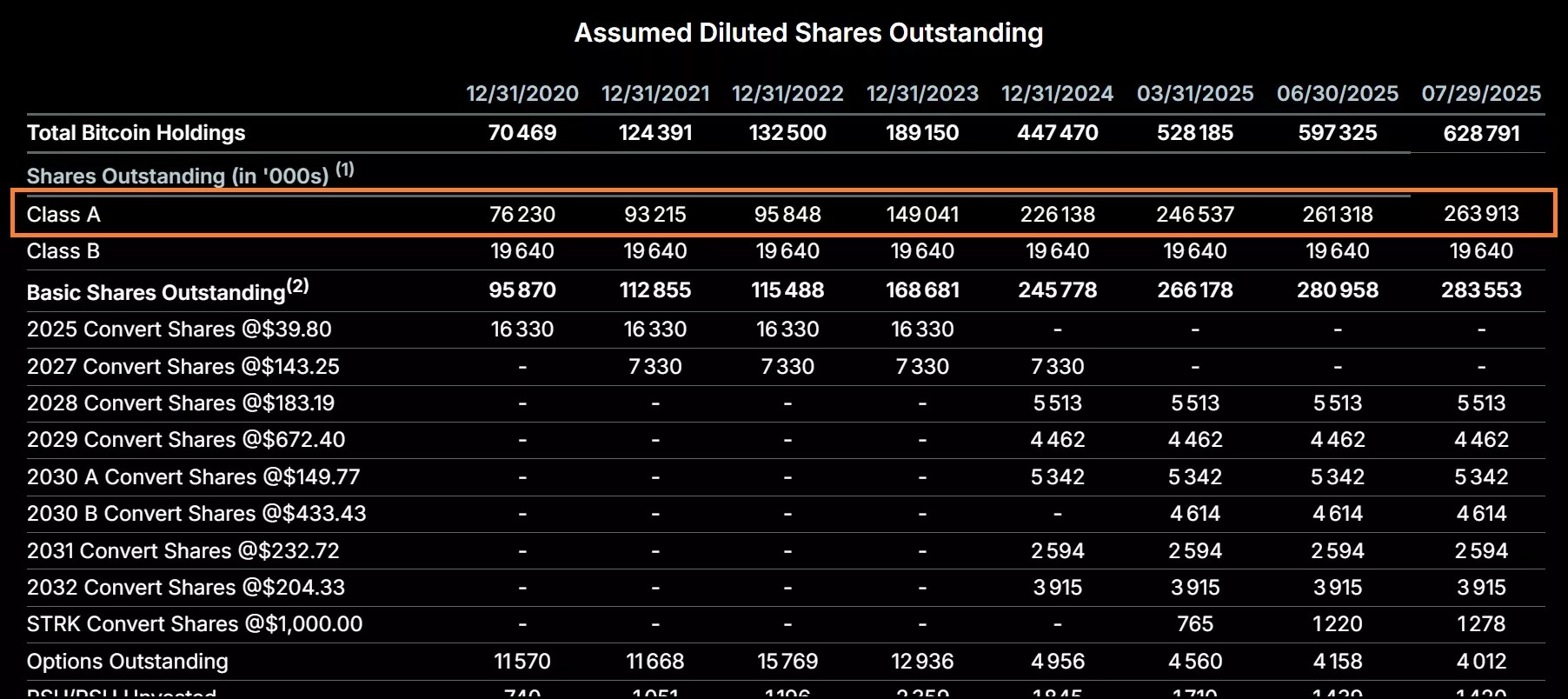
Conversely, without such share issues, Strategy would be financially unable to purchase as many bitcoins, unless it issued even more debt.
Under current conditions, the slowdown in BTC purchases may also be one of the factors behind the decline in crypto prices over the past 24 hours, although this hypothesis certainly weighs less heavily on investors’ concerns than Donald Trump’s latest antics.