While one might think that the trend would reverse with the decline in cryptocurrencies, the share of ETH and BTC on centralized exchanges continues to fall. How can this be explained?
The amount of ETH and BTC is in free fall on CEXs
Last week, Glassnode analysts published a market report highlighting the declining proportion of ETH and BTC on centralized exchanges (CEXs).
In almost constant decline since 2020 for ETH and since 2022 for BTC, this statistic now stands at 10.83% for ETH and 14.49% for BTC:
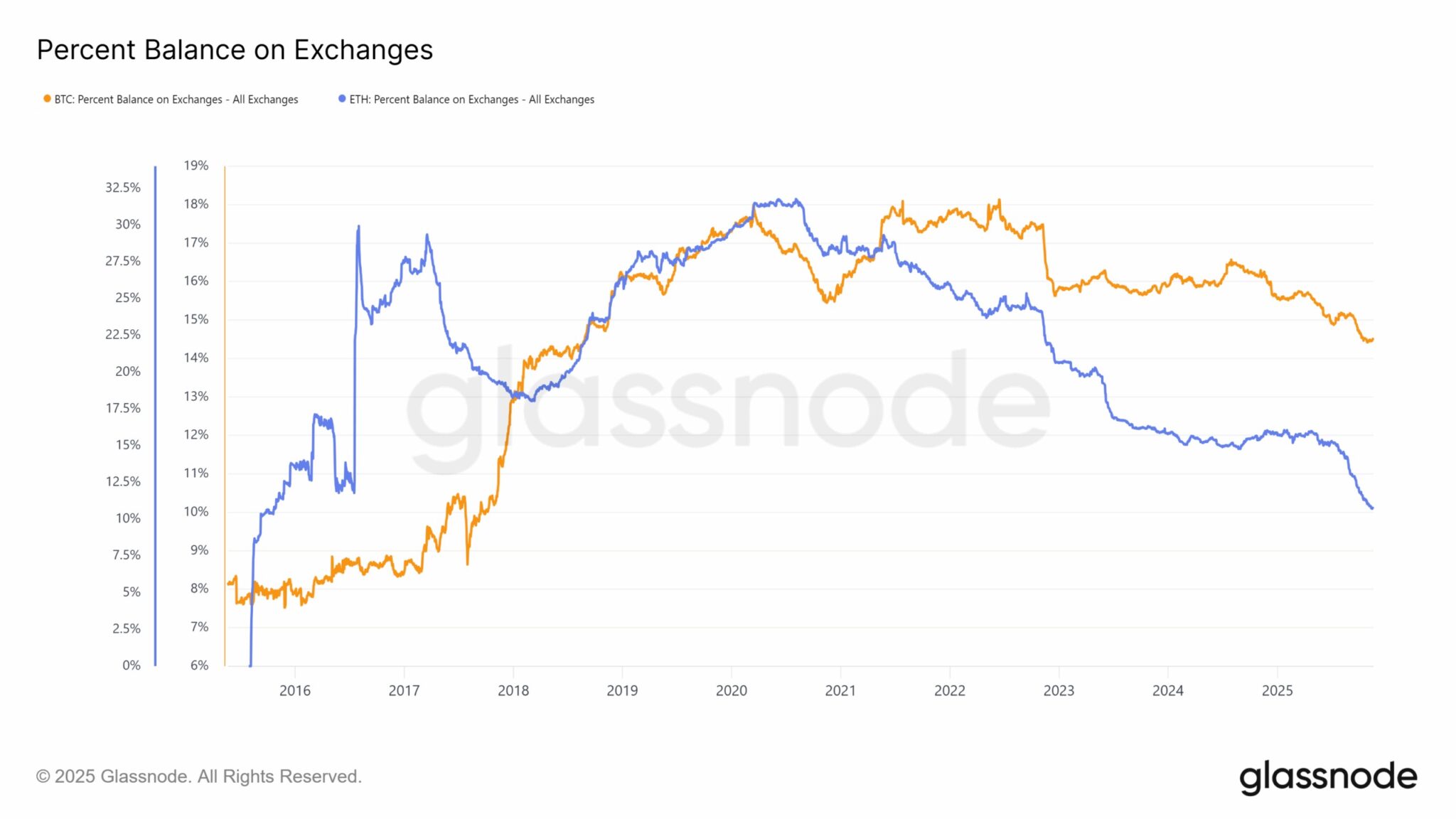
In recent years, it was commonly believed that the greater the amount of cryptocurrencies on centralized platforms, the more likely investors were to sell. In this context, it may be tempting to jump to the opposite conclusion, namely that the fewer assets there are on CEXs, the less likely investors are to sell.
However, such correlations must be sought with caution. Admittedly, the chart above shows that this reasoning held true to some extent for BTC between 2021 and 2022, but we also note that it was not valid for ETH. In fact, the beginning of the decline corresponds to the start of staking on the Beacon Chain.
It should therefore be emphasized that these figures only relate to assets held on CEXs:
The supply on exchanges simply corresponds to the share of cryptocurrencies in circulation held in wallets linked to centralized exchange platforms. Please note: this figure does not take into account decentralized exchange platforms.
Therefore, it does not reflect the multitude of other tools available to investors, starting with ETFs. Although entities such as Coinbase have generally been entrusted with the custody of the assets of these investment vehicles, institutional funds are not represented in the percentages of BTC or ETH held on CEXs.
However, it is mainly institutional investors who have driven this bull run, and in this case, their intention to sell cannot be identified using this indicator.
Furthermore, even for retail investors, it is becoming increasingly easy to sell cryptocurrencies outside of centralized platforms. In this context, we could see the percentages of ETH and BTC held on CEXs continue to decline over the years, until they reach a certain floor, regardless of market conditions.