
While Strategy had announced rules to govern its issuance of shares to finance its investments in Bitcoin (BTC), the company has made further changes. Here’s what this means.
Strategy revises its share issuance policy again
On August 1, we reported on Strategy’s new policy regarding the terms under which the company would create new shares to finance its Bitcoin (BTC) investments. The key takeaway was that when this indicator was below 2.5x, Strategy would not issue any new shares, except to pay interest on its debt or dividends on preferred shares.
This subtlety was already cause for concern, but Michael Saylor, the founder of Strategy, published an update to the recent rules, more or less breaking his promises with relative subtlety:
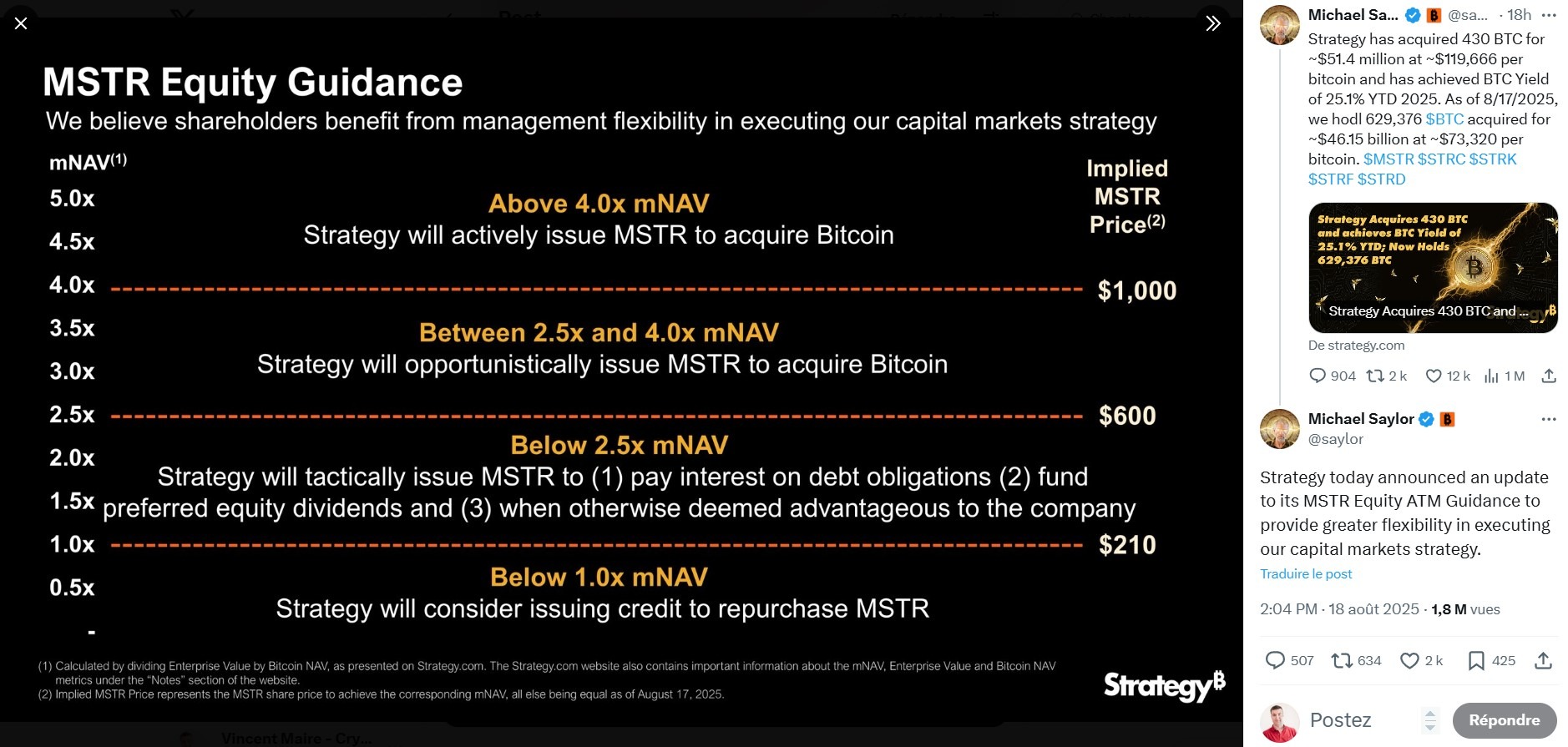
Thus, we can see two new developments in this announcement: the possibility of raising debt when the mNAV is less than 1x, but above all, the addition of “when deemed advantageous to the company” regarding the issuance of new shares when the mNAV is less than 2.5x.
As this model involves little new debt issuance, it may seem viable. Due to the mNAV calculation model, the latter may rise if the price of BTC falls faster than the price of MSTR shares, or fall when the price of the latter falls faster than the price of BTC, and vice versa. As a result, Strategy is playing a subtle game in which it seeks to maximize the relative value of its bitcoin holdings relative to its market capitalization.
However, the most debatable point of this model is that MSTR shares are thus subject to almost permanent inflation. Since our article on August 1, for example, 203 new shares have been issued, representing inflation of 0.076%. Since the beginning of the year, the same number of shares has increased by 16.8%.
To date, Strategy holds $72.28 billion in BTC for a market capitalization of $103.17 billion. While the company’s value proposition is now almost exclusively limited to creating the largest possible reserve of BTC, buying a MSTR share is in a sense equivalent to buying BTC at a price 42.72% higher than its true market price. On the other hand, when a company significantly dilutes its shares, the upside potential of its stock is impacted accordingly.
Taking all these factors into account, it will therefore be interesting to assess the sustainability of this strategy in a bear market.