Announced at the beginning of the year, HIP-3 has been setting the Hyperliquid ecosystem alight since its launch on October 13, 2025. Considered the biggest breakthrough for the fourth quarter, this update removes the centralized trusted third party and allows anyone, in exchange for 500,000 HYPE staked, to create their own perpetual contract market. It’s a revolution that combines innovation, community, and new opportunities for builders.
Centralization at the heart of the problem
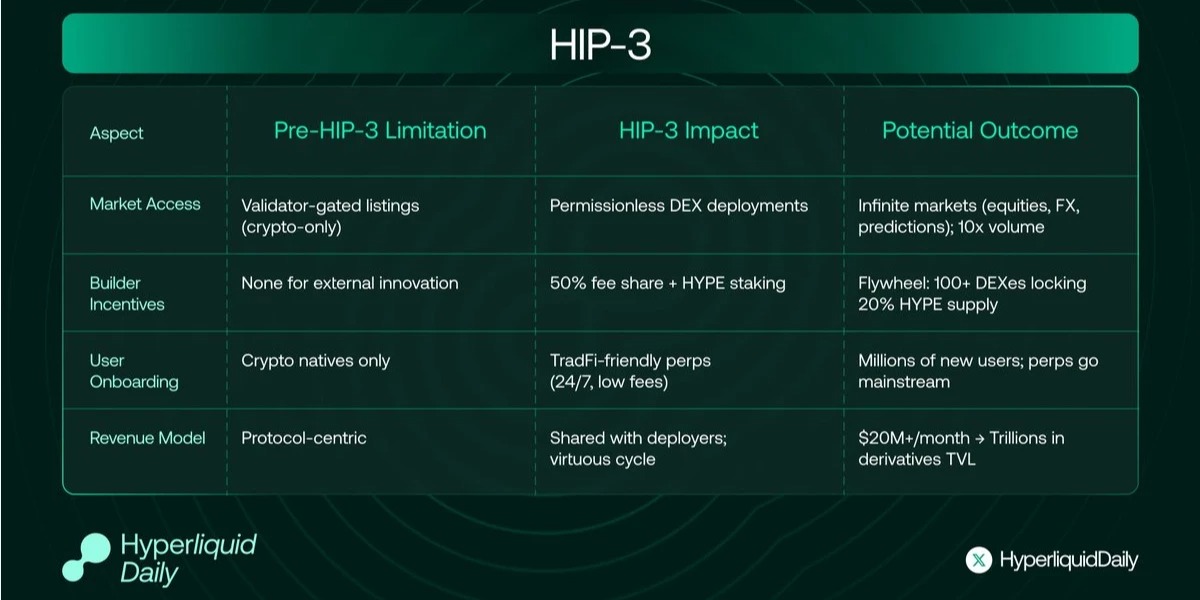
Before HIP-3, the creation of new markets on Hyperliquid depended on validators or centralized teams, who alone decided which assets could be listed. Each market required manual approval, making the process slow and opaque. This model posed several problems:
- it contradicted the decentralized spirit of blockchain;
- it imposed a barrier to entry;
- it limited the creation of innovative products such as custom indices or “exotic” markets.
Faced with these limitations, the Hyperliquid community and team designed HIP-3: a completely open and decentralized system for creating perpetual contract markets.
What is HIP-3?
The core of HIP-3 is based on a staking and decentralized auction model. Now, anyone (DAO, individual, or institution) can deploy a market without prior authorization by staking HYPE tokens.
The protocol uses a Dutch Auction system every 31 hours via HyperCore, allocating deployment rights while preventing spam. Each operator must stake nearly 500,000 HYPE (approximately $20 million) as collateral, subject to a slashing mechanism.
Slashing
This is a form of financial penalty: if an operator acts maliciously (manipulating the oracle, endangering the market), all or part of their stake can be confiscated by a vote of the validators. This system creates a collateral of trust, linking the interests of market makers to those of users.
HIP-3 transforms Hyperliquid into a truly unified ecosystem, where all markets share the same engine: HyperCore. It manages the order book, matching, consensus, and liquidity. If Hyperliquid is the house, then HyperCore is its foundation.
This architecture makes all markets interoperable: they share the same liquidity and APIs, and enable seamless communication between products. Hyperliquid becomes an “Everything Exchange,” capable of hosting cryptocurrencies, stocks, indices, commodities, and even prediction markets.
Ventual: traditional finance arrives on HIP-3
Some projects plan to take advantage of this new freedom. Among them is Ventual, a DEX based on HIP-3. It allows speculation on the valuation of private startups such as OpenAI and SpaceX, markets that were previously inaccessible to DeFi.
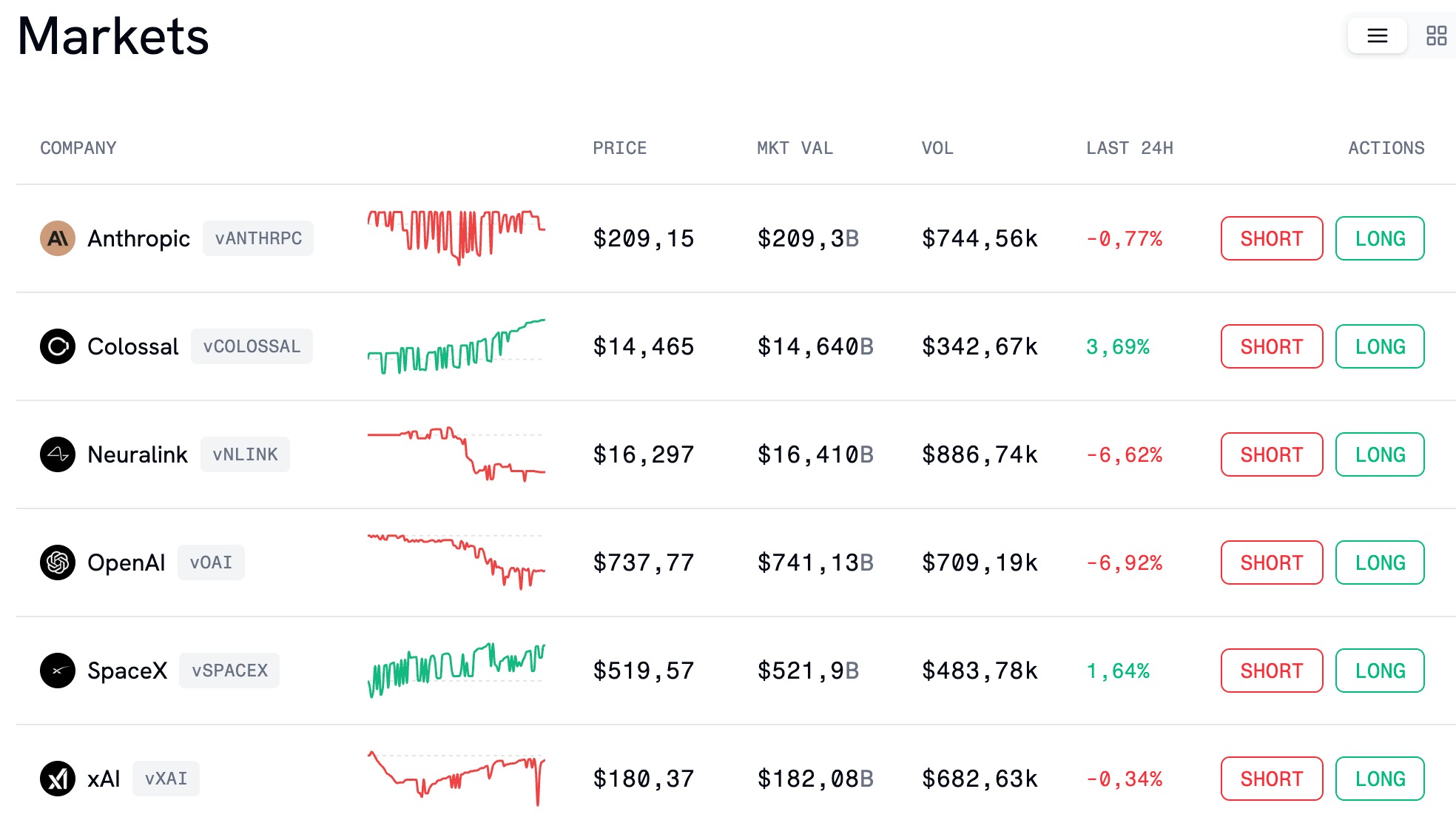
Thanks to HIP-3, Ventual has complete freedom to design its own product: collateral, fees, margins, listed assets, oracles, and even liquidation management. Everything is customizable.
Each sub-DEX built with HIP-3 thus functions as an independent exchange, with its own order book, liquidity, and economic incentives. It’s a real toolbox for developers.
Before HIP-3, such a model would have been impossible. Traditional DeFi platforms rely on oracles limited to conventional data (cryptocurrencies, indices, commodities). This made it impossible to integrate more atypical assets, such as private startup valuations.
Ventual can now do this, even adapting its liquidation mechanisms to the nature of these illiquid assets. This innovation paves the way for a new generation of financial products on blockchain, combining traditional finance and DeFi.
For the most daring users, an airdrop phase may be underway on its testnet: https://testnet.ventuals.com/trade
Testnet
A testnet is a trial version of a blockchain, where users can test the features of a protocol without risking real funds.
The rankings are visible in the Leaderboard tab, and the rules remain simple: generate as much volume as possible, as regularly as possible, while making a profit (positive PnL). No official date has been announced yet, but the competition is already in full swing. It is also possible to deposit stablecoins (USDT, USDC) in the Ventuals vault on Hyperbeat in hopes of earning points.
The limitations and controversies of HIP-3
Despite its ambition, HIP-3 has attracted several criticisms. With an entry fee of 500,000 HYPE, only players with large amounts of capital can participate, such as Framework Ventures, Ethena, or HyenaTrade. This creates a new type of centralization, this time economic, to the detriment of small innovators.
Deployers must manage the entire technical configuration on their own: oracles, collateral, margins, security, etc. A mistake can cause losses for validators or lead to unjustified slashing. Hyperliquid has acknowledged that it has encountered difficulties in this regard.
Finally, centralization is not completely eliminated: it changes form, shifting from political governance to economic control, where the wealthiest can dominate the ecosystem, regardless of the relevance or quality of the markets.