
Following a recent all-time high reached in early November, the computing power allocated to the Bitcoin blockchain has seen a significant decline toward the end of the year. Could this be a favorable scenario for a bullish rebound in BTC?
Decline in Bitcoin miners’ computing power
The evolution of the Bitcoin blockchain relies on certain essential prerequisites, such as a steady and sustained rise in BTC prices to offset the loss of income for miners following each new halving, which halves their earnings.
This need is all the more critical as mining difficulty simultaneously rises steadily, reaching new highs on a regular basis. The goal: to align the complexity of obtaining a block with the number of miners present and the available computing power (hashrate).
At the same time, this computing power dedicated to the Bitcoin blockchain has seen a significant 4% decline over the past 30 days. Analysts at VanEck describe this as “the sharpest drop since April 2024.”
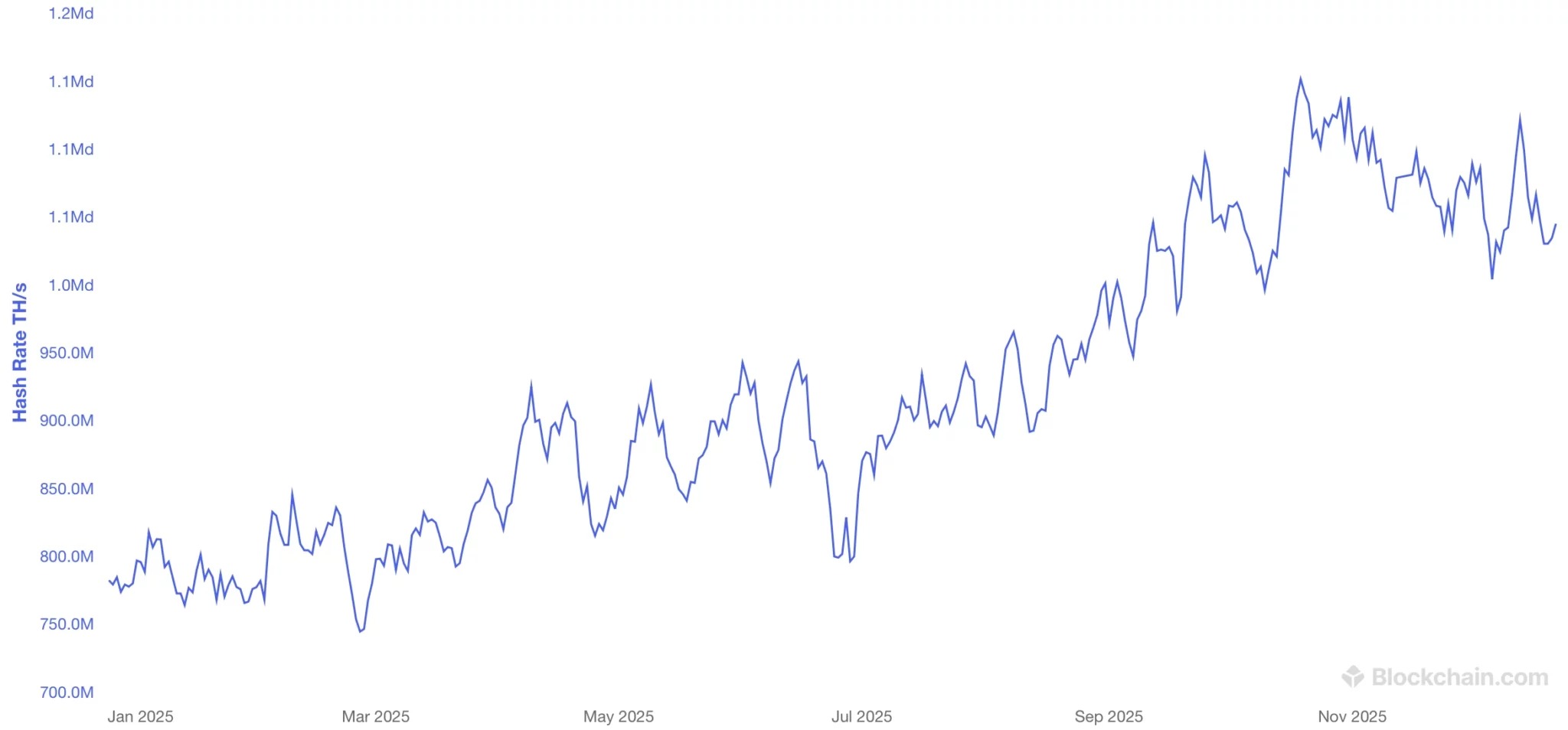
Bitcoin hashrate over the past year
The cause is the sharp drop in the price of BTC, leading to the shutdown of certain machines, as well as new Chinese pressure on this industry at the local level and a shift toward the potentially more profitable AI sector, which could “lead to the disappearance of a share equivalent to 10% of the Bitcoin network’s hash rate.”
It is estimated that nearly 400,000 mining machines have been shut down. Even though miners’ profitability has been poor recently, many players continue to mine despite periods of economic headwinds, as they believe in Bitcoin’s future.
VanEck
A bullish scenario for long-term BTC holders?
According to VanEck experts, this decline in computing power allocated to the Bitcoin blockchain could appear to signal the mining industry’s struggle to survive in an increasingly competitive environment. But the reality may well turn out to be entirely different…
By comparing 90-day future BTC returns to past 30-day changes in the hash rate since 2014, we find that future returns are more likely to be positive when the hash rate decreases rather than when it increases (65% vs. 54%). Furthermore, we find that average future 180-day returns are approximately 30 basis points higher (+20.5% vs. 20.2%) when the hash rate declines rather than when it rises.
VanEck
An upcoming rise in BTC that could be supported by the resumption of the Digital Asset Treasuries (DAT) accumulation process. In particular, considering that the longer the hash rate compression persists, the greater the likelihood that the expected positive returns will occur with increased magnitude.
Buying BTC when the 90-day hash rate growth is negative, rather than at any other time, has historically improved future 180-day returns.
VanEck