
In the wake of the price drop, the value of assets under management for spot Bitcoin ETFs is now at its lowest level since May. Let’s take a closer look at these outflows, which are also weighing on ETFs for other cryptocurrencies.
The value of assets under management for Bitcoin ETFs is in free fall
No crypto investor has failed to notice: prices are falling. Against this backdrop, the impact is also being felt by ETFs, with assets under management (AUM) in free fall.
Last Thursday, November 13, spot Bitcoin ETFs even experienced the second-worst day in their history, with nearly $870 million in net outflows. After reaching an all-time high (ATH) of $169.54 billion on October 6, this AUM has now fallen by 28.62% to $121 billion, marking a low not seen since May 8:
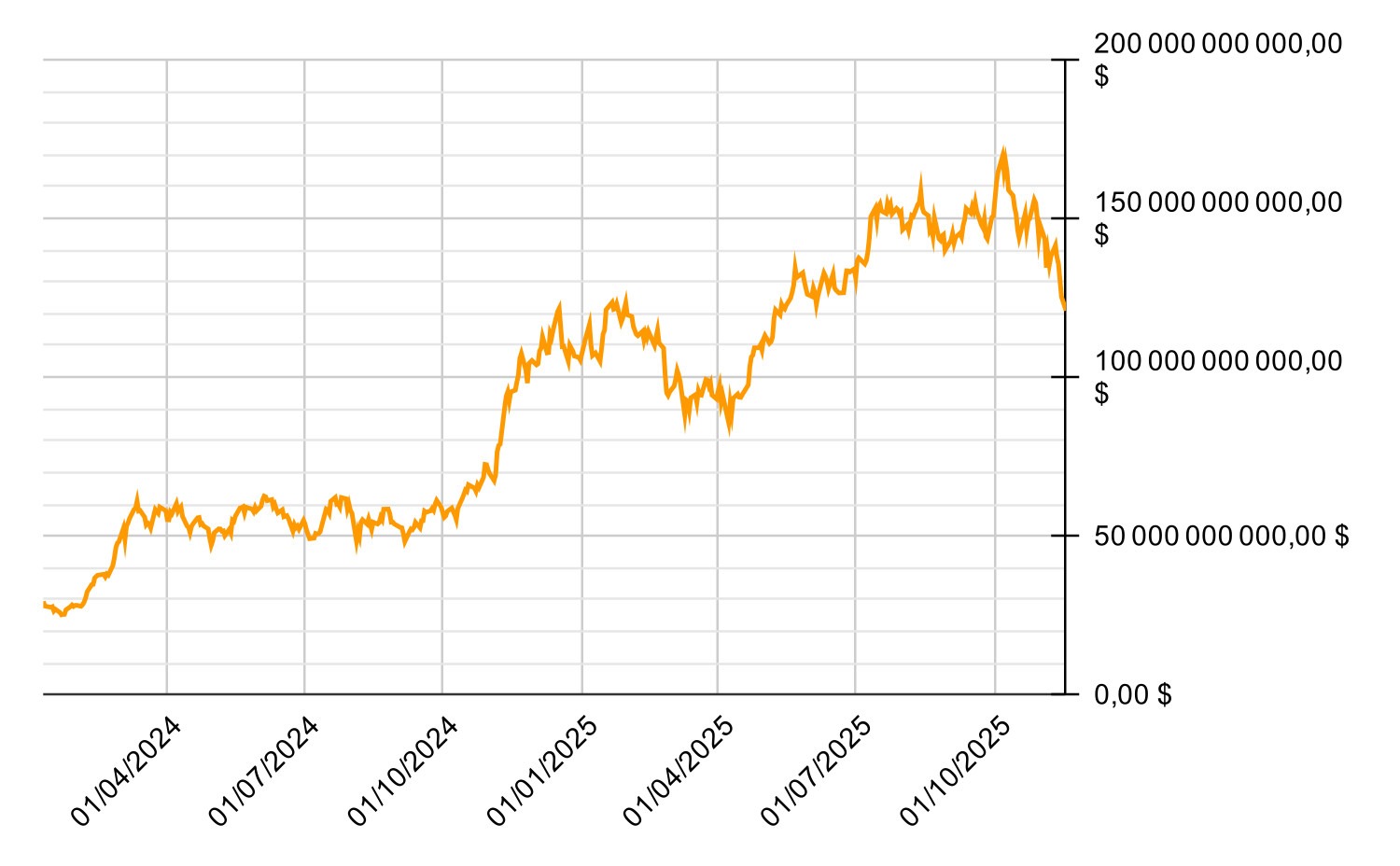
Evolution of AUM for U.S. spot Bitcoin ETFs
In BTC terms, however, it’s worth noting that this decline is more moderate, at 2.78%, with AUM now equivalent to 1.316 million bitcoins. Since the beginning of the month, these ETFs have nevertheless seen nearly $2.6 billion in outflows, with only three days of gains, marking the worst monthly start for these investment vehicles.
A Widespread Trend
As for spot Ethereum ETFs, the picture is no better. With AUM at $18.76 billion, this represents a low not seen since July 18, as well as a 41.43% decline from the high reached on October 6.
Furthermore, since the start of November, Ethereum ETFs have seen only one day of positive net inflows, with the rest resulting in losses—except for November 10, which remained unchanged.
It’s also worth taking a look at altcoin ETFs, such as those tracking SOL, XRP, LTC, and HBAR. So far, they’ve experienced only one day of losses, which occurred on November 14 for Canary’s HBAR ETF.
However, this does not necessarily mean that adoption is taking off. And for good reason: there have been numerous days with no net change, and when volumes are positive, they are far less significant than those for BTC and ETH.
Looking at SOL ETFs—the most popular category among altcoins—the assets under management for products from Bitwise, Grayscale, and VanEck currently total just $513.48 million.
While ETFs have helped drive prices in the ecosystem over the past two years—particularly for BTC—it remains to be seen how much influence they will have in the event of a full-blown bear market. It is worth noting that, to date, nearly 88% of Bitcoin ETF liquidity is concentrated in those offered by BlackRock, Fidelity, and Grayscale, with BlackRock’s IBIT accounting for 60% of its category.