
Strategy announced the purchase of 10,645 BTC for $980 million. Despite this accumulation, the market reacted negatively: the price of Bitcoin fell 5% in the hours that followed. This counterintuitive reaction raises questions about the current climate surrounding BTC.
Strategy buys, Bitcoin falls
Strategy continues its ambition to accumulate more and more Bitcoins, but this time, the market reacted in the opposite direction. As soon as the announcement was made, the purchase of 10,645 BTC for $980.3 million, the price of Bitcoin fell 5% in the following hours.
Acquired at an average price of $92,098 per BTC, this purchase is the ninth made by the company since the last historic high of $126,000.
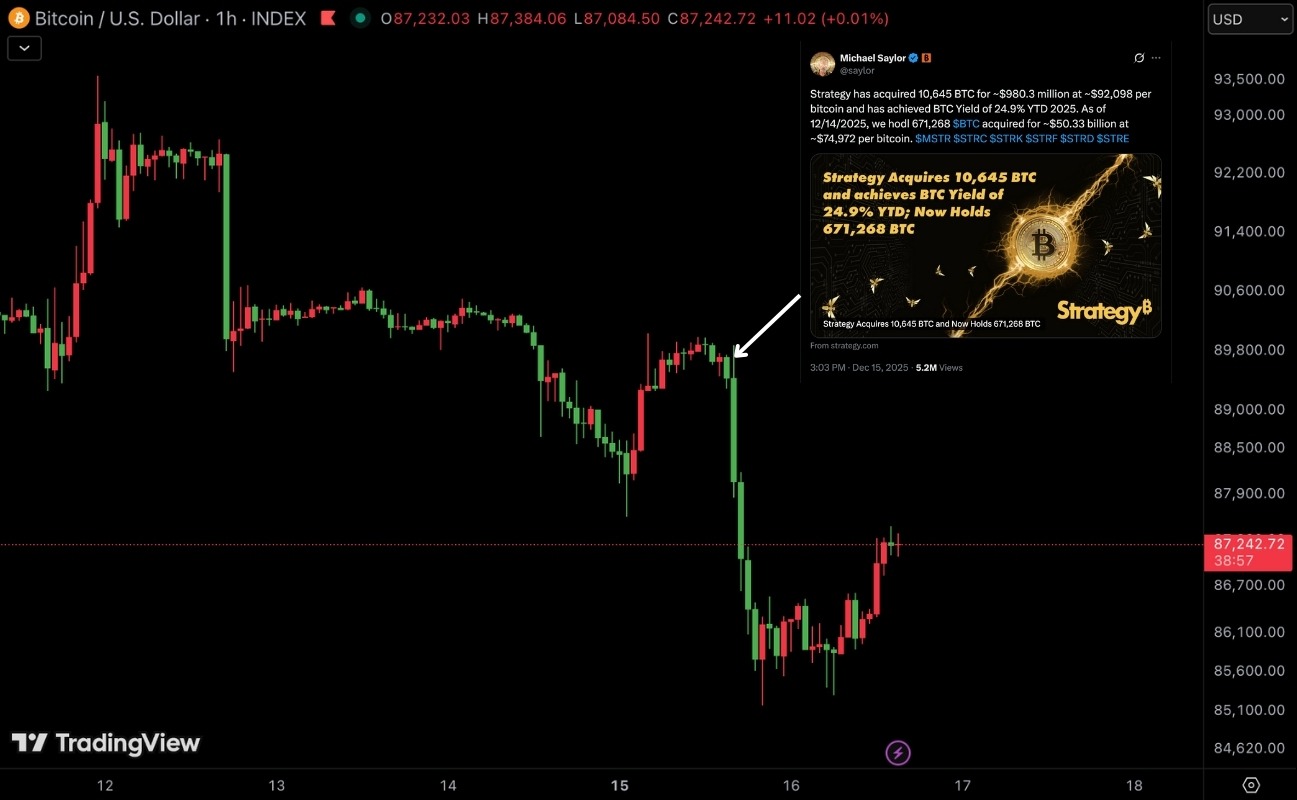
As soon as the announcement was published, Bitcoin began to correct, erasing half of the short-term rebound that began after the November crash, which had brought the price down to $80,128.
It is difficult, if not impossible, to determine whether this drop is directly related to Michael Saylor’s announcement. However, the timing raises questions. In a market as volatile as Bitcoin, reactions to announcements, even seemingly positive ones, can often be the opposite of what is expected.
In this case, it is likely that well-positioned investors took advantage of the announcement to trigger a wave of profit-taking, exploiting the FOMO effect among new entrants. The current correction, with a drop from $90,000 to $85,000, could thus be explained by leveraged speculative positions initiated since last month’s lows.
Is the strategy tenable?
In total, MicroStrategy now holds 671,268 BTC, acquired for approximately $50.33 billion, at an average cost of $74,972 per Bitcoin. Despite a difficult market environment at the end of the year, the company is confident and seems well on track to deliver on its promise: to increase the amount of BTC held per share.
Indeed, while at the end of 2024, each MSTR share represented approximately 158,000 satoshis (0.00158 BTC), this figure has now risen to 198,000 satoshis, representing a 25% increase in Bitcoin reserves per share.
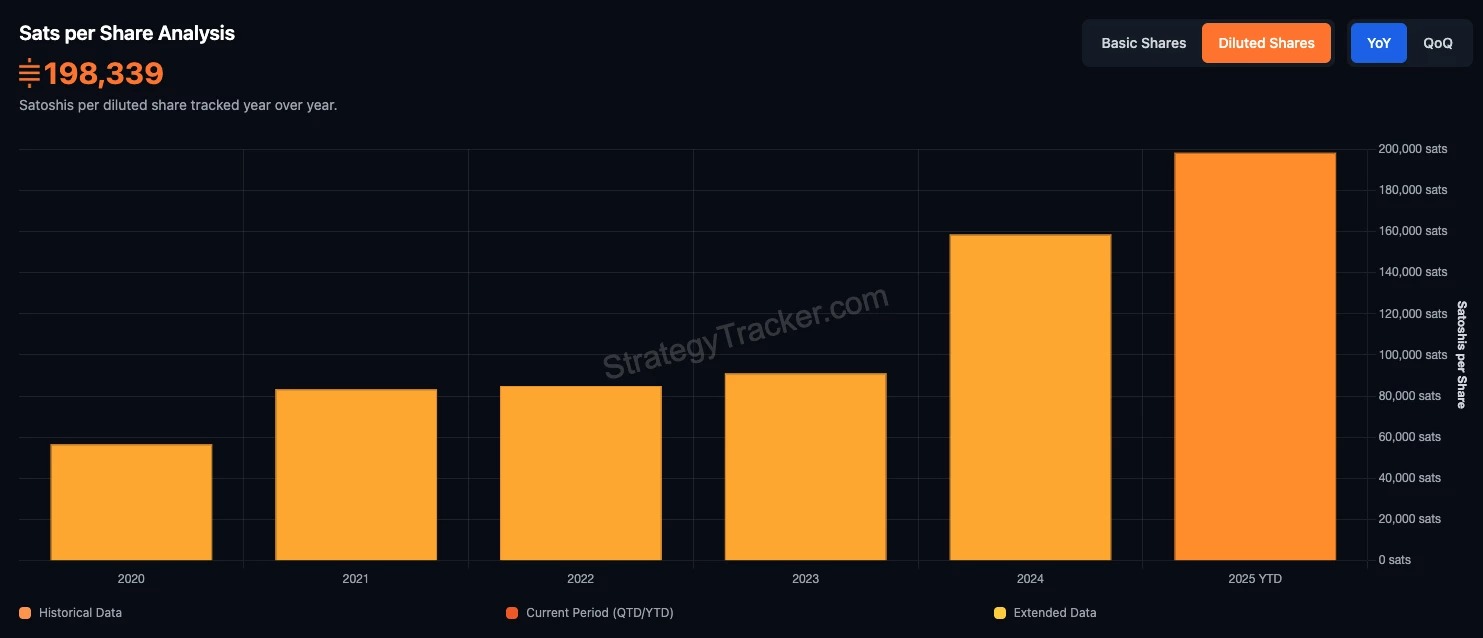
However, it is important to remember that shares in so-called “treasury companies” such as MicroStrategy carry significant risks. Their model is based on the promise of continuously increasing the number of BTC per share, which involves frequent borrowing or other sometimes risky financing mechanisms in order to continue buying Bitcoin.
While this strategy seems to be working for Michael Saylor, other similar companies have not been so fortunate: MicroStrategy (MSTR) shares have lost 65% since July, Metaplanet shares have lost more than 80%, and Nakamoto Games (NAKA) shares have lost more than 97.5% since March 2025. If these declines continue, they could threaten the long-term future of its Bitcoin reserves.
Finally, this model raises a fundamental question: while Bitcoin was designed to eliminate intermediaries, these companies reintroduce a layer of centralization by placing Bitcoins under the control of one or even several companies, if custody is managed by a third party. This situation weakens their resilience in the face of the coercive power of states.