
The available data on the Lightning Network indicates that the network’s growth is stagnating, but that capital flows continue to flow into it. Although it is not perfectly decentralized, the Lightning Network remains distributed among several major hubs.
The $100,000 mark holds strong
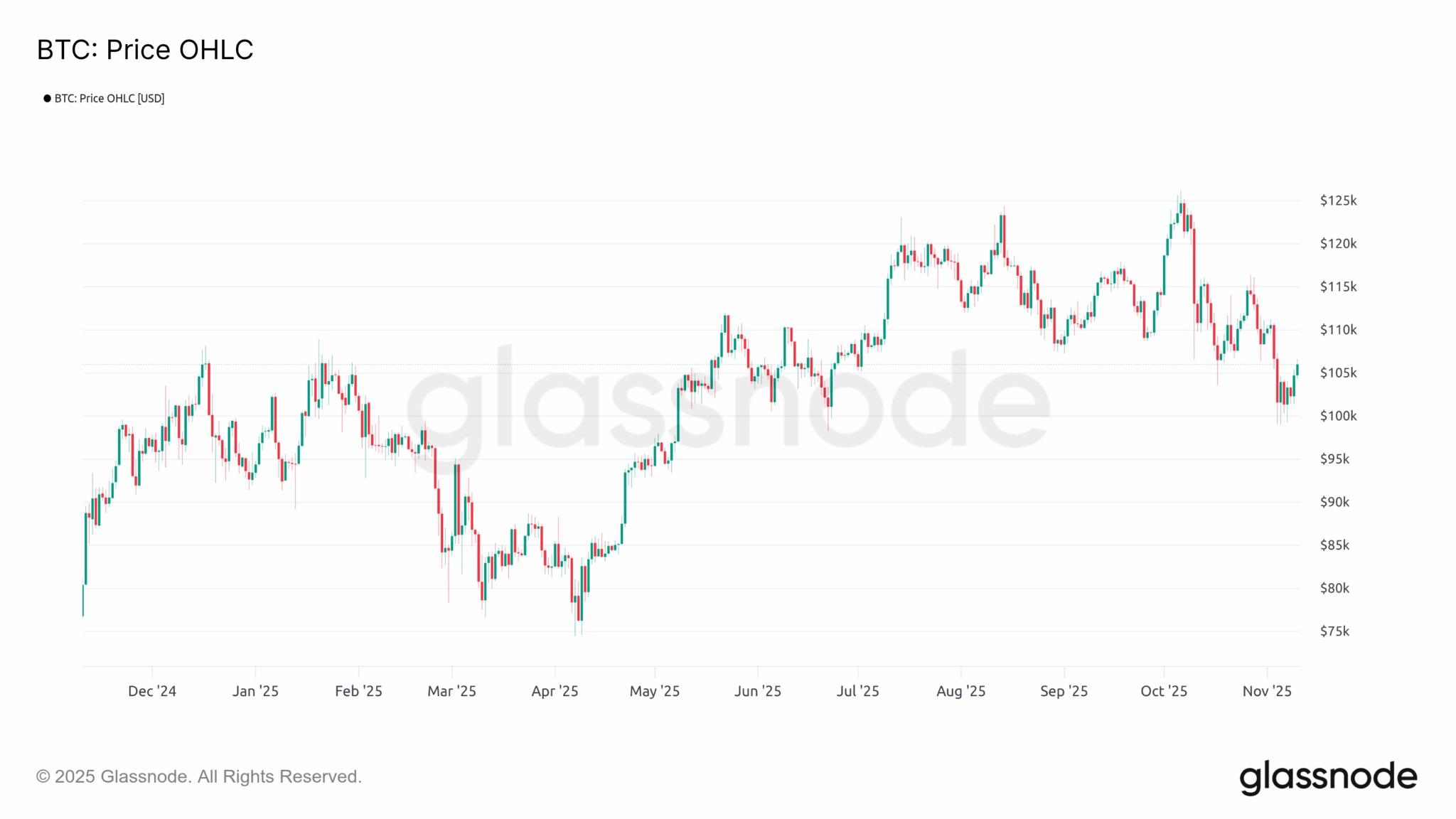
After another downward push, the price of BTC revisited the symbolic $100,000 mark. This price level once again acted as support, offering investors an attractive short-term buying opportunity.
Following on from our previous analysis, today we will monitor the evolution of the Lightning Network in order to estimate its growth and adoption rate.
We will thus examine an often-underestimated facet of Bitcoin network usage, which nevertheless represents a significant portion of its monetary activity.
It should be noted, however, that it remains difficult to accurately track interactions on the Lightning Network, which casts a shadow over the monitoring of its activity and may potentially impact our future analyses. Let’s take stock here!
Lightning Network Evolution
Important note: since LN channels can transfer large volumes of BTC without being closed, it is difficult to accurately estimate the transaction volumes circulating on the Lightning Network. The data presented below comes from independent data providers and reflects a partial reality of the current state of the network.
The Lightning Network is a decentralized network built on top of the Bitcoin (BTC) protocol, enabling instant, peer-to-peer payments at very low cost.
On the Lightning Network, each transaction corresponds to a transfer of funds between two nodes via payment channels. A channel allows for almost instantaneous off-chain exchanges at no cost, as long as it remains open, which can impact data relating to network activity. This system of bidirectional payment channels allows for an infinite number of payments between two parties without each transaction being recorded on the blockchain, thus avoiding transaction fees for each transfer.
Although data relating to the Lightning Network is sometimes inaccurate and varies depending on the data provider, it is essential to study it in order to gain an overall view of monetary usage on the Bitcoin network.
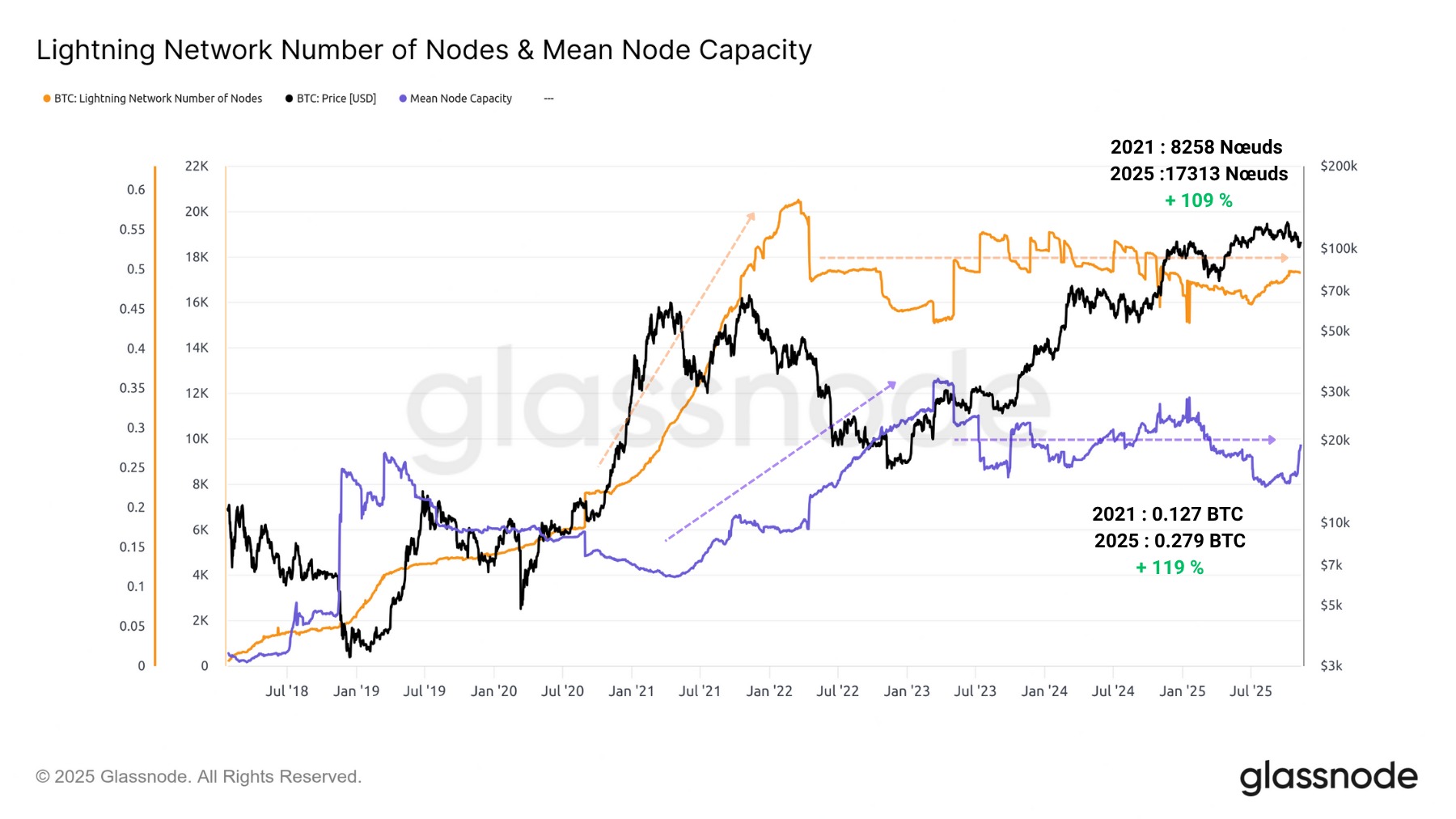
Between 2021 and 2022, the number of Lightning nodes increased significantly, signaling significant development and adoption of the network. However, the total number of Lightning nodes has stagnated at around 16,000 since March 2022.
The average capacity (maximum volume of BTC transferable via a Lightning node/channel) of Lightning nodes on the network also rose sharply in 2021 and 2023, before stagnating until now.
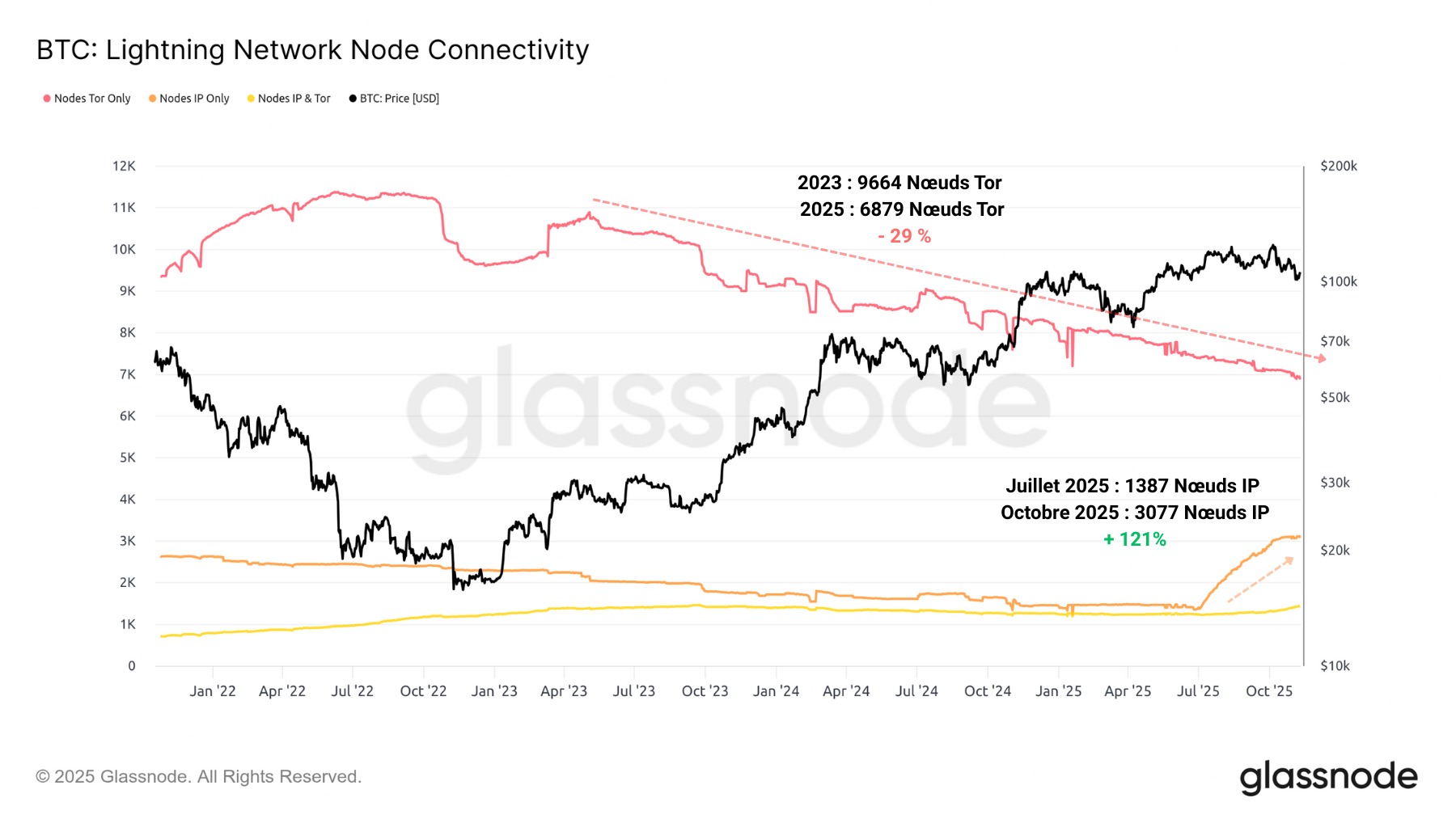
The nature of Lightning nodes is another important aspect of the network, as it defines the network access to which the nodes are connected.
While the Lightning network is currently composed mainly of nodes connected to the Tor network, we have seen a significant drop in this number since 2023, with no visible compensation in other types of connectivity.
However, nodes connected to the IP network have seen a sharp increase since July 2025, suggesting the arrival of one or more large users using this type of connectivity.
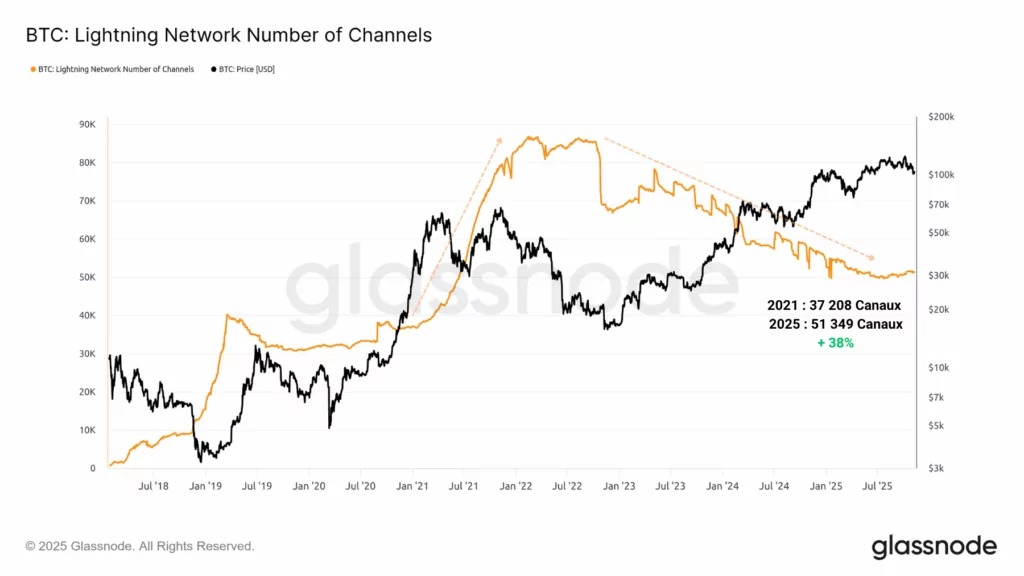
The number of open Lightning channels is another sign of network usage, and has followed a two-phase trend in recent years.
Between 2021 and 2022, the number of open Lightning channels exploded, suggesting massive adoption of the network. However, shortly before the collapse of the FTX platform, marking the end of the 2022 bear market, this number fell sharply.
This event marked the beginning of a gradual decline in the number of open Lightning channels, which seems to have stabilized recently. Overall, there are now 38% more channels than in 2021.
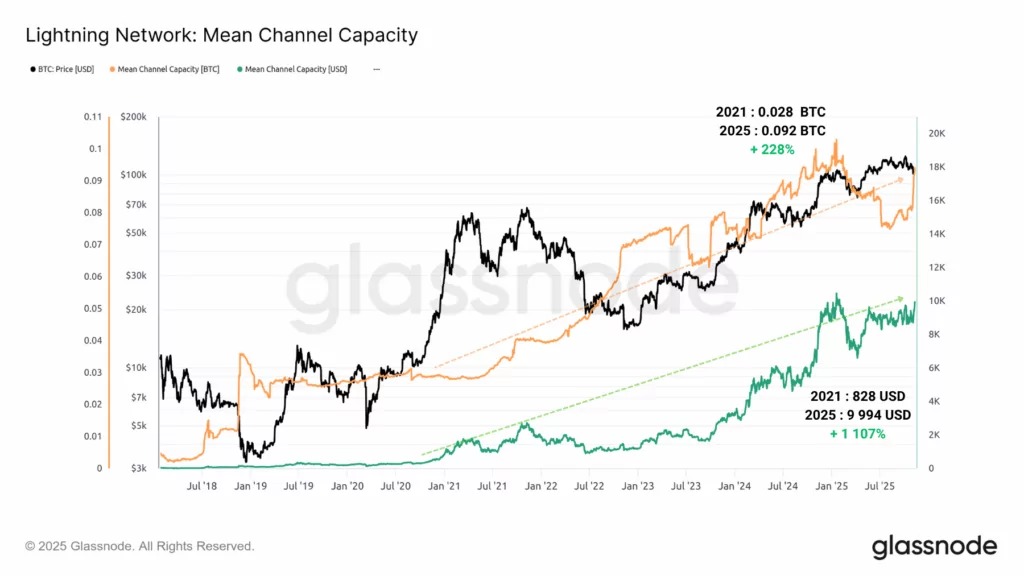
In addition to the number of open channels, it is essential to measure the average channel capacity of the network to estimate whether the Lightning Network can support more transactions and users.
Between 2021 and 2025, the average capacity of Lightning channels increased by 228% in BTC units and by more than 1,100% in USD units, marking a significant increase in the liquidity available on the network.
In particular, we can see a major increase in this metric over the last few days, suggesting a massive deployment of new capital on the network.
A multipolar network
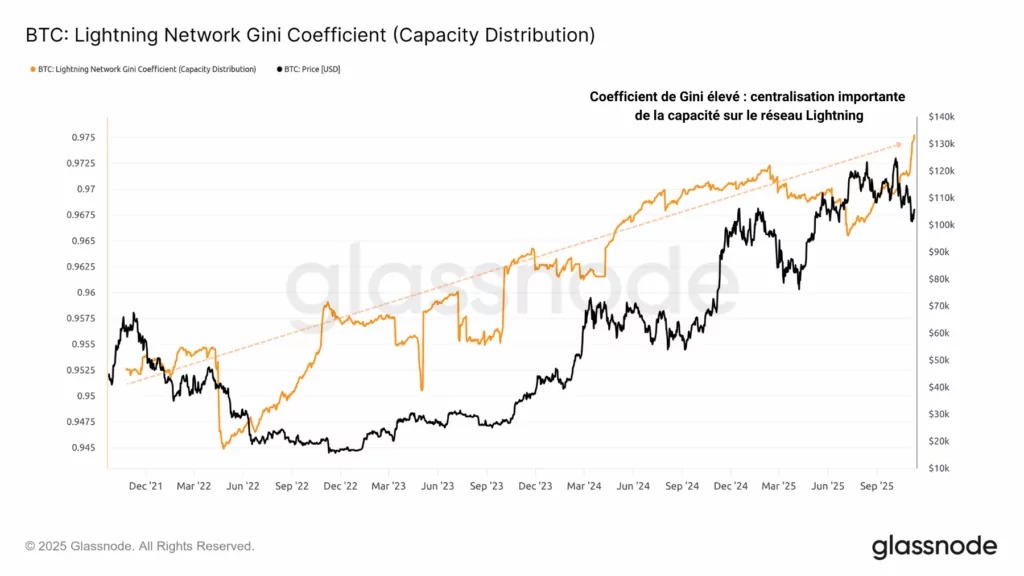
Despite its decentralized ethos, a common criticism of the Lightning Network is the risk of liquidity centralization in a few large nodes (particularly those operated by exchanges or popular services).
The Gini coefficient, or Gini index, is a statistical measure that accounts for the distribution of a variable (income, wealth, etc.) within a population.
Applied to the available capacity on the Lightning Network, this index is clearly close to 1, a value indicating significant inequalities in the distribution of liquidity across the network.
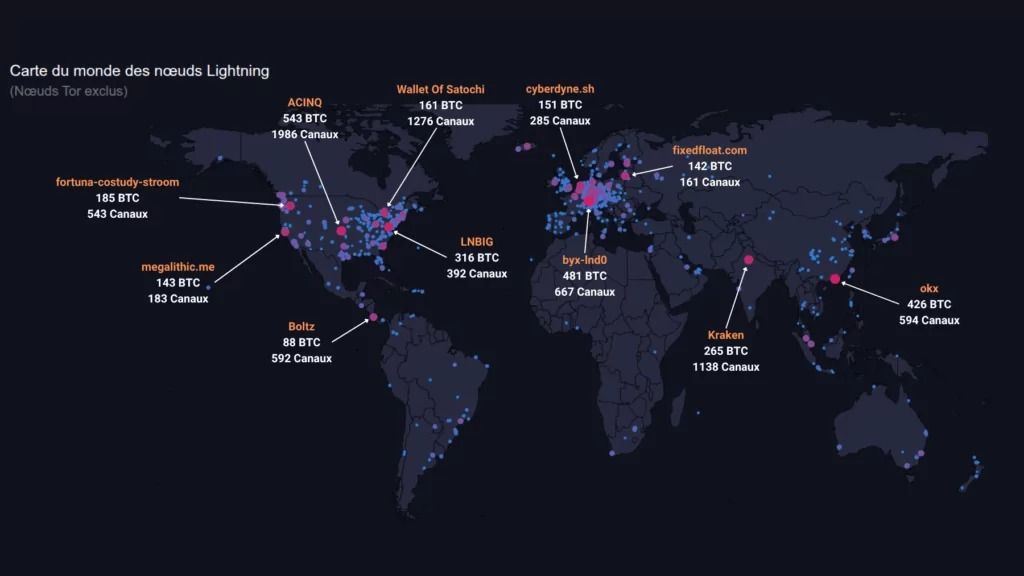
The following graph puts this observation into perspective by showing the global distribution of Lightning nodes. It becomes clear that the services and liquidity available on the Lightning Network are mainly concentrated on the east coast of the United States and in Europe.
While this is not a guarantee of pure decentralization, the Lightning Network is clearly distributed among several major hubs that compete to attract as much liquidity and activity as possible.
Summary of this analysis of the Lightning Network
Ultimately, the available data on the Lightning Network indicates that the network’s growth is stagnating, but that capital flows continue to pour in.
Between 2021 and 2022, the number of Lightning nodes increased significantly, before stagnating at around 16,000 since March 2022. In addition, the number of Lightning channels also exploded over the same period before beginning a gradual decline, which seems to have stabilized recently. Overall, there are now 38% more channels than in 2021. Between 2021 and 2025, the average capacity of Lightning channels increased by 228% in bitcoin units and by more than 1,100% in dollar value, marking a significant increase in available capital on the network.
Finally, although it is not perfectly decentralized, the Lightning Network remains distributed among several major hubs that compete to attract as much liquidity and activity as possible.