
The engagement and activity of Bitcoin network users has been particularly low since 2024. While transaction demand is collapsing, the market is also facing significant spending behavior. Let’s take a closer look at what this means.
BTC takes a nosedive
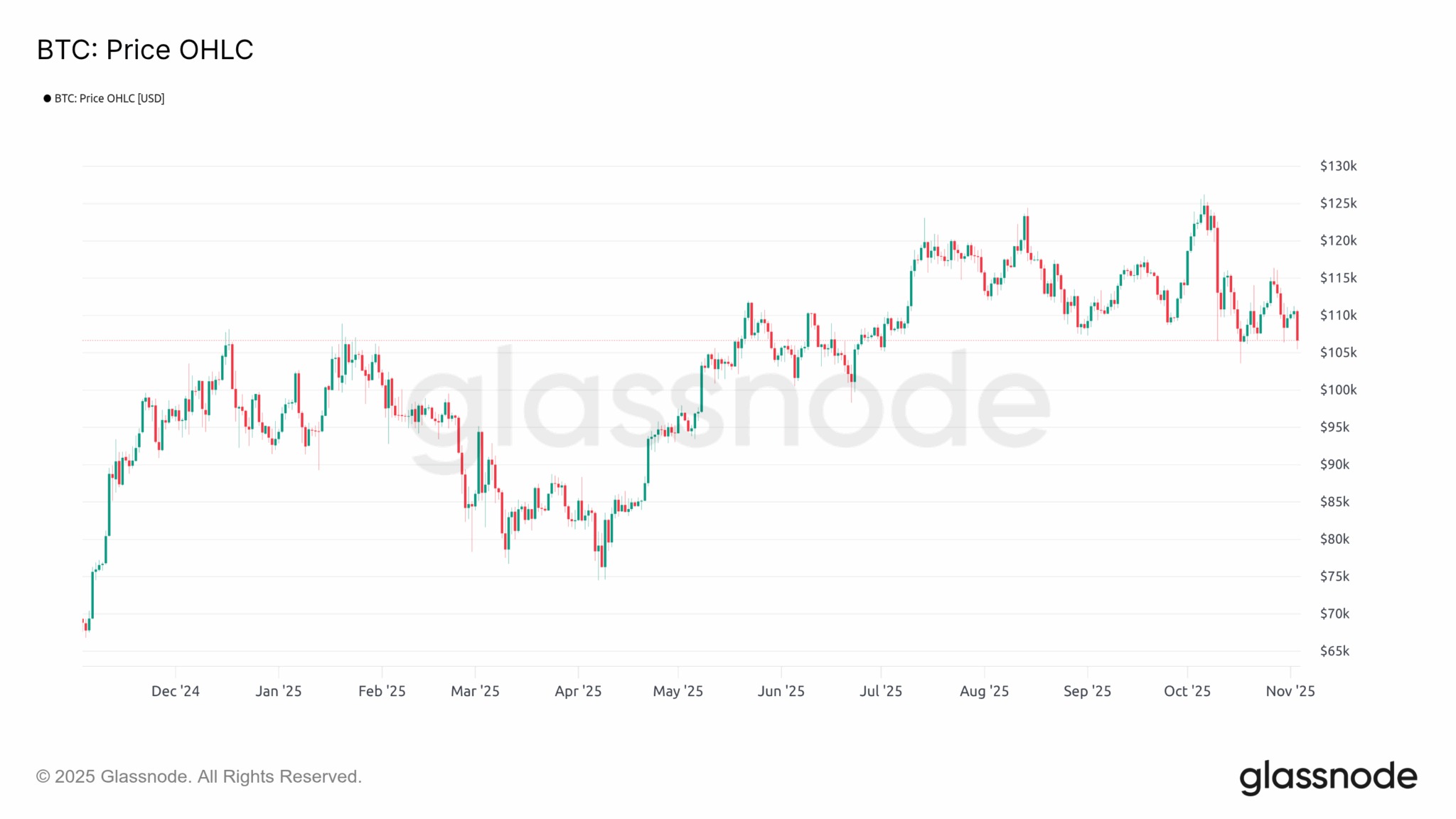
As the price of BTC attempts once again to break below $100,000, the latest entrants find themselves still underwater.
Adding to the apparent short-term fragility of the market are new signs of a slowdown, with a notable drop in on-chain activity on the Bitcoin network.
How is the use of the Bitcoin network evolving, and what are the dominant behaviors currently? Let’s take stock!
Loss of on-chain activity
In our previous analysis, we identified early signs of a slowdown in the BTC market, including a significant divergence between the price of Bitcoin and the average latent profitability of investors.
Today, we are looking at metrics related to Bitcoin network usage to assess whether the levels of activity and engagement among its users are sending positive or worrying signals.
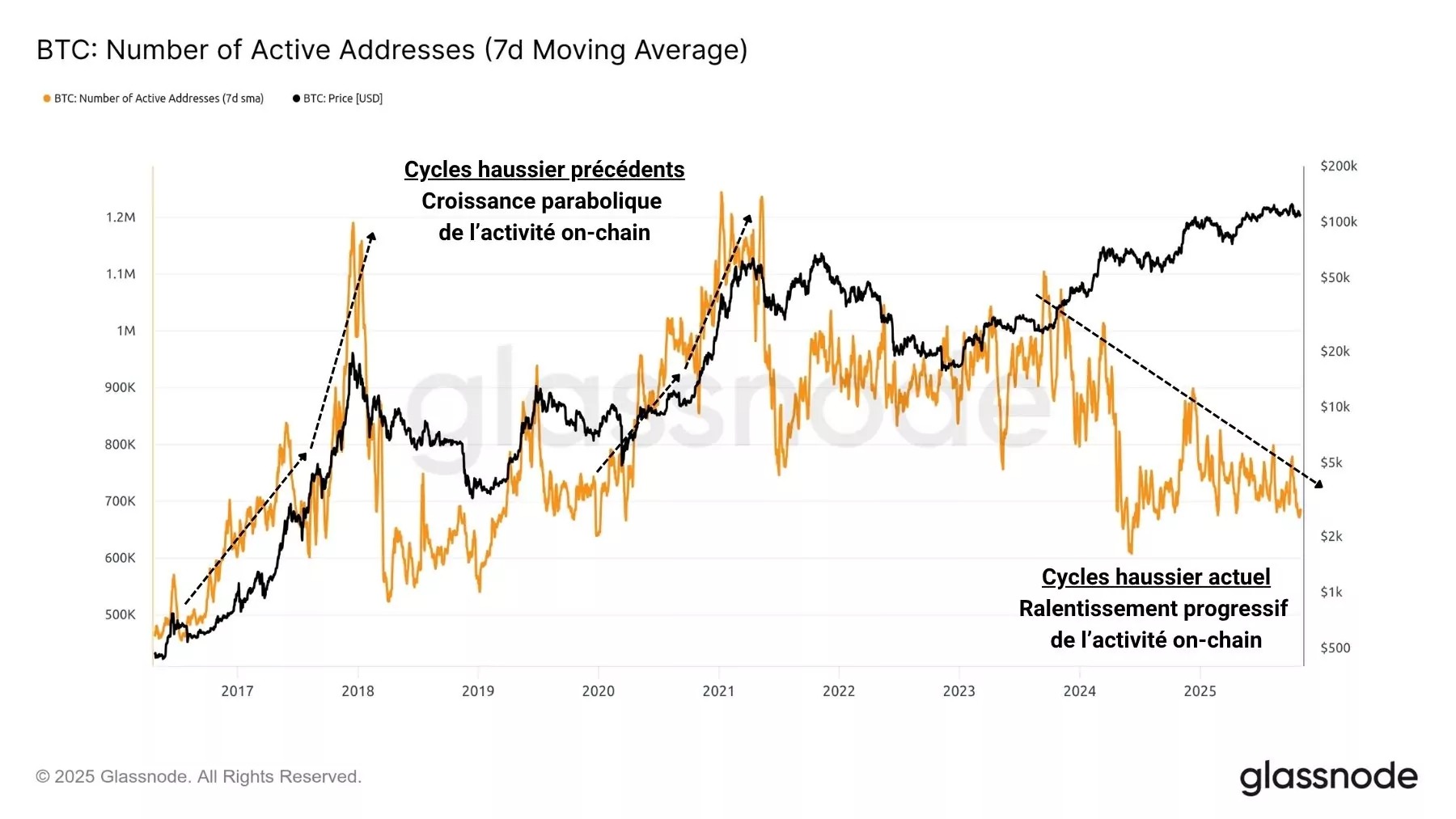
The following chart shows the number of BTC addresses that have made at least two valid transactions per day during the last three bull cycles.
While parabolic growth in address activity is visible for the 2017 and 2021 bull cycles, the current dynamic looks more like a gradual slowdown.
This striking contrast suggests that participant engagement and activity have been particularly low since 2024. It also signals a loss of interest in traditional uses of Bitcoin and a shift in trading activity to off-chain platforms (centralized exchanges), such as derivatives markets.
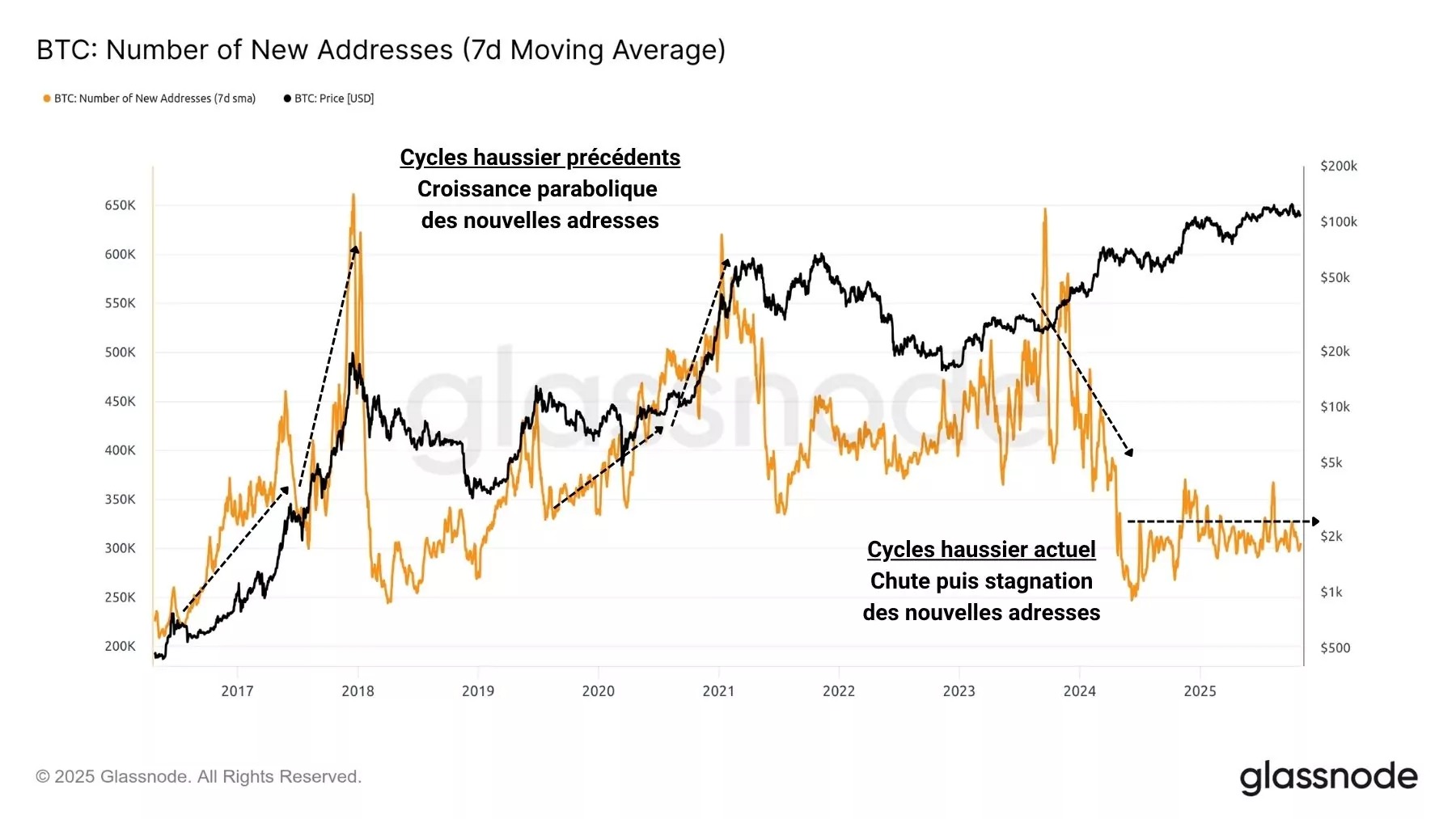
A similar observation can be made regarding the metric of the number of new addresses created per day. Here again, there is a major difference between the dynamics of past cycles and the current context.
Since the creation of new addresses is generally associated with transactional demand, a stagnation in this metric indicates reduced use of the network and a lack of interest among its users.
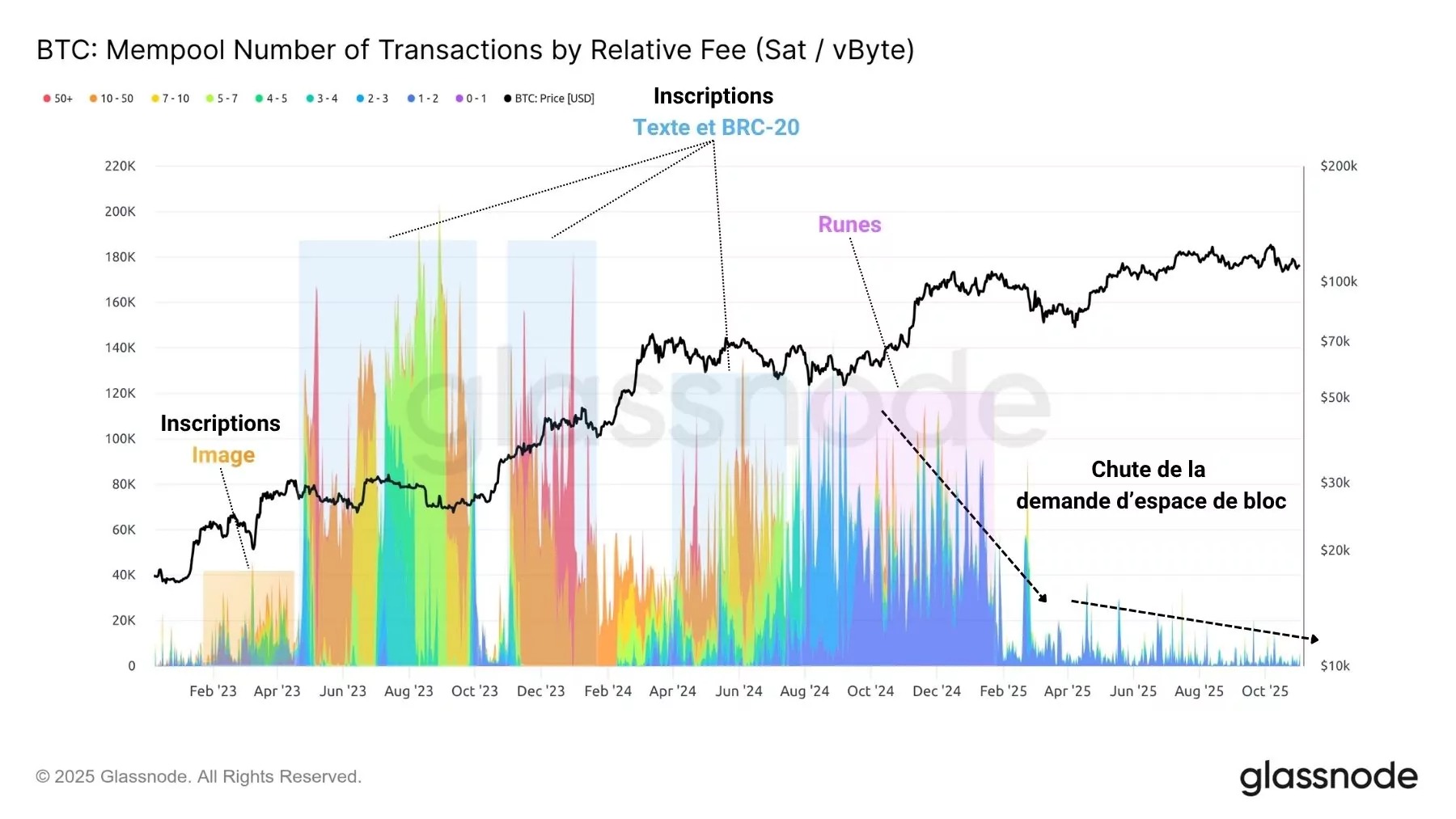
The situation is even more striking when we look at the state of the mempool, the waiting room where transactions that have not yet been included in a block are held.
While the mempool experienced several waves of high transaction demand between 2023 and 2024, particularly due to the craze caused by Inscriptions/Ordinals and, later, Runes, nothing of the sort is currently visible.
Today, the mempool is virtually empty and transaction fees have fallen, evidence that demand for block space has collapsed compared to previous years.
In fact, Bitcoin network users are less active, whether transferring funds between entities or storing arbitrary data on the blockchain.
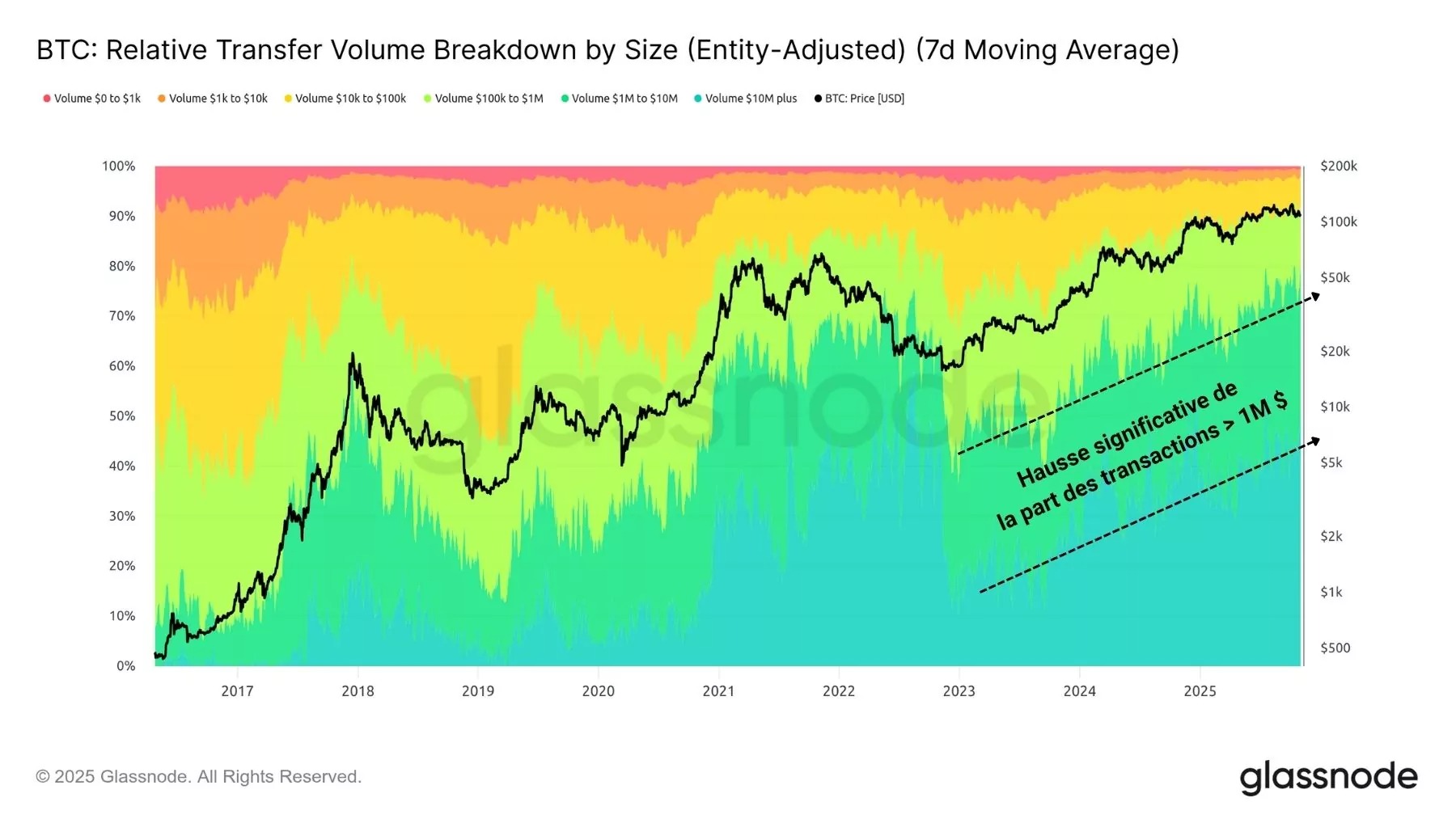
The chart below measures the distribution of transactions based on their size in dollars, adding a new and essential dimension to the previous findings.
Since the cyclical low at the end of 2022, we have seen a significant increase in the share of transactions exceeding $1 million in volume.
While these transactions accounted for between 40% and 50% of total trading at the beginning of 2017, they now account for more than 70% of daily transfers.
This suggests that the market is attracting more and more institutional capital and that BTC investment and trading are becoming more professional as the bridge between traditional finance and the cryptocurrency sector widens.
Distribution dominates
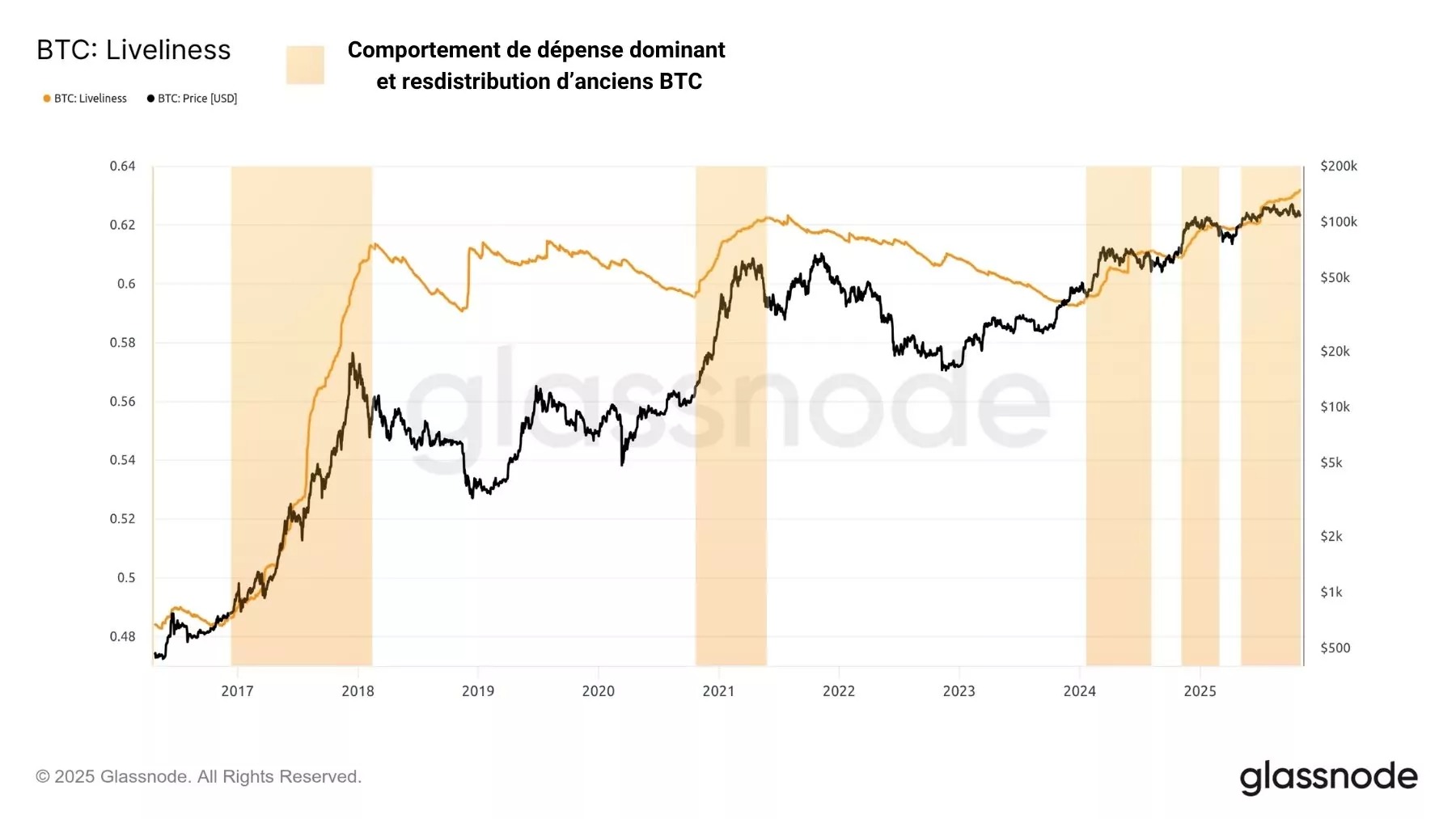
While BTC on-chain activity is slowing down noticeably, it is essential to ask what the dominant behavior of exchanges remaining on the network is.
The following metric measures the age of spending to estimate whether the dominant behavior is saving or spending over a given period.
As in most bull cycles, this indicator signals that significant volumes of BTC are currently being moved, indicating that investors are spending more than they are saving.
This behavior is typical of the final stages of bull markets, where investors take profits during upward surges, increasing selling pressure that causes the price to fall in a correction phase.
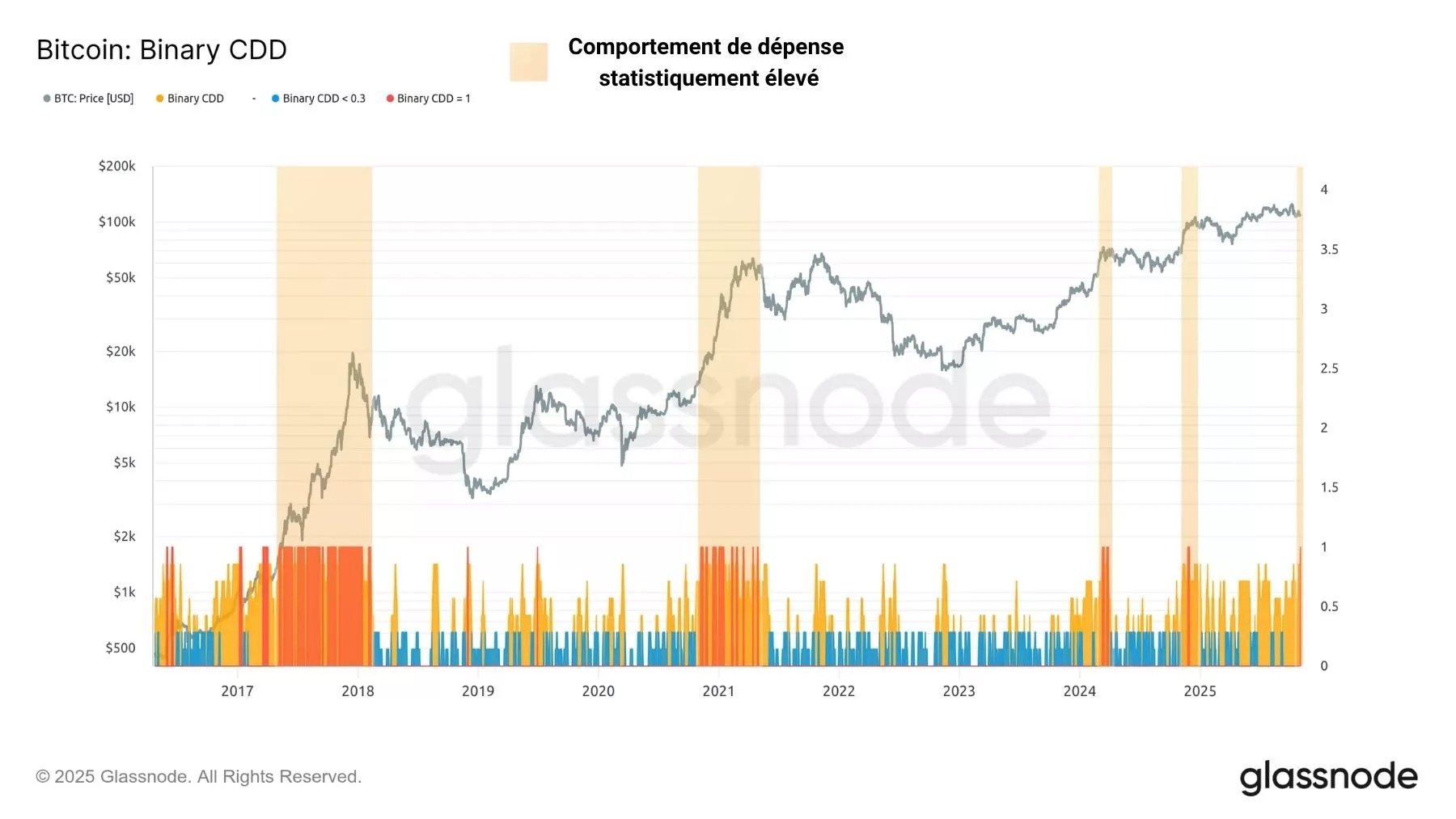
To go further, the indicator below measures the intensity of investor spending behavior in order to estimate the weight on the market at a given moment.
The Bitcoin market has recently seen statistically high spending behavior, as was the case during previous local peaks in 2024, or cyclical peaks in previous bull markets.
Significant demand will therefore be needed to absorb the selling pressure currently weighing on the market.
Summary of this on-chain analysis of Bitcoin
Ultimately, this week’s data indicates that the engagement and activity of Bitcoin network users has been particularly low since 2024, with transactional demand now very weak.
As the mempool empties, a shift in trading activity to off-chain platforms, particularly derivatives markets, is one of the most plausible explanations for the current loss of activity.
The increase in transactions of more than $1 million confirms a clear trend: the market is turning to institutional capital, while individuals are becoming scarcer.
Finally, the BTC market has recently seen statistically high spending behavior. Significant demand will therefore be needed to absorb the selling pressure weighing on order books.