
Are we already witnessing the decline of publicly traded companies involved in Digital Asset Treasuries (DAT)? The question arises as the American company ETHZilla begins selling its ETH to finance a share buyback program.
ETHZilla: the failure of a Digital Asset Treasury in progress?
Just a few months ago, crypto corporate treasuries were popping up everywhere with the aim of revitalizing often moribund stock market activity through massive purchases, often directed towards Bitcoin. This model was quickly exported to the altcoin market, with a clear preference for Ethereum and its associated staking option.
Then, the initial euphoria quickly gave way to a noticeable slowdown, even for the industry leader Strategy. This led to the first critical situations, with companies whose capitalization fell below their BTC holdings.
This reality did not sit well with their shareholders, who had flocked to the company in order to take advantage of a market net asset value (mNAV) — the ratio between the value of the cryptocurrencies held and the company’s market capitalization — that could boost their returns.
The shareholders of ETHZilla would certainly agree, judging by the company’s share price over the last six months. .
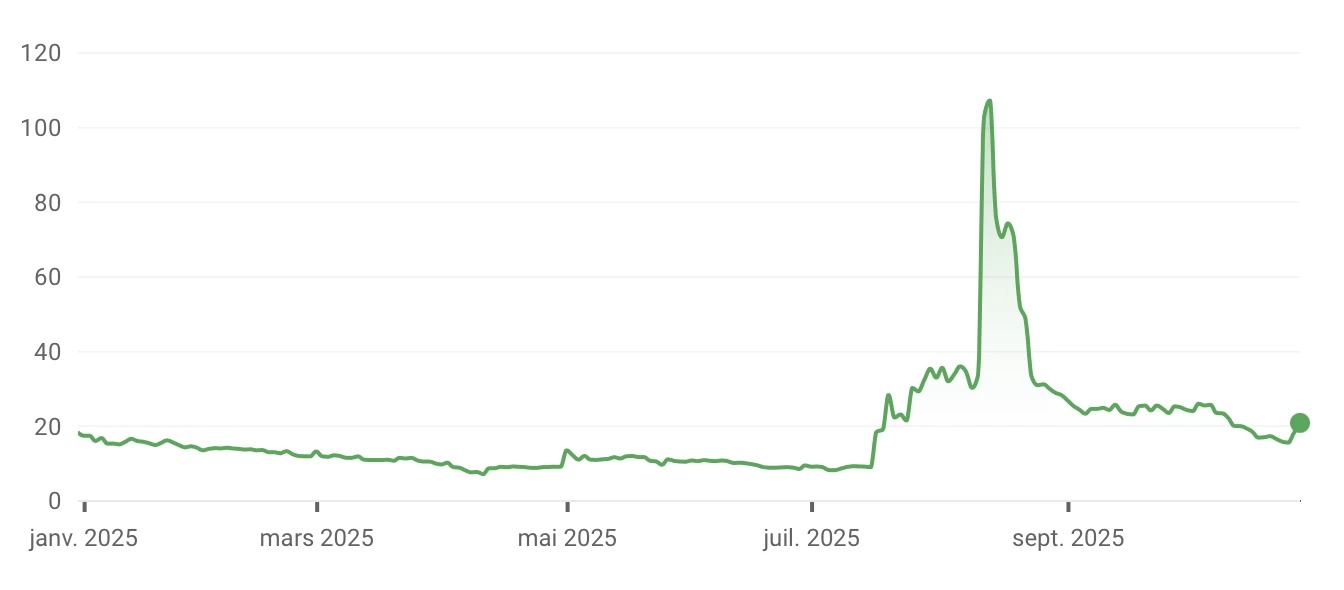
Indeed, this “technology company linking traditional finance and decentralized finance,” largely supported by billionaire Peter Thiel, has just announced a significant change of direction in its Digital Asset Treasury strategy.
The plan: an initial sale of $40 million of its ETH holdings to finance a share buyback program.
Selling ETH to buy back its shares
According to its press release, the American company initiated this program on October 24 following a decision by its board of directors. The goal? To initiate the buyback of $250 million worth of company shares.
To finance this program, ETHZilla announced that it has already sold “approximately $40 million of its ETH cash holdings.” This transaction has so far enabled it to buy back 600,000 common shares for approximately $12 million, as part of a first step that will consist of “buying back its shares until its net asset value (NAV) is normalized.”
According to ETHZilla’s Chairman and CEO, McAndrew Rudisill, this transaction “leverages the strength of the balance sheet” of his company to proceed with share repurchases that are described as “immediately accretive.”
By opportunistically repurchasing shares while our stock is trading below NAV, we expect to reduce the number of shares available for securities lending/borrowing activities, while increasing the Company’s net asset value per share.
McAndrew Rudisill
This is a step backward that clearly does not mark the end of the race, as “ETHZilla continues to hold approximately $400 million in ETH on its balance sheet to support future strategic initiatives.” But for how long?