
In recent weeks, the decentralized crypto perpetual exchange Aster has been enjoying tremendous success. With competition becoming increasingly fierce, have we entered a bubble in this sector?
The staggering figures of the Aster perpetual DEX
During September, the decentralized exchange (DEX) for perpetuals, Aster, went from being a virtually unknown protocol to a potential competitor for Hyperliquid (HYPE). The reason for this lies with Changpeng Zhao (CZ), whose tweets contributed to the adoption of the application.
According to Aster’s official data on Dune, the DEX now claims $1.46 billion in total value locked (TVL), 3.2 million users, and has totaled nearly $2.24 trillion in volume since its launch.
By comparison, Hyperliquid has totaled $2.891 trillion in volume on perpetuals since its launch.
Behind this apparent success, Aster has now generated the equivalent of $19.5 million in volume:
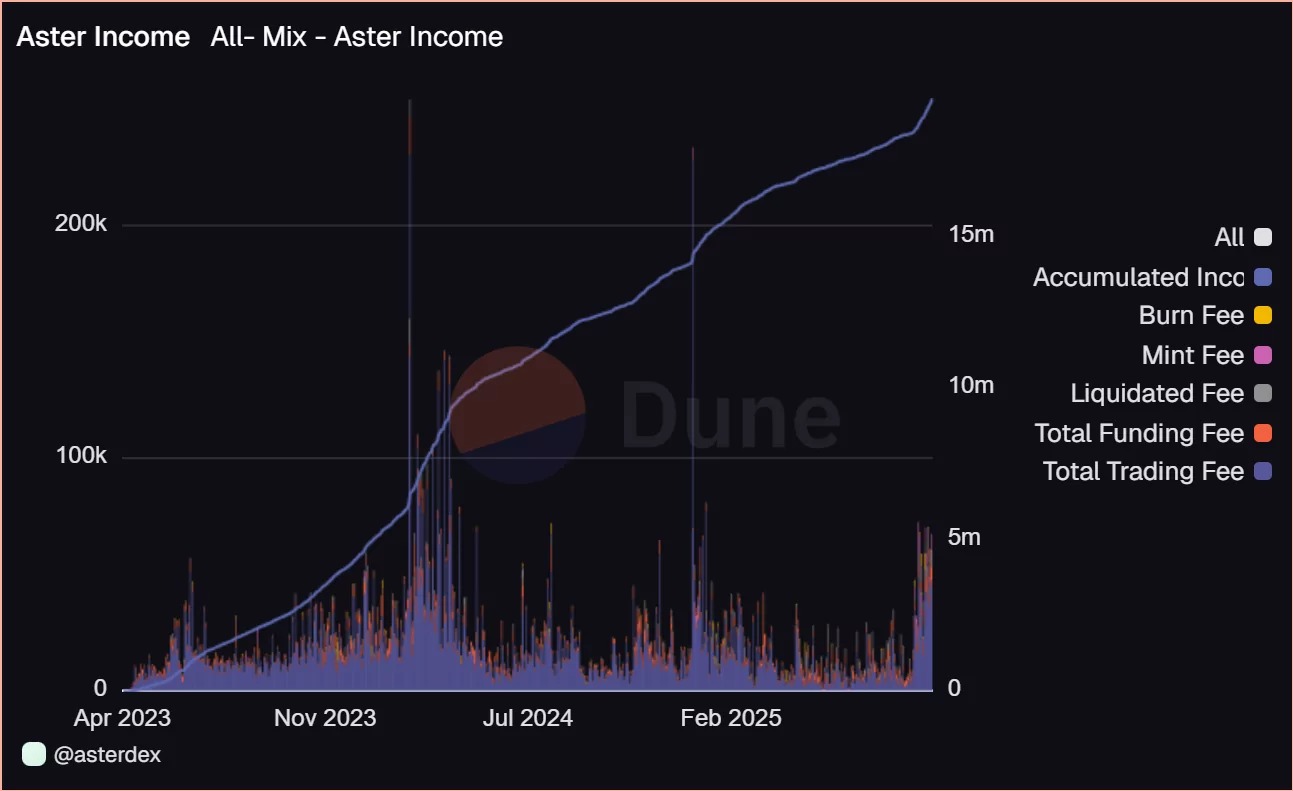
As for the ASTER token, it is trading at $1.95 per unit at the time of writing and ranks 52nd in the cryptocurrency rankings, with a capitalization of $3.3 billion.
An already controversial success
Despite Aster’s success, some gray areas have begun to emerge over the weeks, with the market wondering how such figures could be achieved in such a short time.
In a previous article, we looked at the glaring discrepancy between Hyperliquid’s open interest and that of Aster. As a reminder, open interest is the total value of contracts still outstanding at the end of a day, and in this regard, Hyperliquid far dominates the competition, currently at $14.9 billion, compared to $4.64 billion for Aster.
This week, DefiLlama announced that it was removing Aster’s dashboard after noticing strange correlations between the volume of perpetual contracts on Aster and Binance. For 0xngmi, the founder of DefiLlama, the protocol also lacks transparency, particularly in its order book, whereas it is very easy to see current positions on competing platforms such as Hyperliquid.
While these factors are not deal-breakers in themselves, as centralized platforms also sometimes lack transparency, it is nevertheless more ironic for a decentralized exchange.
The trend of perpetual crypto DEXs
In terms of adoption, beyond the prospect of airdrops that can temporarily distort volumes, there are several factors that will influence a trader’s choice of one DEX over another.
Among these factors, we can first mention the user experience, which encompasses areas ranging from the platform’s ease of use and functionality to its speed. To this must also be added liquidity, platform security, and possibly the blockchains on which it operates, with their specific constraints and advantages.
In this context, the perpetual DEX sector is now highly competitive, but long before it was in the spotlight as it is today, these applications were already part of the decentralized finance (DeFi) landscape. Before Hyperliquid, dYdX was the benchmark, and other players such as GMX and Jupiter also managed to make their mark. Today, the offering is multiplying and names are gaining varying degrees of popularity depending on the community’s expectations regarding potential airdrops.
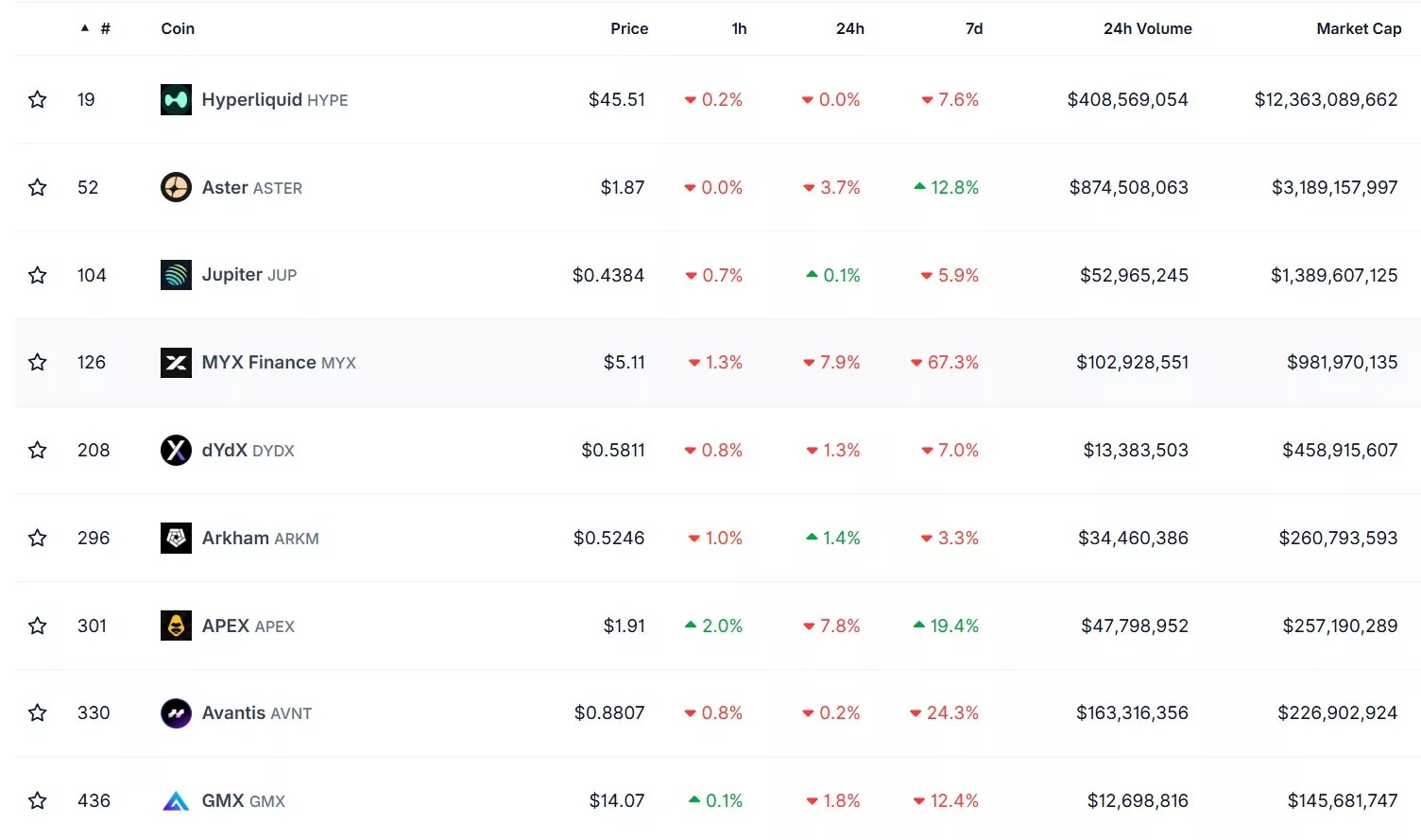
Even Justin Sun, the founder of the Tron (TRX) ecosystem, known for copying all the trends, has made his contribution with the SunPerp DEX. According to CoinGecko data, tokens linked to perpetual DEXs are now worth $20 billion, 60% of which is represented by HYPE:
The current climate may echo what the ecosystem experienced between 2020 and 2021, when the number of decentralized spot exchanges multiplied rapidly in the wake of Uniswap’s (UNI) success. Each new player boasted of being more revolutionary than the last, but in reality, investors were mainly playing the competition to maximize their returns. Today, the fad has passed, and while Uniswap has a few competitors such as PancakeSwap (CAKE), the DEX remains the clear leader in its category.
As a result, it’s a safe bet that a similar phenomenon will occur with perpetual DEXs and that only a handful of names will manage to stand out over time. After that, a new vertical will take over, also with its own excesses.