The world’s major asset markets are currently experiencing sustained upward momentum, as demonstrated by Bitcoin’s latest historic high. This situation raises questions, given the dollar’s obvious decline. Are we experiencing a “structural macroeconomic change”?
“The US dollar is set to experience its worst year since 1973”
Since Donald Trump’s arrival in the White House, the global economy has been faltering. And for good reason: the application of his prohibitive tariffs is at odds with the international dynamism needed to ensure prosperous activity. And what about the situation of the dollar, entangled in an “America First” policy that weakens its status as a global reserve currency?
This observation has led analysts to question the current macroeconomic situation. This is particularly true in light of a sustained and widespread rise in the value of major global assets, such as gold, which “broke 40 records in 2025 and is now worth $26.3 trillion,” silver, which has risen more than 60% since the beginning of the year, and Bitcoin, which is currently hitting historic highs.
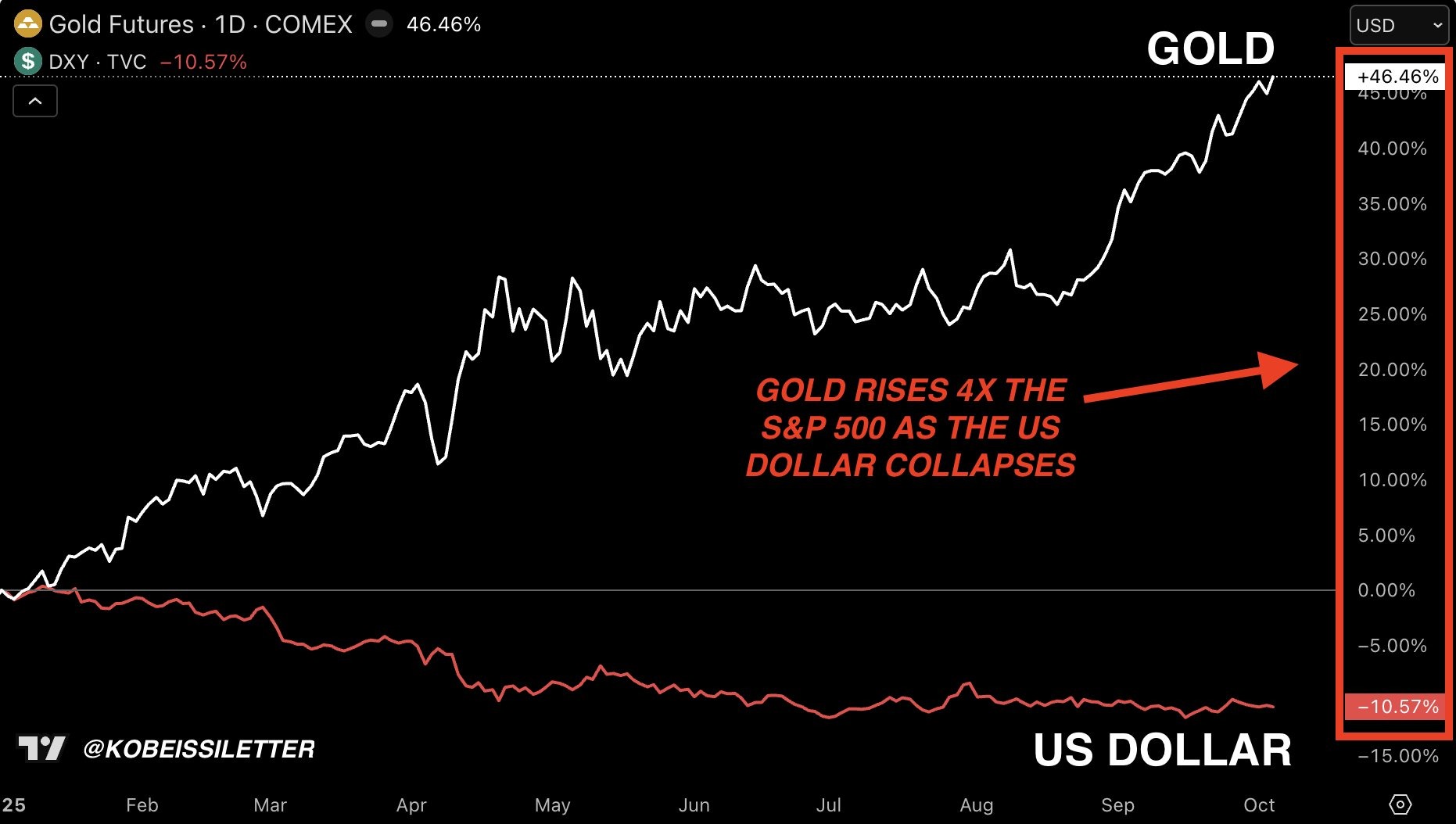
As Kobeissi Letter explains in its latest publication on the X network, “these assets are traditionally considered safe havens, expected to rise when stocks fall.” However, everything is also going very well on the US stock markets, as well as for the Magnificent 7, the large technology companies that dominate the markets.
The S&P 500 is up 39% in six months, adding $16 trillion in market capitalization. The Nasdaq 100 has risen for six consecutive months, which has only happened six times since 1986. And the Magnificent 7 (Apple, Microsoft, NVIDIA, Alphabet, Amazon, Meta, and Tesla) are investing more than $100 billion per quarter to fuel the AI revolution.
Kobeissi Letter
In fact, safe-haven assets are now moving in almost direct correlation with stocks, with a rate of 91% in 2024 for gold and the S&P 500. Meanwhile, “the US dollar is poised for its worst year since 1973.”
“Asset holders will be the big winners”
According to analysts at Kobeissi Letter, a “structural macroeconomic change” is currently underway. And with good reason: the dollar has seen a 40% decline in purchasing power since 2000, while “the Fed is lowering rates even as core inflation (Core PCE) exceeds 2.9% for the first time since the 1990s.”
The “only logical explanation”? Active anticipation by the markets in response to what is being presented as the dawn of a new era in monetary policy.
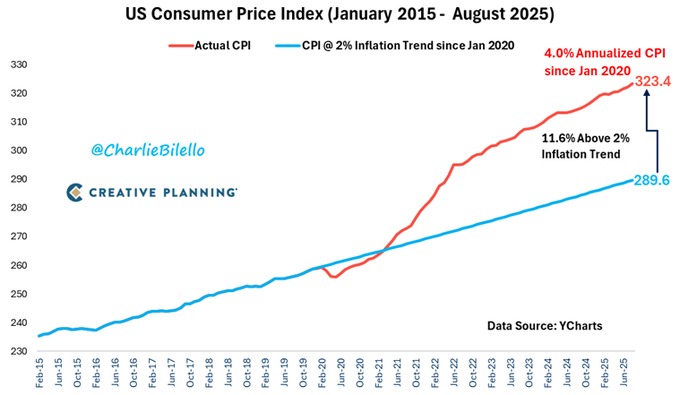
When safe-haven assets, risky assets, real estate, and inflation all rise at the same time, it is a sign of structural macroeconomic change.
Kobeissi Letter
But this paradigm shift will not be beneficial for everyone. Analysts at Kobeissi Letter argue that “asset holders will be the big winners,” as the social divide in the United States widens, increasing the number of people left behind.
A “generational macroeconomic shift”
In conclusion, this analysis points to the release date of ChatGPT as a key factor in the collapse in the number of job offers, while at the same time the stock markets are showing significant momentum.
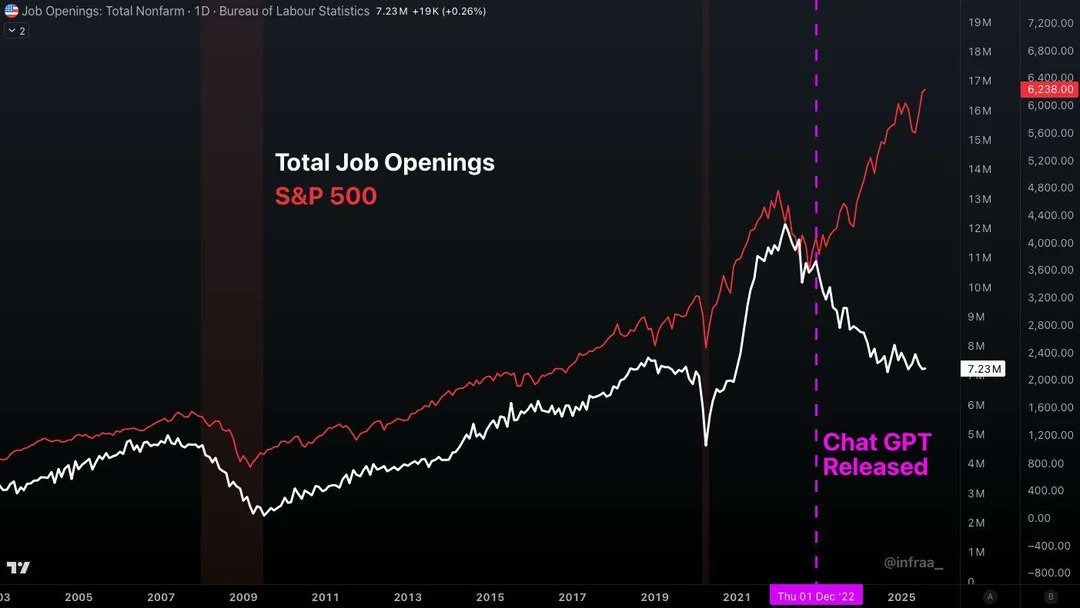
This is because “commodities, bonds, and cryptocurrencies are all becoming tradable and investable asset classes.” A “generational macroeconomic shift” is underway…