
The year 2025 appears to mark a turning point for the cryptocurrency market, particularly due to the massive influx of institutional investors and more sophisticated investment behavior. The result: traditional investment cycles are being disrupted, and retail investors are turning to stocks.
Institutional investors “are here to stay”
The cryptocurrency market is evolving in step with its most popular sectors, but also with its ever-increasing adoption. Within this reality, the year 2025 stands out very clearly as the year of the massive and confirmed arrival of traditional finance and its institutional players.
This observation was made by analysts at market maker Wintermute in an annual report titled: “How Crypto Broke Out of the Traditional Four-Year Cycle in 2025.” Indeed, the pattern associated with Bitcoin halvings no longer seems to hold in the face of “players who have become more experienced and disciplined.”
Trading has shifted from a purely volume-driven activity to a more mature and thoughtful trading environment. Transaction volumes have continued to grow, but execution has become more intentional, with the over-the-counter (OTC) market increasingly favored for its size, discretion, and control.
Wintermute
Data that allows Wintermute analysts to assert that “institutions are here to stay,” with a 23% increase in their involvement in the cryptocurrency market between 2024 and 2025, compared to just 5% for retail investors.
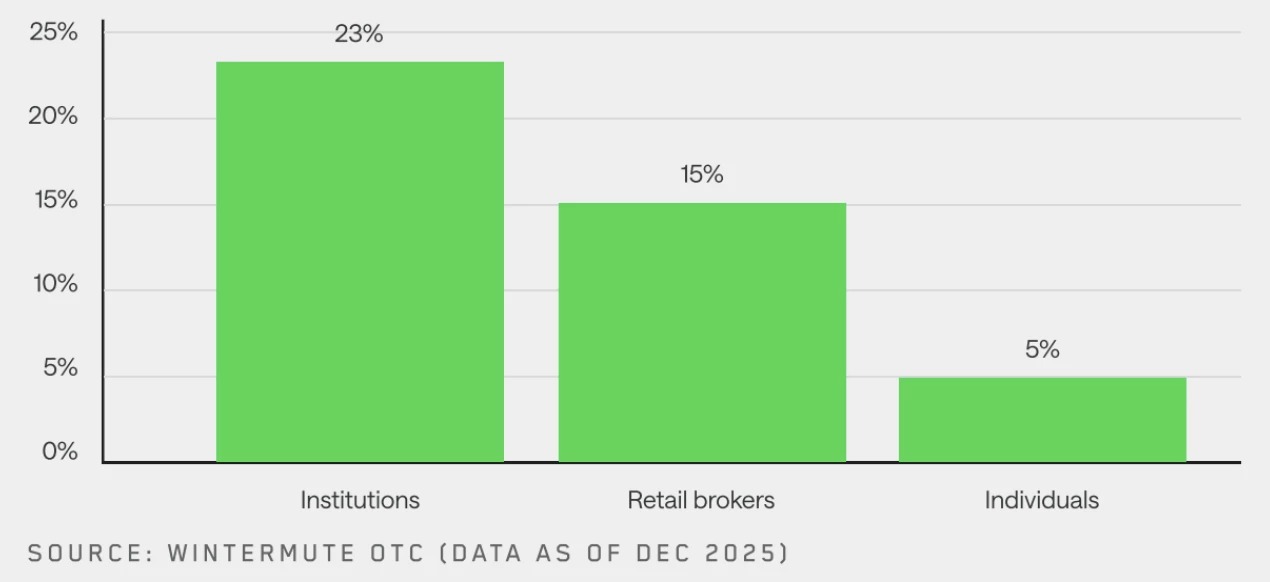
The growth in the number of market participants shows that institutions are increasing their involvement
Capital has entered the crypto market, but where is it going?
“Visible structural changes” within the OTC market, one of the direct consequences of which involves a concentration of liquidity toward Bitcoin and Ethereum “and a few select large-cap assets,” largely supported by the ETF market and the rise of Digital Asset Treasuries (DAT).
Although there has been some consolidation toward large-cap tokens by funds and retail investors this year, trading volume growth has been driven by ETFs and DATs, which have expanded their mandates beyond major assets.
Wintermute
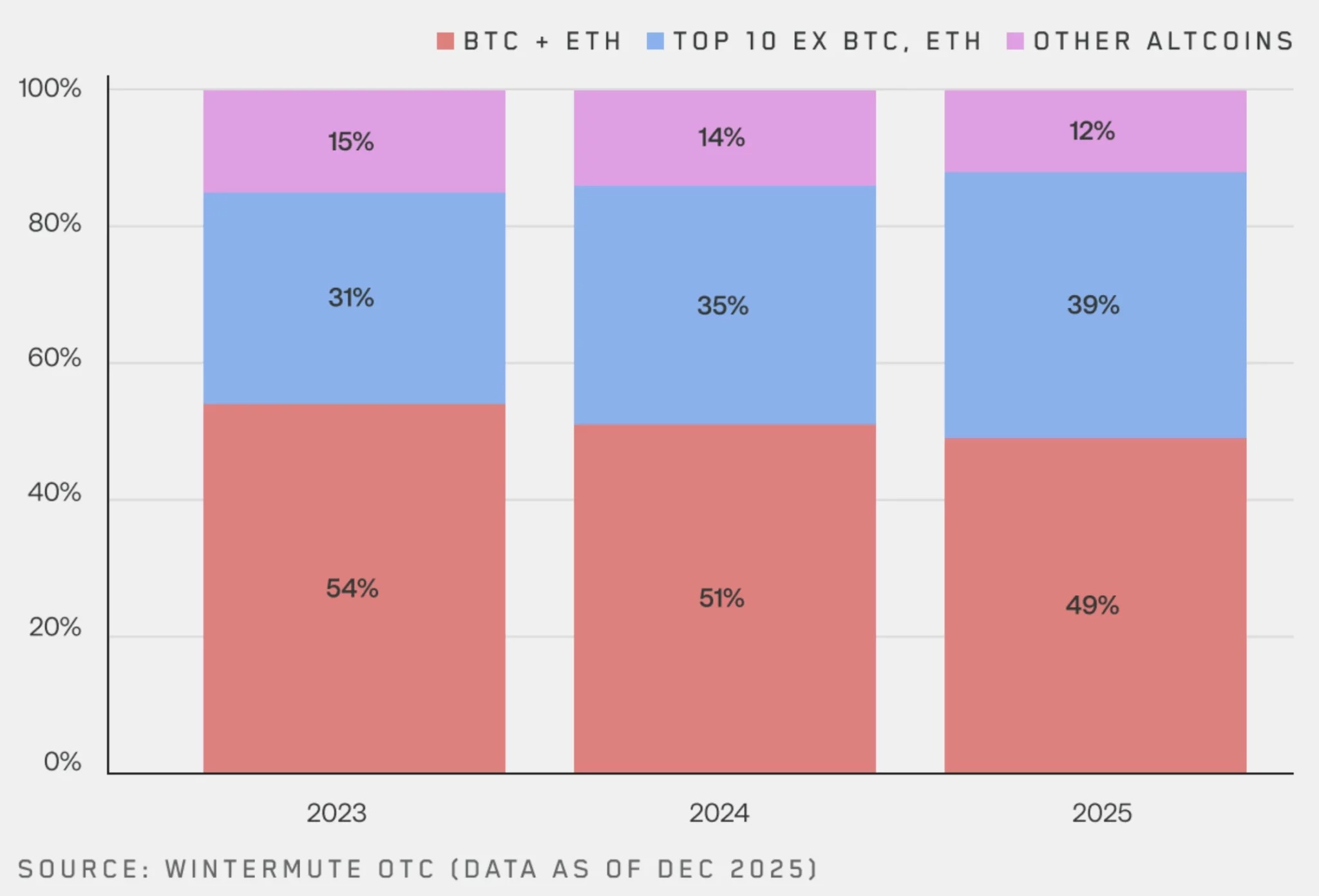
ETFs and DATs have channeled liquidity toward Bitcoin and Ethereum
A concentration that is clearly detrimental to the altcoin market, as the “widespread rotation” typical of altseason—which usually marks bull markets—simply “never happened.” The result: much shorter speculative rallies—about 20 days on average, compared to nearly 60 days in 2024—and narratives that quickly ran out of steam.
It’s hard not to mention memecoins, which “peaked in the first quarter and never recovered, unable to regain support levels as trading activity fragmented and declined.” But we can also mention perpetual DEXs or AI-related tokens, whose hype faded just as quickly.
Investors turning to stocks
In this rapidly changing landscape, a genuine shift in focus appears to be taking place. Indeed, as traditional finance makes a strong entry into the cryptocurrency market, retail investors, for their part, seem to be choosing to turn to traditional stocks.
This shift primarily concerns “AI, robotics, and quantum themes in the stock markets, which have captured attention that was previously historically focused on crypto.”
At the same time, the crash on October 10—and its $20 billion in liquidations—triggered “a return of retail investors (via broker flows) to major assets for the first time since late 2023.”
According to Wintermute analysts, three key factors could shift the current dynamics:
- Institutional exposure extending beyond ETFs and DATs;
- A rise in BTC and ETH leading to a redistribution toward altcoins;
- A shift in retail investor attention from the stock market back to crypto.
In any case, the conclusion seems clear: the cryptocurrency market is entering a new institutional era, the dynamics and prospects of which remain to be defined.