
The Solana blockchain appears to be one of the most popular in the cryptocurrency sector. However, this success may be hiding a largely unknown dark side in the form of “dark exchanges” with increasingly large volumes. It’s time to shed some light on the matter.
Dark exchanges: the hidden side of the Solana blockchain
Despite a noticeable slowdown in recent months, the Solana blockchain has established itself as a hub for many popular sectors, such as memecoins and prediction market platforms at the height of the US presidential election.
This success has greatly benefited the development of its SOL cryptocurrency, but it has also led to the emergence of a much more complex situation: the rise of what some observers identify as proprietary AMMs (Automated Market Makers), more commonly known as “dark exchanges.”
This data was recently highlighted by Amir Hajian, a researcher for crypto market maker Keyrock. And with good reason, as the development of these non-community cryptocurrency exchange platforms raises questions in an environment that is supposed to prioritize decentralization and transparency.
The rise of proprietary AMMs marks a shift in traders’ priorities. Better execution trumps transparency.
Amir Hajian
In reality, these “dark exchanges” are based on obscure and completely anonymous development and management. However, their number has been growing steadily for some time, along with an exponential increase in their volumes, now estimated at billions of dollars per week.
25% of all transactions in the last week
The number of these dark exchanges has been growing in recent months, with half a dozen platforms identified. The largest at present is called HumidiFi, which alone handled nearly $3 billion in transactions last week.
This amount represents half of the estimated total volume of $6 billion for the dark exchange sector, or 25% of all transactions recorded on decentralized exchanges (DEXs) on the Solana blockchain during this period ($25 billion).
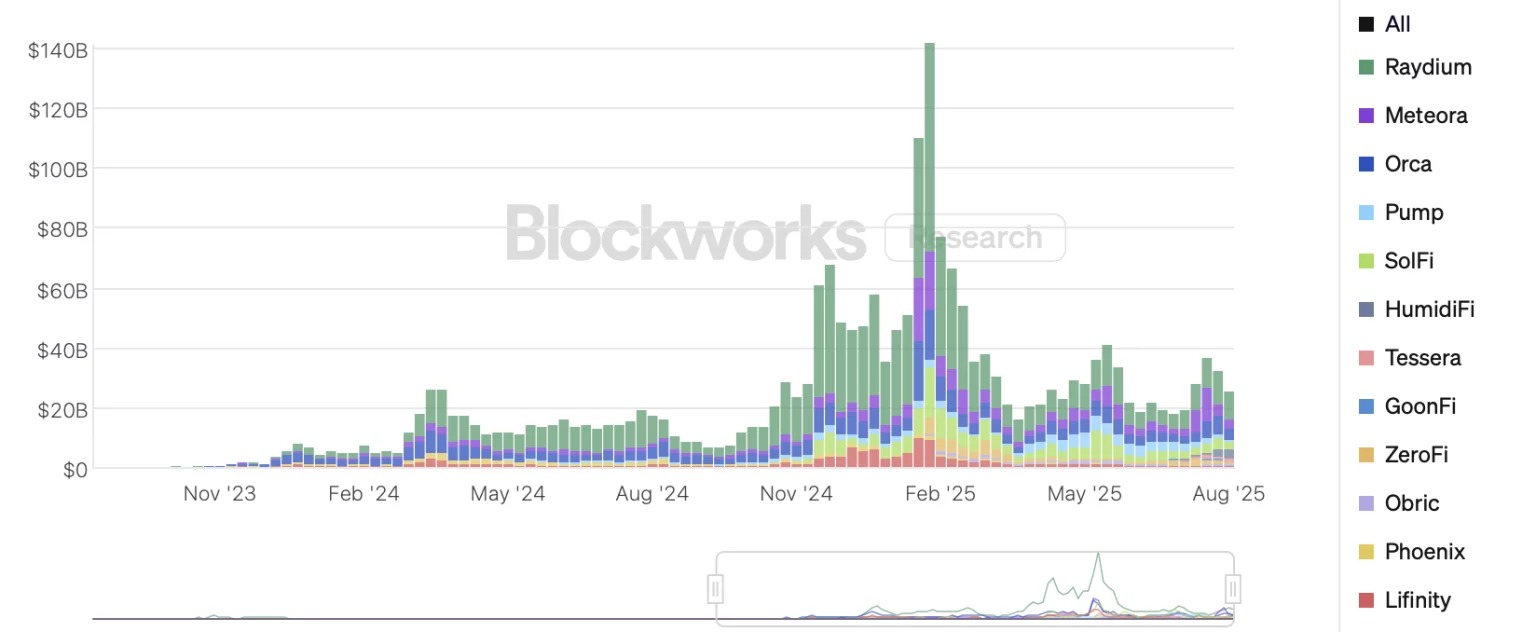
Why are they so successful? The lack of transparency and decentralization of these exchanges allows them to offer active liquidity, but also to defend themselves against the proliferation of trading bots. This operating model is presented as high-end, according to Solana DeFi developer Edgar Pavlovsky.
If I were a Solana engineer looking to compete solely on my technical skills, dark AMMs seem like the most interesting part right now.
Edgar Pavlovsky
As a result, these dark exchanges are increasingly being listed and sought after by DEX aggregators, such as the leader Jupiter, due to their highly competitive transaction fees. This is a very lucrative activity that allows them to operate without even needing an official website.
According to figures published on the X network by Benedict Brady, founder of the crypto data platform Meridian, dark exchanges already dominate the volume of stablecoin transactions on the Solana blockchain. And it is “probably only a matter of time before [their] active liquidity completely surpasses passive liquidity.”