
Since its launch, the Ethereum blockchain has established itself as the place where most innovations are tested and created. This is particularly true for decentralized finance (DeFi), with a possible acceleration ahead in line with the rise of stablecoins.
Ethereum: the backbone of DeFi
For many years, the Ethereum blockchain has been the main platform for many sectors, such as decentralized finance (DeFi). In fact, it currently represents a total value locked (TVL) estimated at over $96 billion, or almost 60% of the $163 billion spread across all blockchains.
This dominance does not seem likely to decline in the near future, judging by the current development of the stablecoin sector. Ethereum is also a leading player in this field, with 55% of its circulating supply directly implemented on its blockchain.
These two realities do not necessarily have to be treated separately. At least, that is the analysis put forward by Vincent Liu, CIO of quantitative trading firm Kronos Research, regarding Ethereum’s recent all-time high—set at $166 billion—for the amount of stablecoins in circulation on its blockchain.
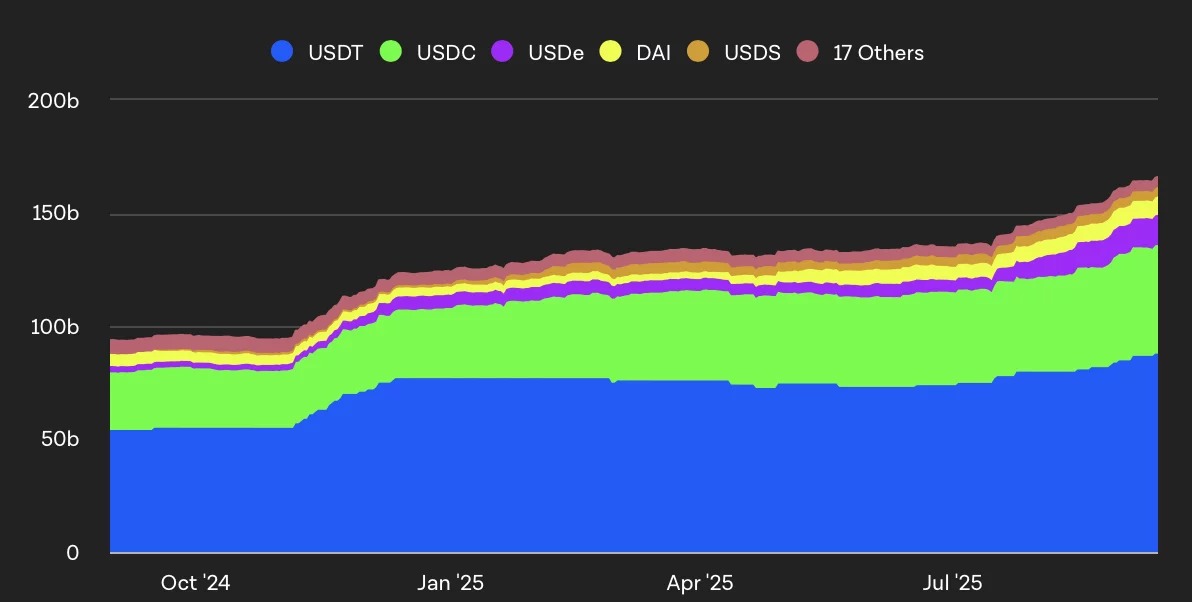
The fact that the supply of stablecoins on Ethereum has reached a record high marks a turning point, shifting from a speculative asset to a true backbone of dollarization within the DeFi ecosystem. It also highlights that liquidity is now strong enough to absorb volatility and support the market during macroeconomic downturns.
Vincent Liu
Towards accelerated dollarization of the DeFi ecosystem
Over the past year, the amount of stablecoins in circulation on the Ethereum blockchain has increased by 76.5%. This growth is even more striking when compared to blockchains as a whole, where the total supply of stablecoins increased by 65% over the same period.
This localization seems to imply a sharp increase in “dollarization within DeFi ecosystems,” according to Vincent Liu. This is all the more true given the importance of the Ethereum blockchain in this sector, as mentioned above.
This momentum could well benefit from a second favorable regulatory effect in the United States, following the SEC and CFTC’s stated willingness to bury the hatchet as part of their Responsible Financial Innovation Act. On the agenda: a relaxation of the regulations applicable to DeFi players, in the event of effective decentralization of the protocols concerned.
According to Nick Ruck, director of LVRG Research, Ethereum’s recent record “indicates a massive increase in institutional liquidity and a deepening of confidence in its infrastructure as a fundamental layer for DeFi.” Could this be the heralded advent of this ecosystem as a financial option in its own right, alongside its traditional counterpart?