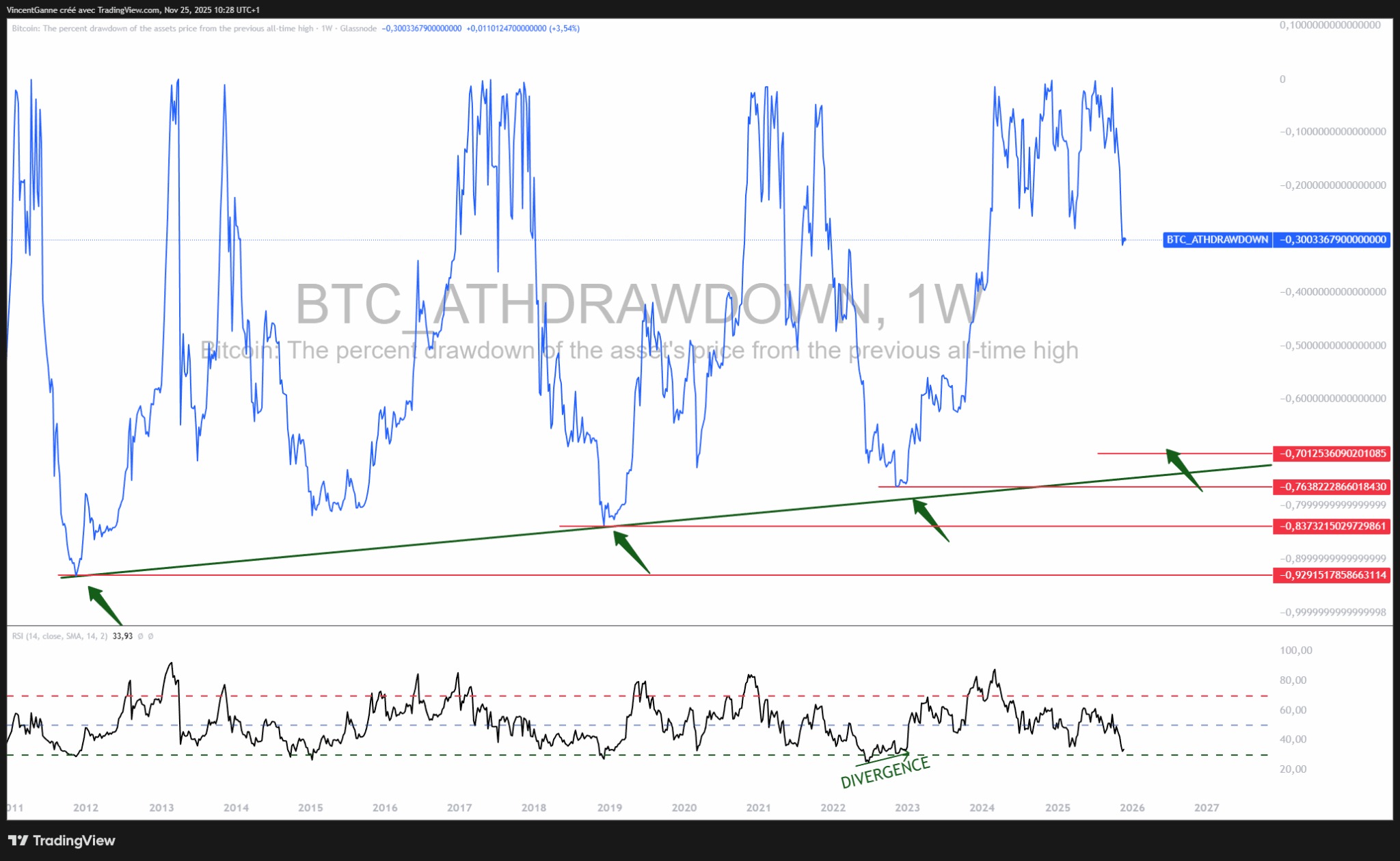
If we accept the working hypothesis that the bull market for bitcoin ended on Monday, October 6, with a peak of around $126,000, then it makes sense to consider that this date marks the beginning of a new bear market, the famous “cyclical bear market.”
A 12-month cyclical bear market
As with every cycle, this downturn is part of the structural logic of the four-year cycle, forged around the halving: a halving of the mining reward every four years. Historically, the cyclical bear market for BTC begins when the market exceeds 500/550 days after the halving in terms of time. The fact that Bitcoin peaked in early October (534 days after the last halving) once again confirms the almost metronomic precision of this four-year model.
There is now enough historical data to observe patterns not only in the bull market phase, but also in the bear market that follows.
Here are the most common technical characteristics of a cyclical bear market:
- Average duration
- Bitcoin bear markets tend to last about a year. This rule of thumb has been verified in the two previous cycles.
- Movement structure:
- The classic scenario consists of three phases:
- an initial sharp downward trend, which we entered on October 6
- an intermediate technical rebound, often referred to as a dead cat bounce
- a final downward leg leading to the true bottom of the bear market
- The classic scenario consists of three phases:
- Amplitude of the correction.
- Even if the intensity of the declines tends to decrease over the years, the drawdown remains historically significant. It should be treated as a major correction, not as a simple market pause, and could reach 50% in this new bear market.
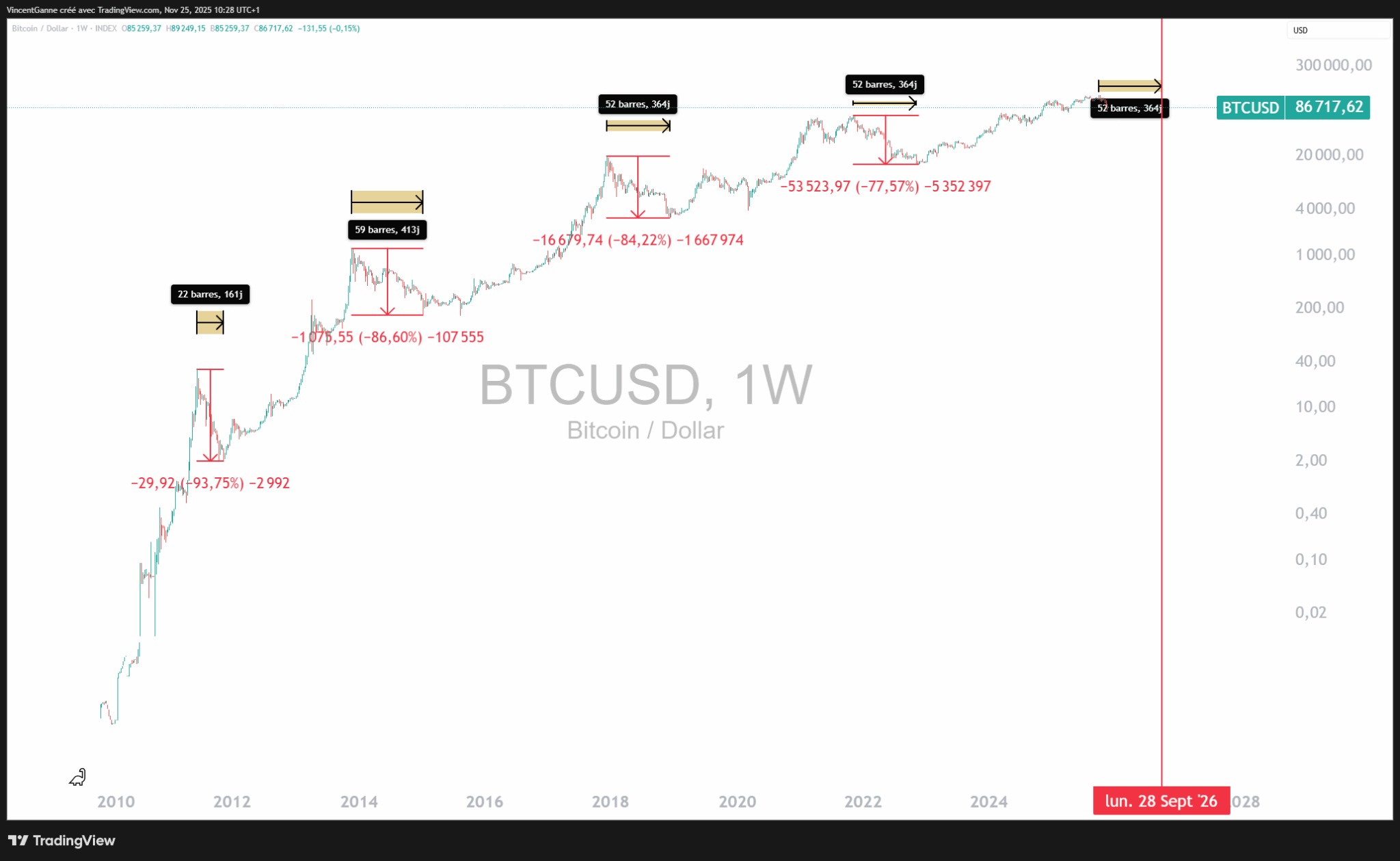
A drawdown that should be lower than in previous bear markets
Assuming that the new bearish phase began on October 6, its theoretical horizon would extend to September or October 2026. The market should then follow the three technical sequences described above, with a final decline potentially ranging between 40% and 60% from the peak of $126,000.
Of course, all of this is based on the validity of the four-year cycle. If it turns out to be nothing more than a statistical coincidence (the number of occurrences is very limited) or a phenomenon that is now obsolete (in which case the current decline is a massive buying opportunity), this analytical framework would immediately lose its relevance. But as long as the data continues to fit, this model remains a serious working hypothesis to explain the decline in the price of bitcoin since October 6.