
With Bitcoin’s hashrate at its lowest level since September, some on-chain data suggests miners are giving up. What’s the story?
Bitcoin miners are feeling the market downturn
In the Bitcoin (BTC) mining industry, several factors must be taken into account to determine whether an operation is profitable.
Among other factors, these include a miner’s available computing power (their hashrate), mining difficulty—whose value depends in part on the total hash rate deployed on the network—electricity costs, any potential ancillary revenue generated by the resale of heat, for example, as well as the price of BTC and network activity, which generates varying levels of fees.
Due to all these variables, Bitcoin mining goes through cycles of profitability and others where cash flow is severely strained. On this last point, the least financially robust players will choose to shut down their machines or turn to other activities due to a lack of profitability. When this reaches its peak, we refer to it as miner capitulation.
The market regulates itself such that the fewer miners there are, the easier it becomes to mine, thereby motivating participants to restart their machines, creating cycles that can be observed through on-chain analysis.
While the price of Bitcoin has fallen 28% from its all-time high (ATH) on October 6, mining difficulty has dropped 6% over the same period. This is because the price decline has eroded miners’ profitability, prompting some to leave the network. On a weekly basis, the computing power deployed on Bitcoin has thus fallen by 12.34% since its October ATH, dropping from 1,140,060,419 TH/s to 999,375,511 TH/s:
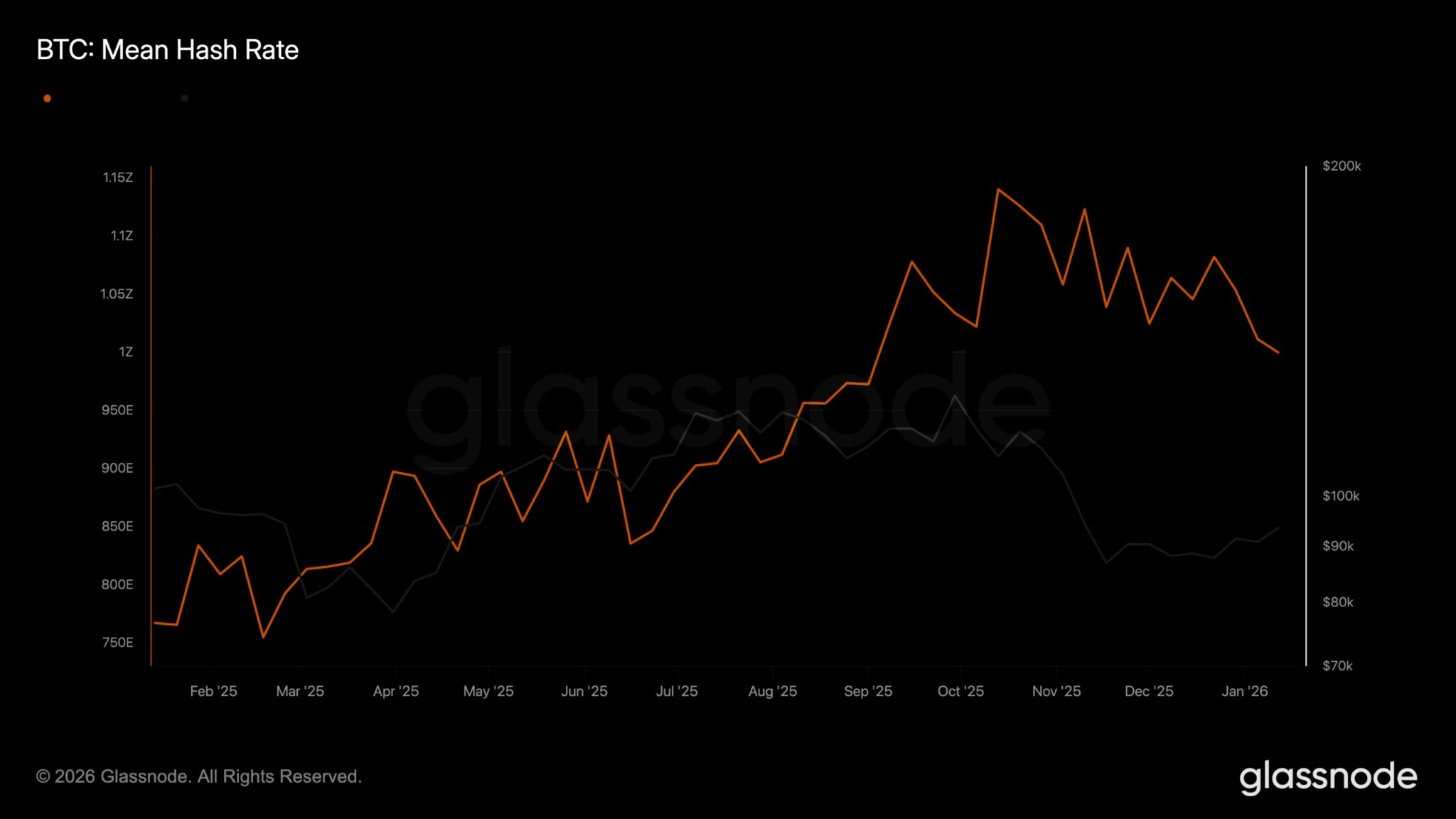
Bitcoin Hashrate (Weekly Data)
Meanwhile, the Hash Ribbon indicates a period of capitulation that began in late November. The Hash Ribbon is calculated using the 30-day moving average (MA30) and the 60-day moving average (MA60) of the hashrate. When the MA30 falls below the MA60, the chart turns dark red, suggesting capitulation. Conversely, the chart turns light red when the MA30 crosses back above the MA60, suggesting a return of miners. Despite a few interruptions, the current capitulation period therefore appears to be the most significant since the summer of 2024:
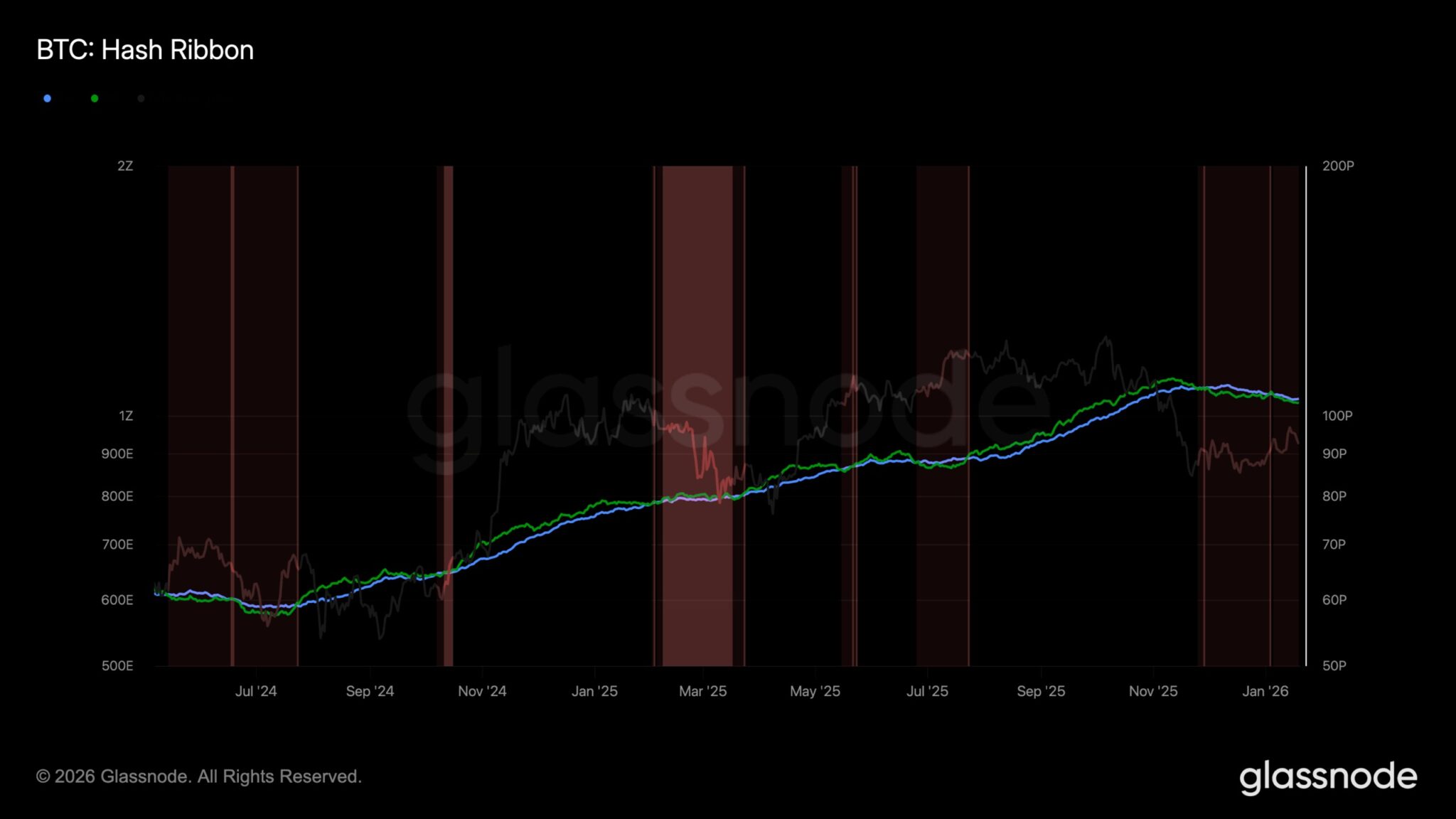
Bitcoin Hash Ribbon since May 2024
On the stock market, Bitcoin miners are also taking a hit, as seen with MARA and CleanSpark, which have lost 44.85% and 23.29%, respectively, since October 6. Meanwhile, BTC is trading at $91,100 at the time of writing, down 2% over the past 24 hours.