
While Tether, the leader in the stablecoin sector, continues to set new records, S&P Global’s ratings agency has just downgraded the rating of its flagship token, USDT. The reasons cited include declining over-collateralization and reserves deemed to be managed in an opaque manner. A source of great pride for its CEO, Paolo Ardoino…
Tether: A Colossus with Reserves of Clay
The path often seems all laid out for leaders in rapidly developing sectors, such as Tether and its USDT stablecoin, which holds a commanding lead in global market share with a valuation of $184.5 billion. However, its dominance—still estimated at over 60%—now appears to be an obstacle in the face of the rollout of crypto regulatory frameworks around the world.
In fact, the USDT stablecoin has been excluded for several months from major jurisdictions such as the European Union and the United States—much to the delight of its main competitor, Circle, and its USDC—even as Tether has posted more than $10 billion in profits since the start of the year.
It’s a sort of paradox, as the regulatory rejection is based primarily on the lack of transparency surrounding the management of its reserves. In any case, this is one of the main points highlighted by the rating agency S&P Global (S&P Global Ratings) in lowering its rating for USDT in a recent report, even though “its price has remained relatively stable in recent years as well as over the past 12 months.”
S&P Global Ratings has reassessed Tether’s (USDT) ability to maintain its peg to the U.S. dollar at 5 (weak), down from 4 (constrained) previously. This downgrade reflects an increase, since our last analysis, in the proportion of riskier assets backing USDT’s reserves.
“We wear your contempt with pride”
Although it has weakened significantly, the over-collateralization of USDT’s reserves—estimated at $181.2 billion—still stands at 103.9%, down from 106.1% a year ago. This decline is not the main issue, according to experts at S&P Global Ratings, given a glaring lack of “safe assets.”
In fact, only 64% of these reserves are held in short-term U.S. Treasury bills, with an additional 10% in low-risk reverse repos. The remainder consists of corporate bonds, cryptocurrencies, gold, secured loans, and other assets, with 24% classified as high-risk, up from 17% last year.
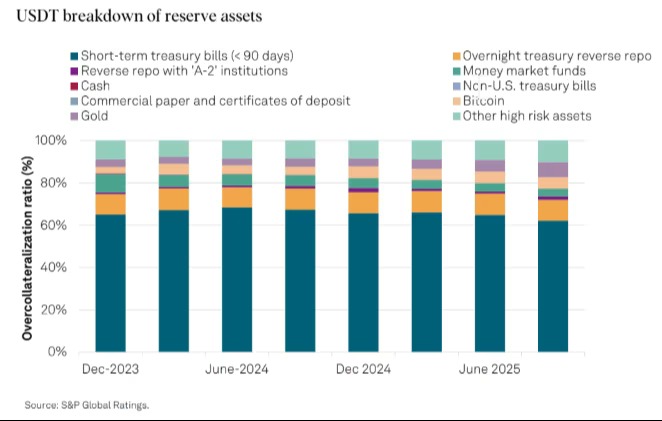
Breakdown of USDT’s reserve assets
But that’s not all. For example, Tether uses the firm BDO Italia to prepare its end-of-quarter reserve snapshots, before adding—without any prior audit—its aggregate asset and liability figures. Furthermore, its restructuring last year split the company into four divisions, with no transparency regarding how they interact in relation to the management of USDT.